





The Honey bee
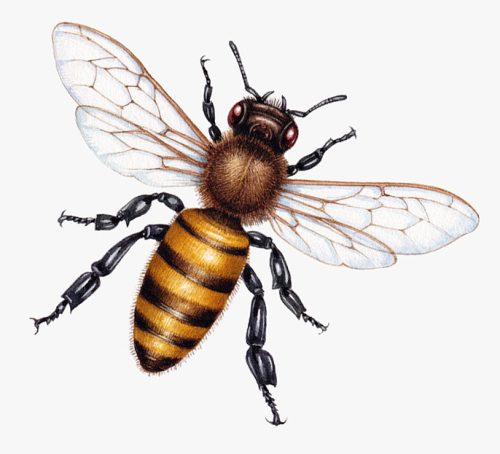
The Honey bee Apis mellifera
The first bee I illustrated was for myself. I thought it was a good idea to have a completed watercolour of a honey bee on file, and so it proved. Since then, I’ve completed lots of honey bee illustrations. I thought this might make a good companion blog to those I’ve written on Illustrating Bumblebees and one I plan to write on Illustrating Other Bees.
Honey bees in the wild
In the wild, Honey bees live in wooded areas, in honey combs made from wax. They’re mostly active between March and September. The bees we see are workers, busily collecting pollen and nectar for the hive, which can number up to 50,000. A queen lays all the eggs, which are tended by the workers. In autumn a batch of male drones are produced. For more, check out the Wildlife Trusts website.
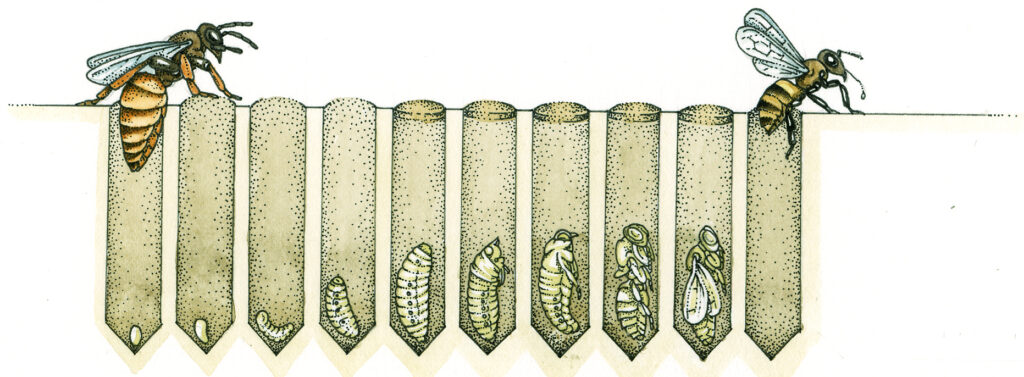
Life cycle of a honey bee, completed for Keeping Bees and Making Honey by Benjamin & McCallum
Honey bees and humans: Hives
Honey bees are renowned for producing both wax and honey, products we humans love. Bee-keeping has been practised for more than 8,500 years, and wax residue on pot shards suggests the earliest Neolithic farmers were keeping bees. (University of Bristol).
Originally kept in woven bees hives, or skeps, the design of human-made bee hives has changed over the years.
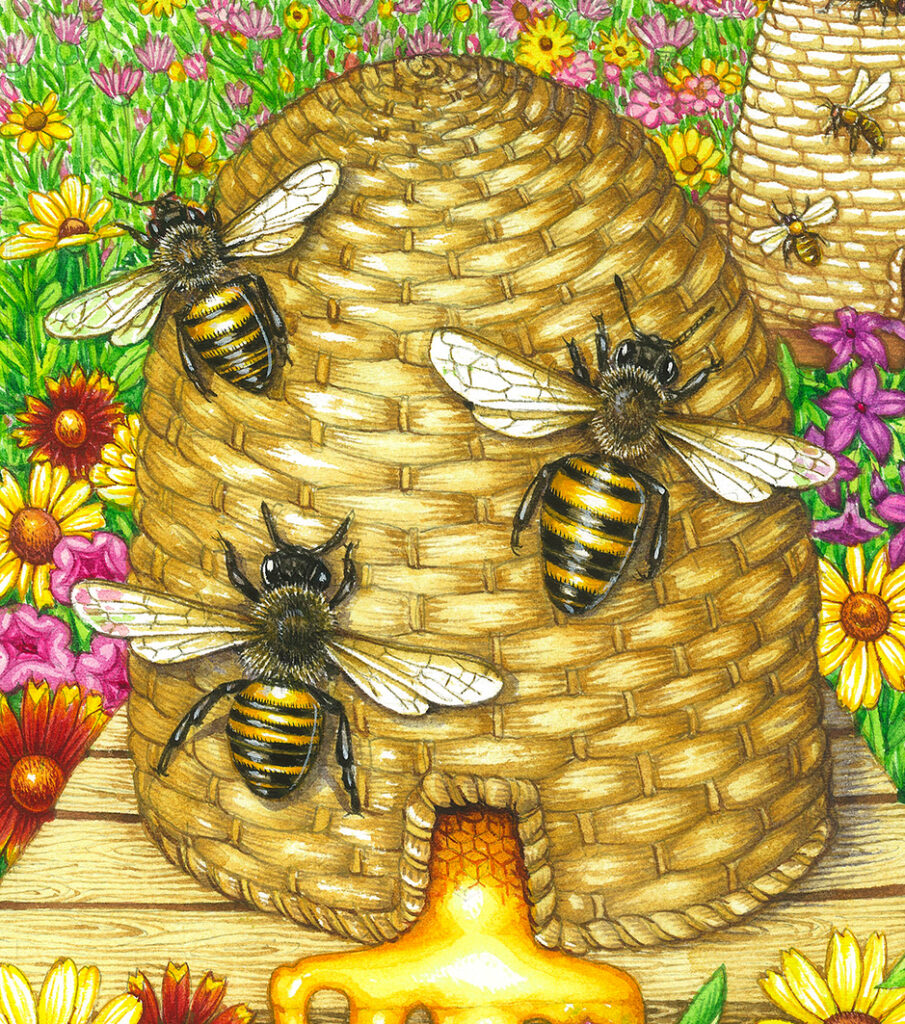
Idealised skep with bees (for Sleeping Bear honey)
Hives are more like boxes these days, although some beekeepers still favour skeps. Hives have integrated frames to use as a base for building honeycomb. These can be bought commercially, or made by hand.
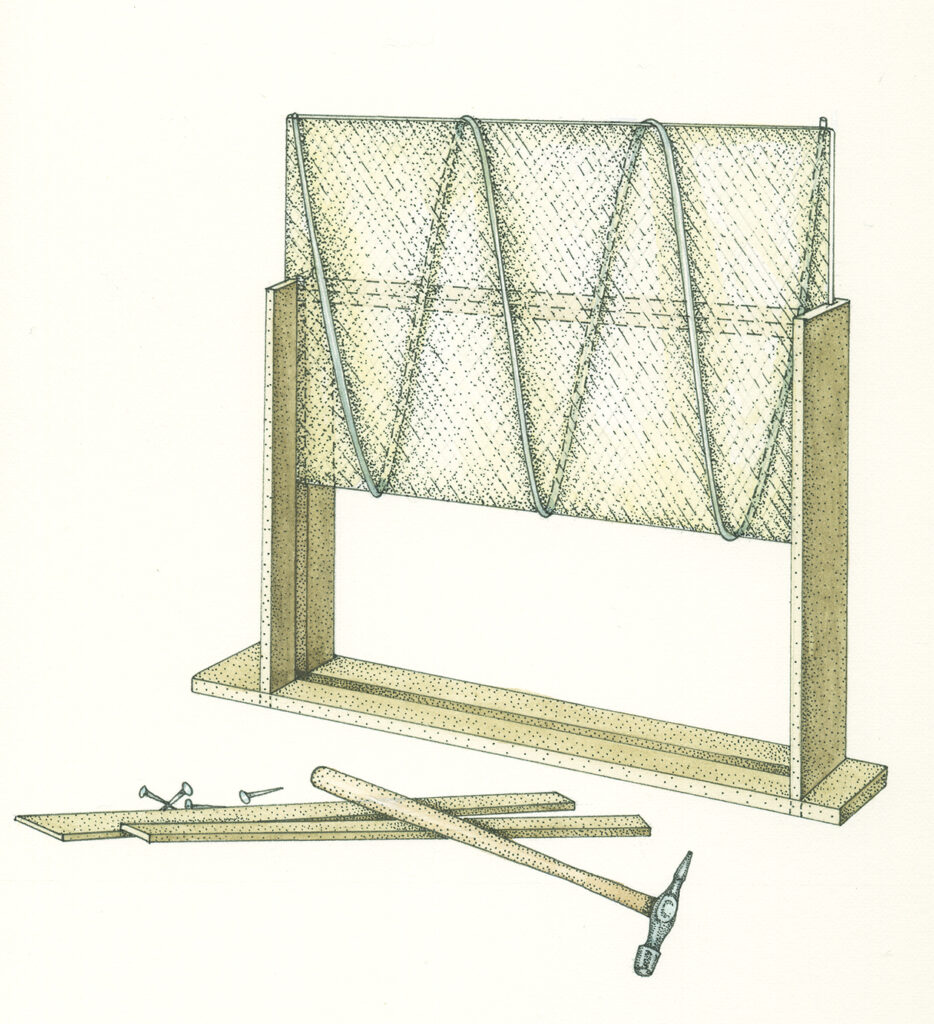
Building a bee frame (from Keeping Bees and Making Honey by Benjamin & McCallum)
Honey bees have become an industrialised business, pollinating a vast array of crops. As Viva! says, “After the almond season, the bees may be taken to cherry, plum and avocado orchards in California or apple and cherry orchards in Washington State. In summertime, they may be transported east to fields of alfalfa (largely used for animal feed), sunflowers and clover in North and South Dakota or to squashes in Texas, clementines and tangerines in Florida, cranberries in Wisconsin and blueberries in Michigan and Maine. Along the east coast they are used to pollinate apples, cherries, pumpkins, cranberries and various vegetables.” Their hives are sealed, and the bees are driven across the US.
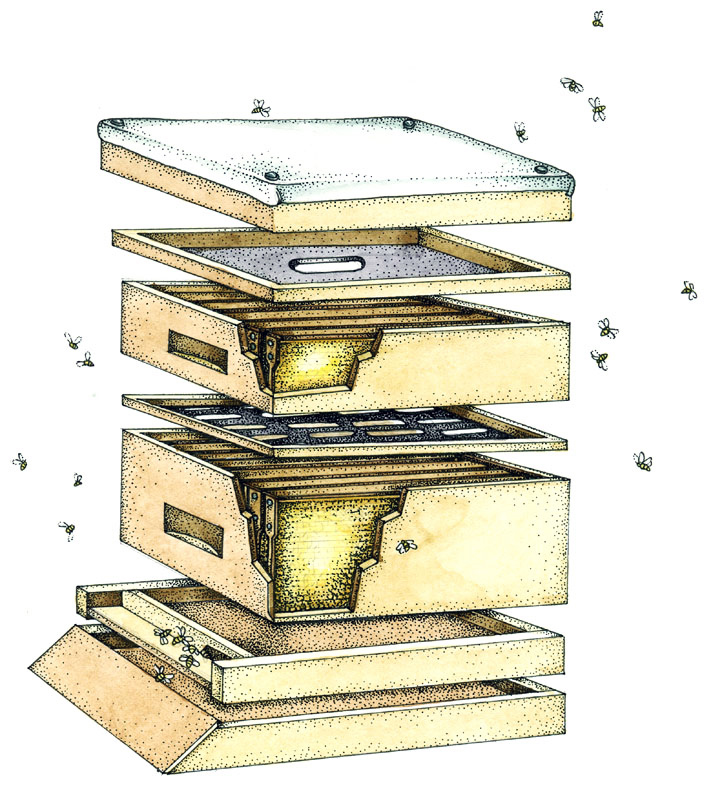
Exploded diagram of a bee hive (from Keeping Bees and Making Honey by Benjamin & McCallum)
Drawbacks of commercial beekeeping
Unfortunately, there is often conflict with spraying insecticides and fungicides, moving colonies about frequently (which stresses the bees), and limiting their diet to these crops. For more, read the report by Ohio State University.)
Illustrating a worker Honey bee from life
To complete this illustration I worked from various dead honey bees I’d found over the years, as well as from photos found online which proved invaluable when it came to getting the details right . The watercolour was about 15 x life size.
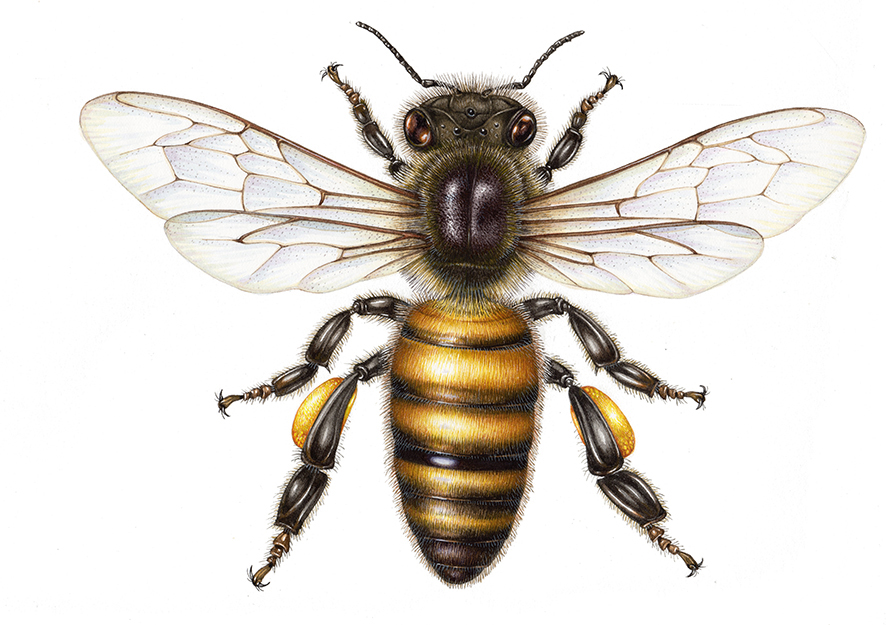
Honey bee Apis mellifera
The transition between the shiny and hairy areas of the abdomen was the most challenging aspect. I slightly adjusted the angle of the collected pollen so you could see the legs more clearly.
I love painting transparent and translucent wings. Once the veins are right I look for nuances in the wing membrane, slight shadows, and any tiny pores or hairs. The veins vary between genus of bees, and often between species, so inventing them is not an option.
The legs are shiny, and also hairy. The segmentation of the feet needs careful examination.
I was pleased with the painting, and it has proved a basis for many other commissions over the years.
A Honey bee for Sir David Attenborough!
One of the commissions I have been happiest about, and proudest of, was producing the illustrations for David Attenborough’s A Life on Our Planet (read my blog on this here).
Along with pen and ink illustrations of Brain coral, the Blue whale, Giant kelp, a Pangolin, and an Ammonite; I drew a Honey bee. This was based almost exactly on the watercolour above.
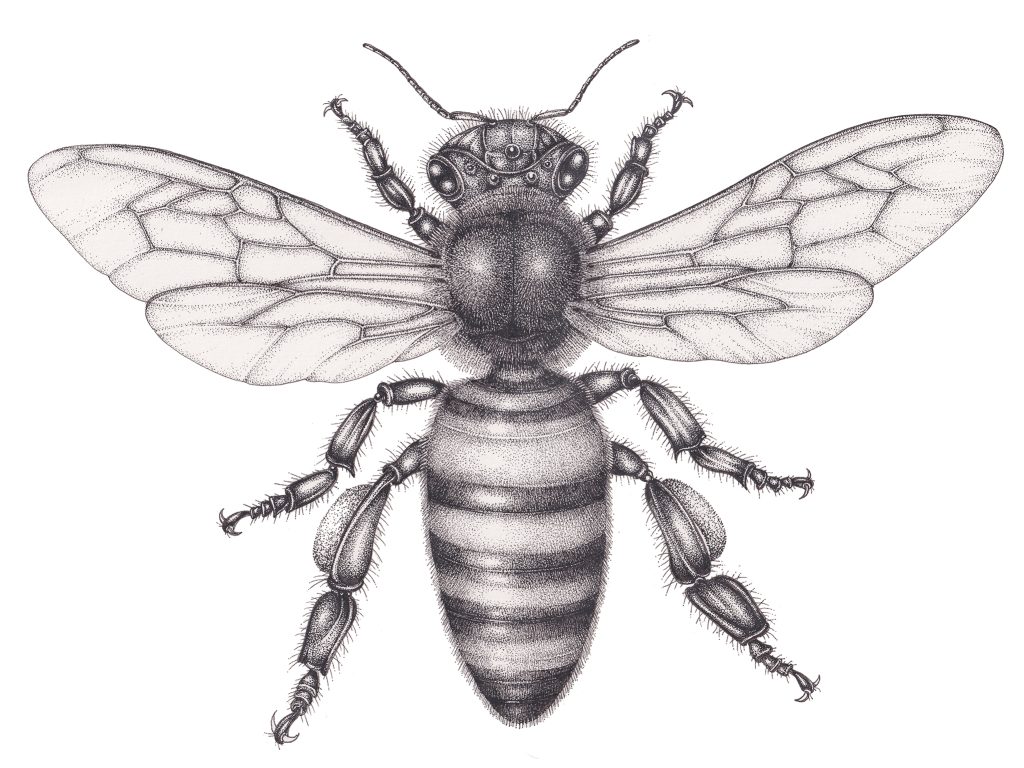
Honey bee worker Apis mellifera illustration from A Life on Our Planet by David Attenborough
The techniques involved were different. Pen and ink work involves building up tonality with stippling, lots of tiny dots and perhaps some lines, not with layers of paint. Working large ensured that when the illustration was reduced for reproduction it looked crisp.
The close-up below shows how the dots and lines blend to give different tonalities.
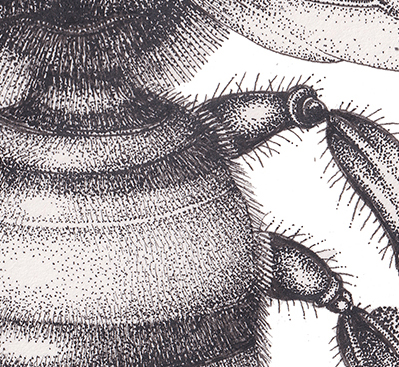
Close up of the Honey bee showing pen and ink technique.
A legal bee for a Honey jar
I am friends with someone who works at a legal firm in London. For many years they kept bees on the roof of their office in High Holborn, London. In exchange for some jars, I drew a Honey bee in a judge’s wig to adorn their honey labels.
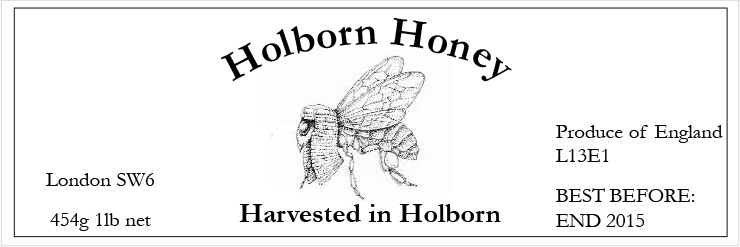
Bee in judge’s wig for a honey jar label
More honey labels
A larger operation, Sleeping bear farms in the USA, commissioned me to illustrate an idealised scene for their honey packaging. It was to feature a meadow of American wild flowers, with some skeps overflowing with honey in the foreground.
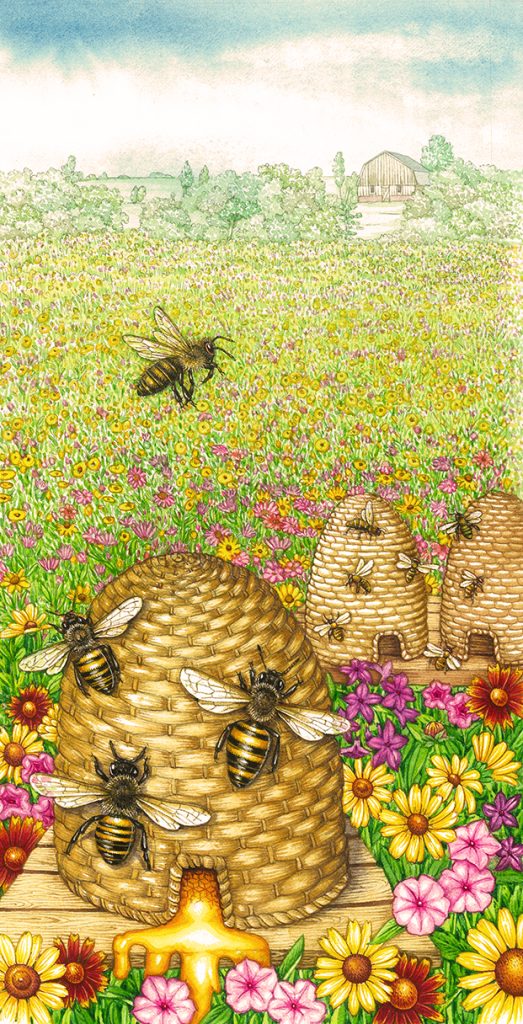
Honey label for Sleeping bears farm
I’d produced other labels for them before, and was only too happy to take on the job. They gave me a list of the flowers they wanted to feature, and specified details of the skeps. I added a traditional barn in the distance, but left much of the top of the illustrations clear for text.
I believe the illustration was used for several years, but am not certain it still appears on their products.
Bees as additions to Botanical illustrations
Sometimes an illustration will call for the addition of a couple of key pollinators, or I choose to add a pollinator or two. I suggested including a couple of honey bees to an illustration of pear blossom, and the client was as pleased with the result as I was. I only wish I could remember who the illustration was completed for!
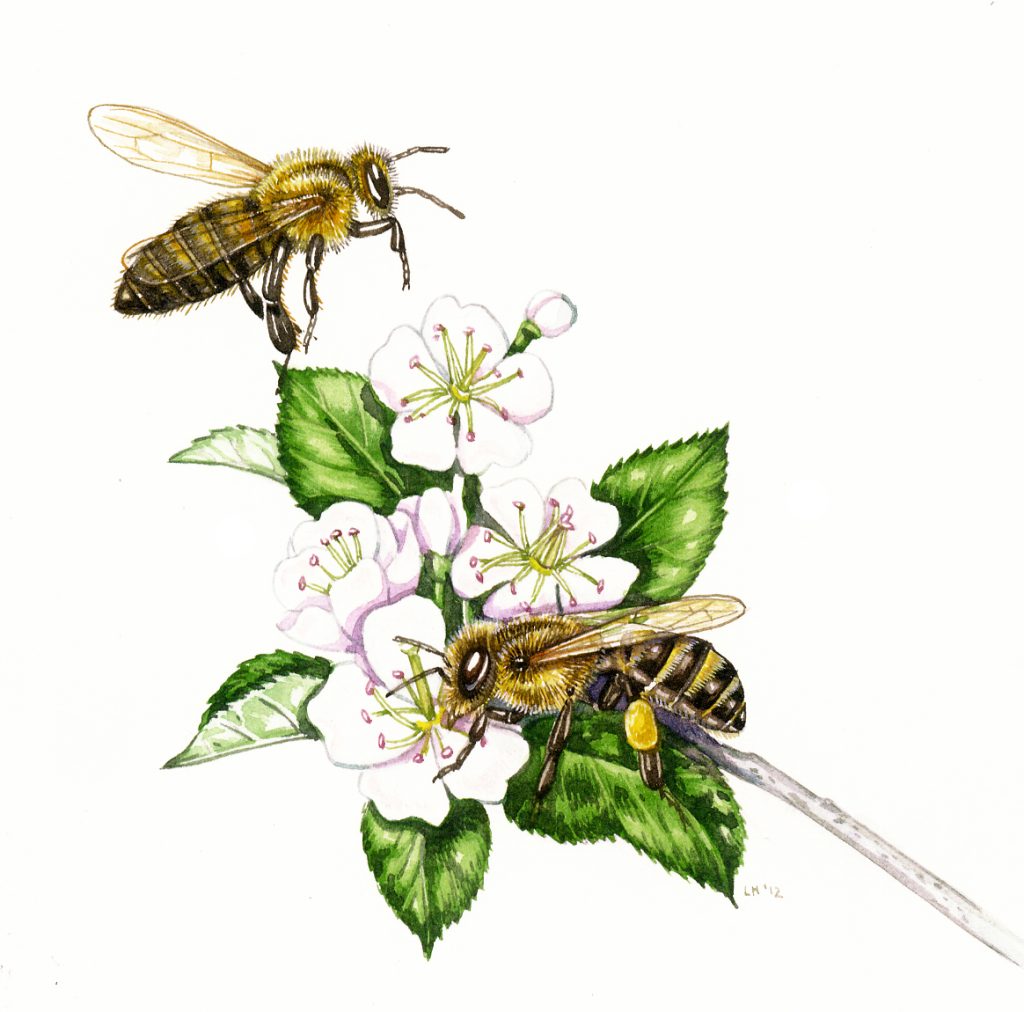
Honey bee Apis mellifera visiting Pear blossom Pyrus communis
Working on illustrations for “Japanese Knotweed: Unearthing the Truth” by Nicolas Seal, the author suggested including an illustration of a flowering raceme with pollinators. Nick runs Environet, a company that manages and eradicates knotweed. However, he is keen to point out the benefits of this resilient plant, and providing plenty of nectar and pollen for bees and other pollinators (such as ants and hoverflies) is one of them. For more on this project, read my blog.
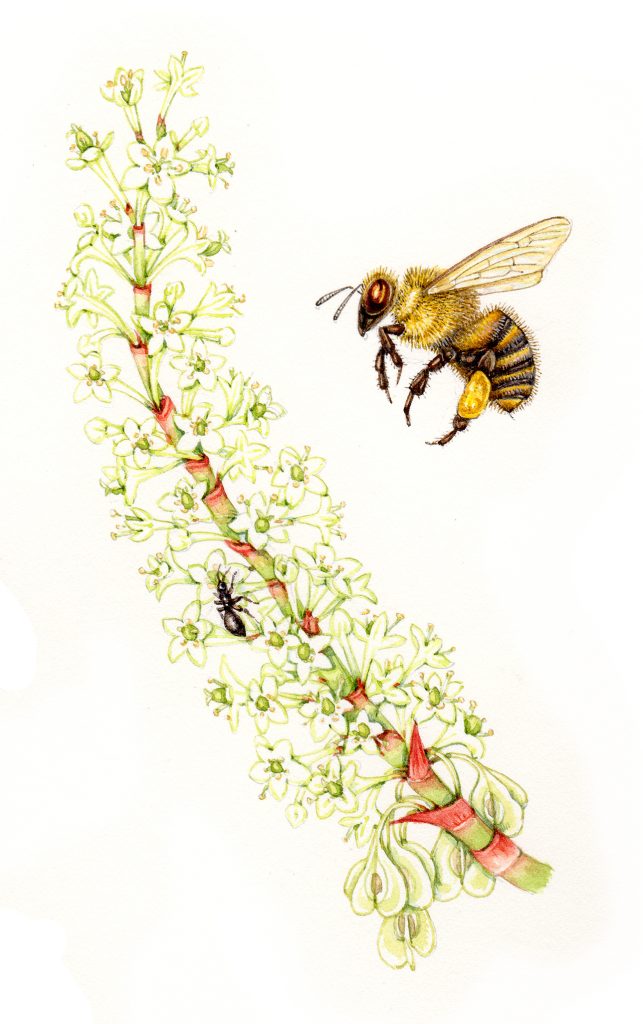
Honey bee visiting Japanese knotweed flower Fallopia japonica
Honey bees on packaging
The Honey bee also appears on a seed packet design completed for Roselyn wildflower seeds. Although I’ve done the pictures for lots of their single species mixes, this is for a mix of meadow wildflowers.
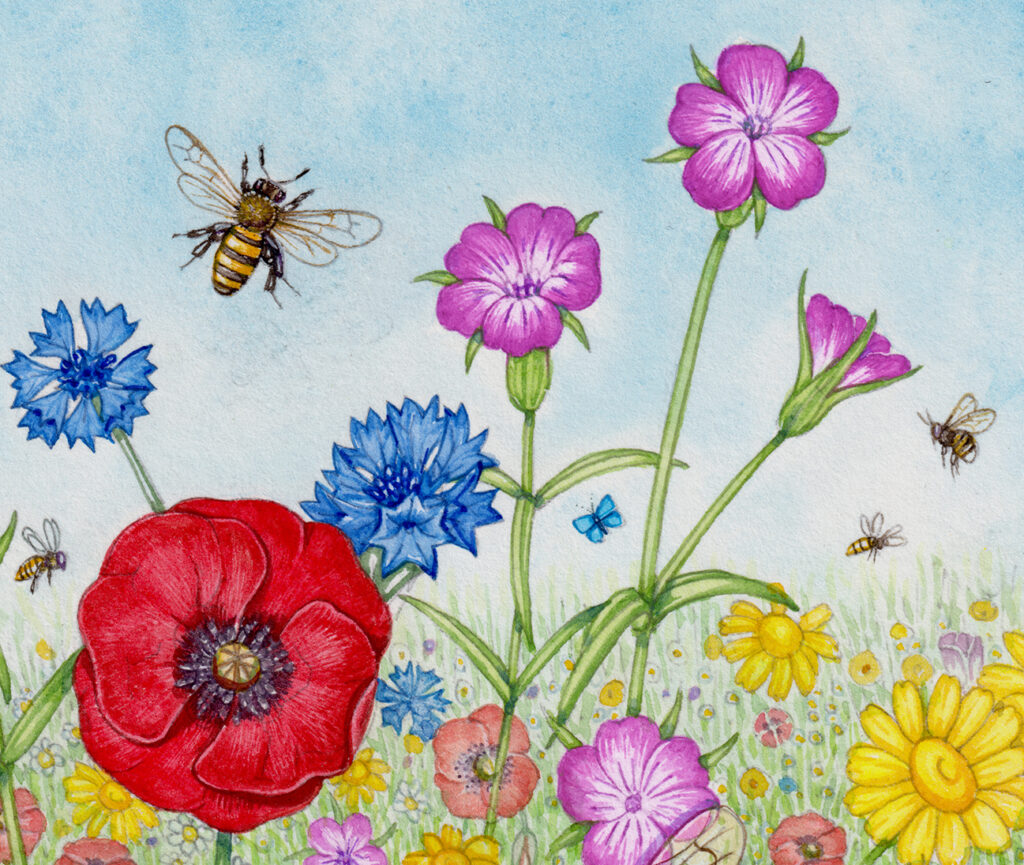
Roselyn Wildflower seed mix with Poppies, Cornflower, Marigold, Mayweed, Corncockle…and a honey bee
Perhaps counter-intuitively, painting insects small is much harder than painting them large. It’s easy to over-emphasize a feature, or make the insect look clunky. This honey bee has rather-too-solid legs, and its eyes are a little too big. As the original is only 5mm x 1cm, I suppose I shouldn’t feel too annoyed with myself.
China products and Honey bees
The most recent project I worked on featuring the honey bee was for Petter Windett design. He commissioned a series of six insects to be used alongside existing floral designs on chinaware. Four of the illustrations are butterflies, two are different views of the honey bee.
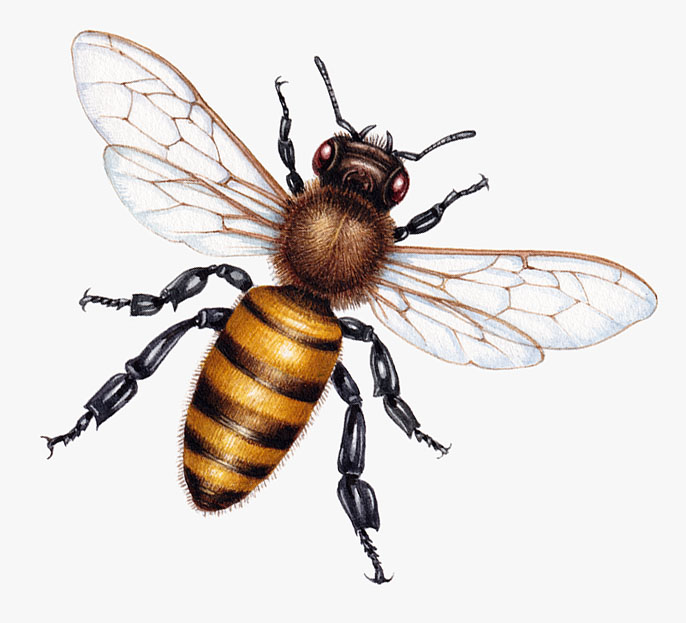
Honey bee Apis mellifera worker for use on chinaware
The illustrations are about 10cm square, cut to white. You may recognize the illustration above. It’s closely based on the worker honey bee I illustrated all those years ago. As I say, when I thought it’d come in handy to have a nicely painted honey bee on file, I was right.
The second bee is in profile. I’d wanted to complete a side view of a honey bee for some time. So being paid to do so was a bonus!
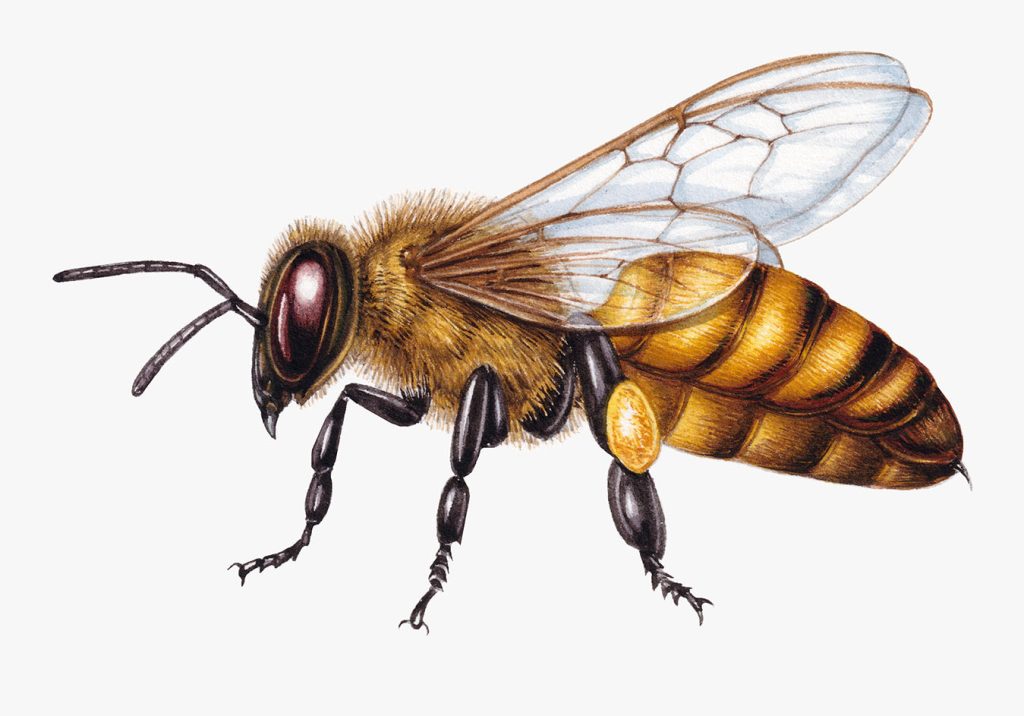
Honey bee Apis mellifera worker for use on chinaware
Illustrating honey bees: What next?
For some years now I’ve been wondering about illustrating the other castes of Apis mellifera. When I get some spare time between jobs, I would love to illustrate a queen, and a drone. That would certainly give me a sense of completion, and who knows? Maybe it would end up being a useful addition to my catalogue of illustrations as well.
