




Life on the Edge: illustrating insects on the South Devon coastline
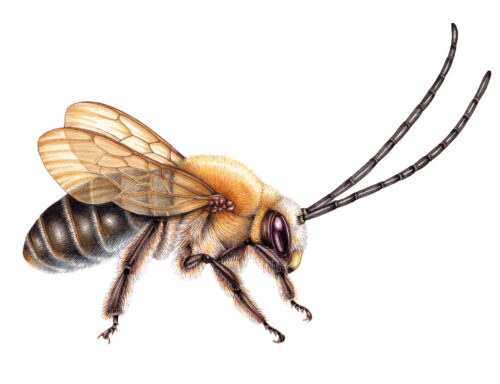
Illustrating insects for South Devon National Landscapes “Life on the edge” project is a real treat. Insect illustration is one of my earliest and greatest passions, so to have a list of invertebrate species to work through is a real joy.
These illustrations will be used in a “Spotter’s guide”, and appear across the base of an information panel. Life on the edge is a project led by South Devon National Landscapes, and supported by partner organisations including the National Trust, Torbay Coast and Countryside Trust and the South West Coast Path Association.
Illustrating insects for an information board
I often illustrate landscapes full of insect species, and have completed a couple for South Devon National Landscape in the past. This time they wanted a large expanse of sea and sky, so text could be overlaid. Along the base, there is a panoply of flowers and the insects that the Life on the Edge project sets out to encourage and preserve.

South Devon National Landscape generic seascape with pollinators and flowers (detail of a larger illustration)
Illustrating insects: Beetles: Bloody-nosed beetle Timarcha tenebricosa
There are two beetles on the list of insects to illustrate. I’m familiar with both of them, having painted them for Jersey Post’s “Beetles” stamp issue, back in 2016.
The first is the Bloody-nosed beetle.
This beetle is 20-23mm long, and can be seen April through September. It lives in grassland, heath, hedges, and coastal habitats. You may see it plodding across paths, it doesn’t hide away.
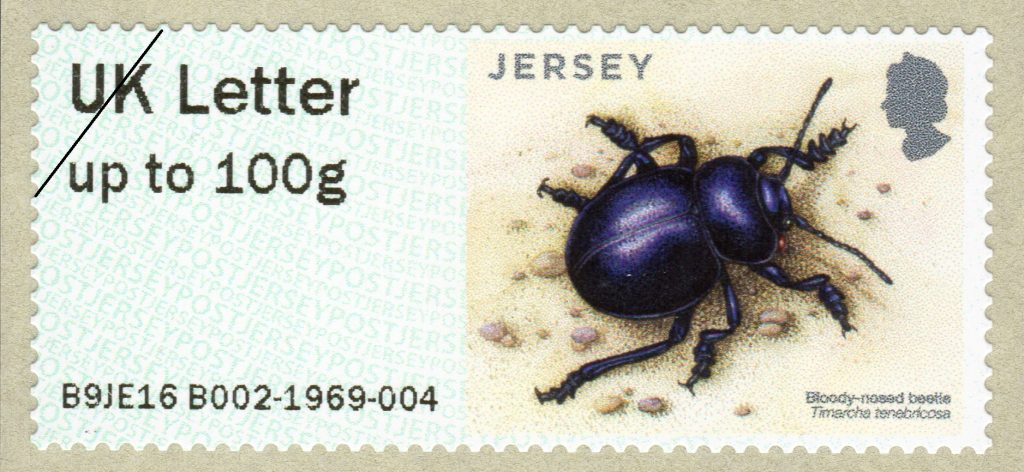
Jersey Post copyright 2016 Beetles Bloody-nosed beetle Timarcha tenebricosa
Bloody-nosed beetles eat bedstraws, from which you might see their larvae hanging. They have blueish, domed elytra (wing cases), and these are fused, so they are flightless beetles. The most surprising thing about these beetles is that they secrete a bright red liquid from their mouths which is a visual warning, tastes unpleasant and deters predators.
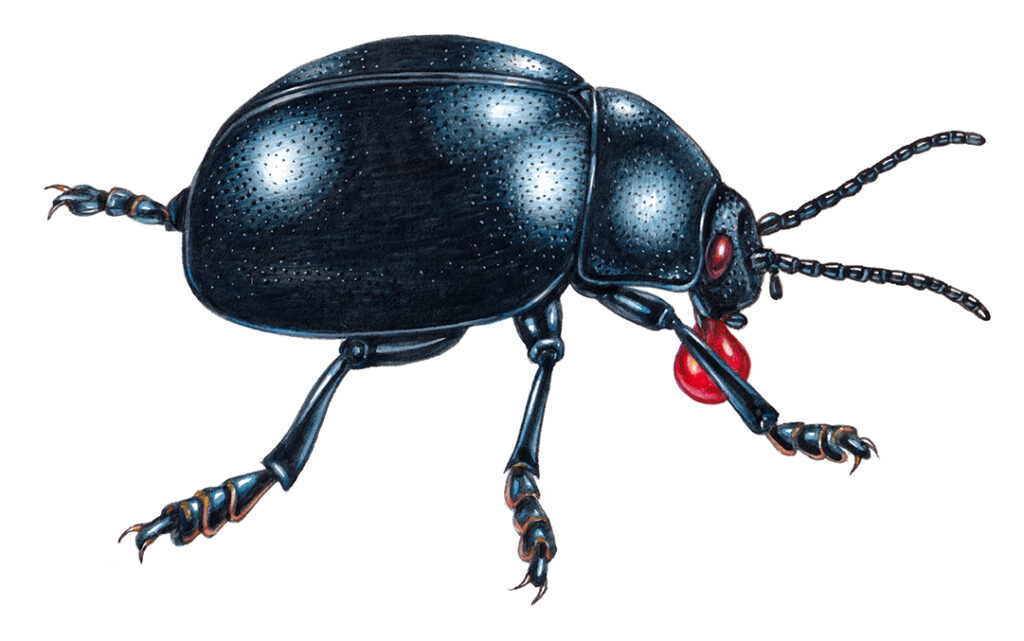
Bloody-nosed beetle Timarcha tenebricosa
Illustrating insects: Beetles: The Swollen-thighed beetle Oedemera nobilis
This is another familiar species. It’s also called the False-oil beetle and the Thick-legged flower beetle It’s 6-11mm long, and can be seen April through September. I’ve seen it wandering about inside in Buttercups. They favour grassland, and coastal areas.
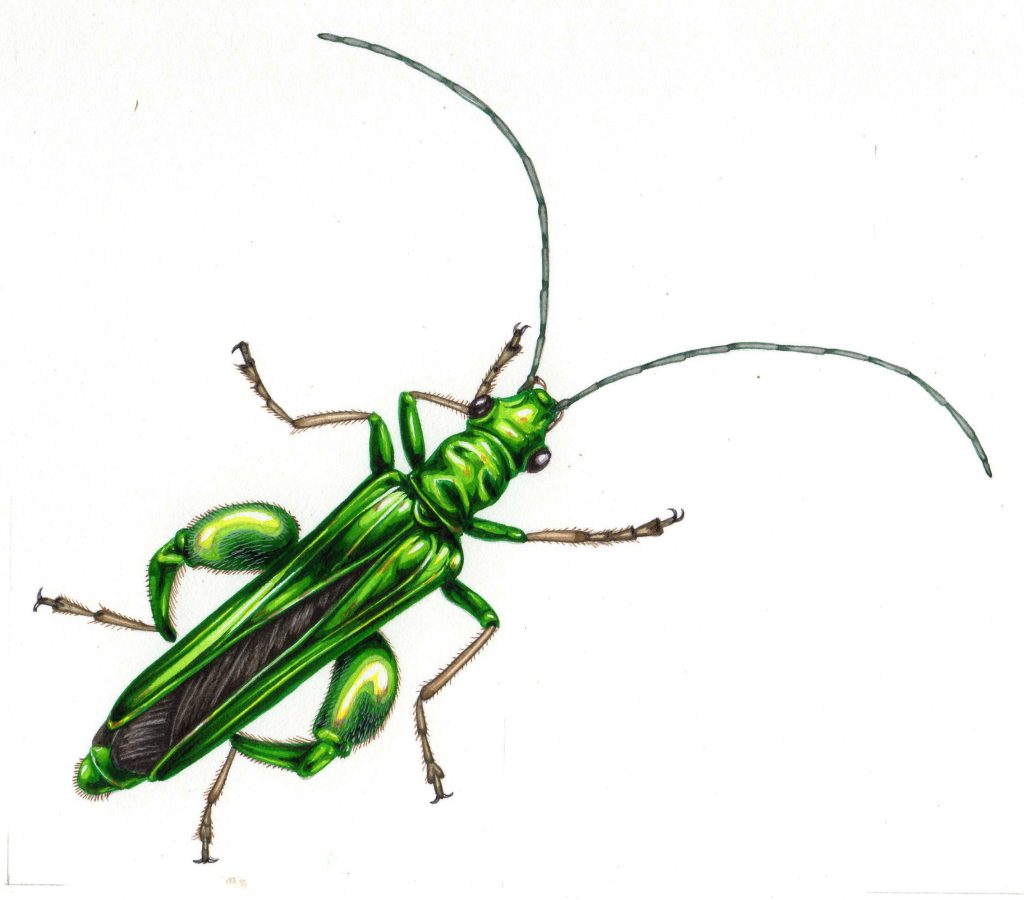
Jersey Post copyright 2016 First day cover envelope Swollen-thigh beetle
They feed on pollen and nectar, and pollinate Blackberry, Ox-eye daisy, and Cow parsley. A beautiful metallic green, they have a coppery sheen. Males have distictive swollen femora, or thighs; the females do not. The elytra don’t quite meet, so you can see the folded wings beneath them.
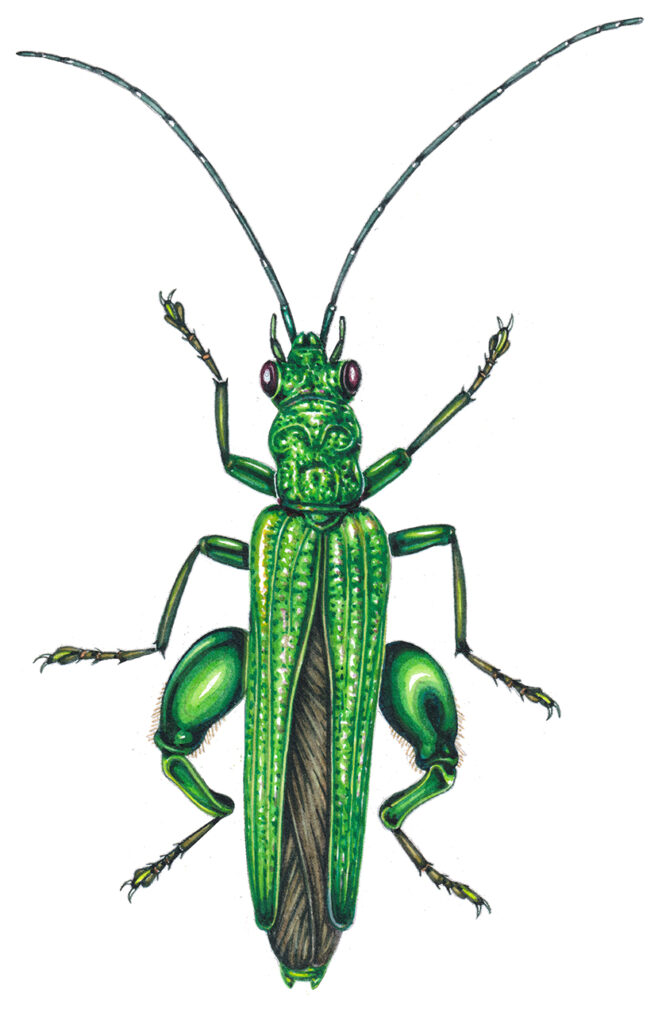
Swollen-thighed beetle Oedemera nobilis
Larvae are laid on the stems of thistles. Their range is expanding, they are becoming common further north.
Illustrating insects: Flies: The Dark-edged bee fly Bombyllus major
The Dark-edged bee fly is the commonest of the four UK bee fly species. They are up to 18mm long, and can be seen from March to May. They live in a wide range of habitats; woodland, parkland, towns and gardens, grassland, heath, farmland and coastal areas. I have seen them sunbathing on wildflowers, and visiting Catmint in my garden.
They eat spring flowers like Primrose and violets, using their long straight proboscis.
Bee flies look superficially like Bumble bees, but have much shorter antennae and far larger eyes. They also have two wings, rather than four. The transparent wings have dark markings on their leading edge, hence the name. Their buzz is higher than that of a bee.
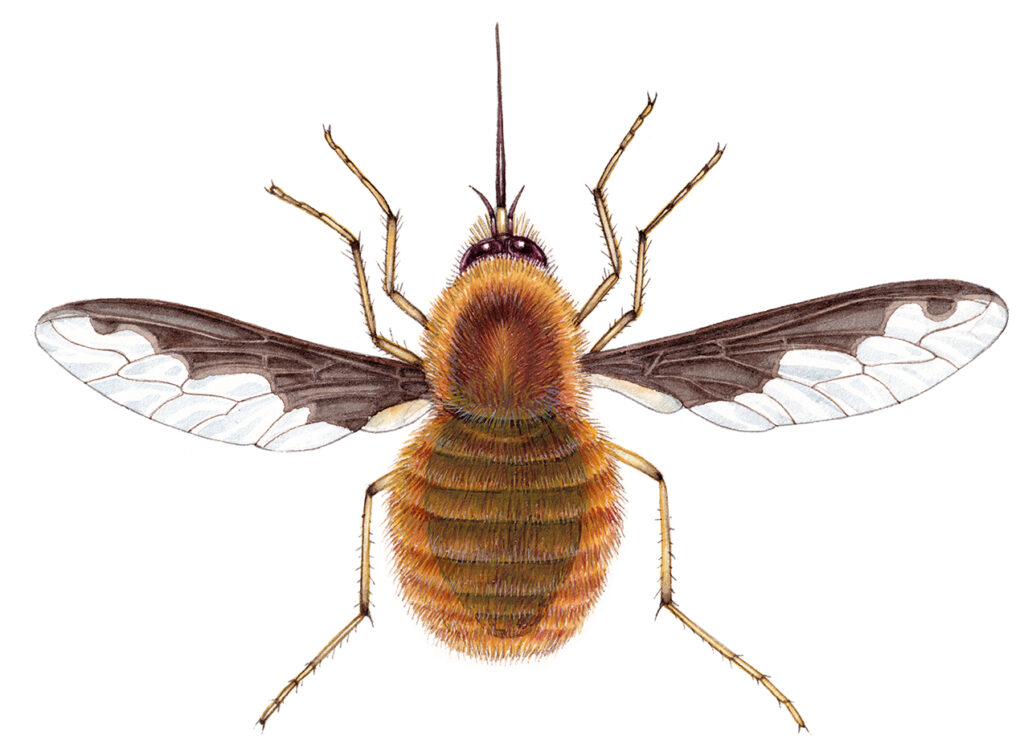
Dark-edged bee fly Bombylius major
These bee flies only take wing when it is 17 degrees C or above, and cannot afford to get wet, so they hide when it rains. Males do a darting courtship and territorial dance at 2.5m up.
Females cover their eggs in sand or grit for camoflauge, then flick them into the nests of solitary and ground-nesting bees. Once hatched, the grubs feed off the larvae of the host bees. They are expanding their range northwards, but are msotly found in the South, Midlands, and Wales.
Illustrating insects: Flies: The Dotted bee fly Bombyllus discolor
The second Bee-fly I was asked to draw is 8-12mm long (without proboscis) and can be seen March to April. They are far less common than the Dark-edged bee fly, and are found in Devon between Prawle Point and Start Point. I believe I saw one in a foxglove, in Pembrokeshire
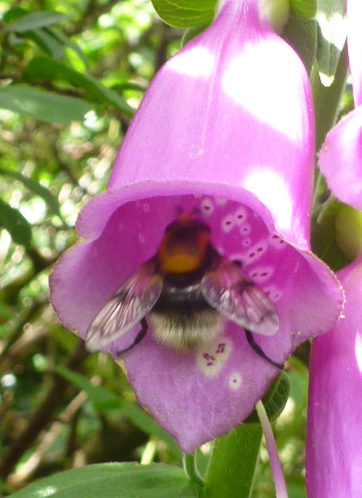
The Dotted bee fly Bombyllus discolor in a foxglove. Probably.
They are easy to spot thanks to the distinctive spots on their clear wings. they behave just like a bee, darting between flowers, but have a higher buzz.
As with the Dark-edged bee fly, they have a rigid proboscis which they use to feed from flowers. Some mistake this for a sting, but it is simply their mouthpart. Sometimes called “Flower thieves”, they can use this to stab the throats of flowers and steal the nectar.

The Dotted bee fly Bombyllus discolor
They parasitize the nests of mining bees, the Adrena genus, especially those of the Yellow-legged mining-bee Adrena flavipes. Females disguise the eggs in a similar way to the Dark-edged mining bee, and drop them into the nests. Once hatched, they eat all the pollen stored for the Adrena larvae, before going through a highly unusual first metamorphosis. When then emerge, they have a rather bloodier appetite, and eat the Adrena larvae. They then have a second metamorphosis (known as Hypermetamorphosis) before emerging as adults.
Illustrating insects: Flies: The Hornet Robberfly Asilus crabroniformis
This Robberfly is one of 28 Robberflies in the UK, but is easy to recognize because of its’ stripes and larger size. It is up to 25mm long and can be seen from June to October. It favours heathland and grassland. It’s increasingly rare, between 1980 and 2000 its’ numbers plummeted by 21%, and it is now a priority species.
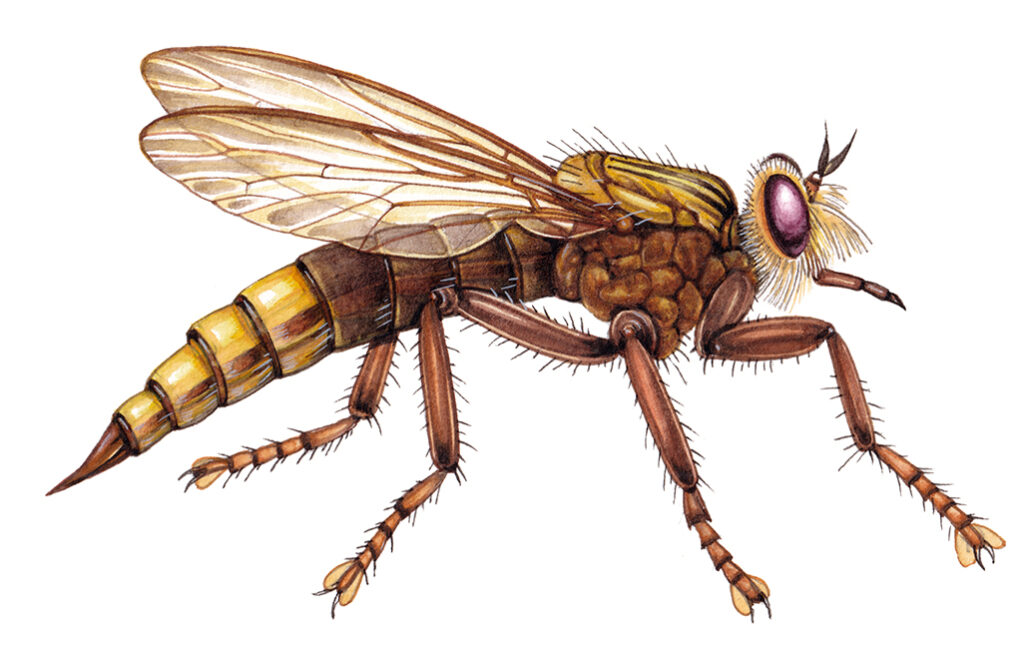
Hornet robber fly Asilus crabroniformis
The Hornet robberfly is a predator, catching insect prey on the wing and keeping hold of it with long spines on the front legs. The “moustache” of hairs protects its’ mouthparts from struggling prey as it pierces them and drinks their fluids. Although it favours dung beetles, it will also eat bees and grasshoppers.
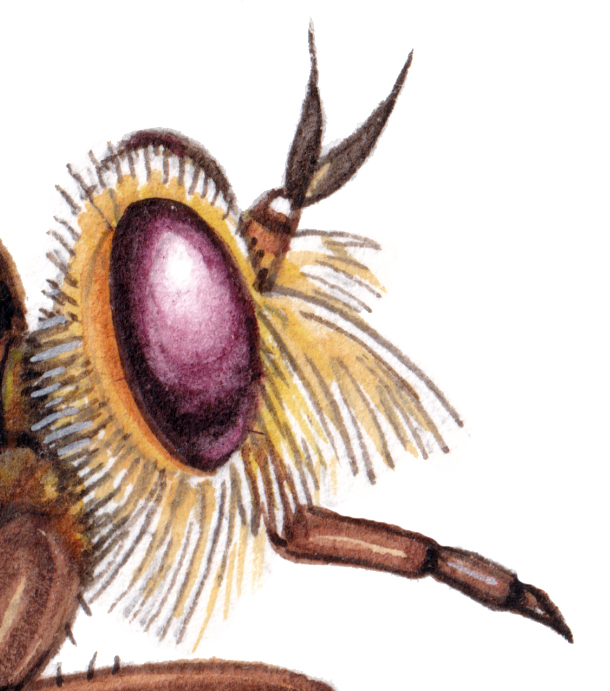
Head of the Hornet robberfly showing protective hairs and piercing mouthpart
It is a wasp or hornet mimic, with yellow and black stripes. It perches on dung or on prominent stones or sticks to keep an eye out for prey.
Larvae are laid in animal dung where they hatch and predate on the grubs of other species.
Chemicals fed to livestock, such as avermectins, have led to the species’ population decline. The chemicals contaminate the dung and kill the larvae.
Illustrating insects: Bees: The Brown-banded Carder bee Bombus humilus
This bumble bee is one of three carder bee species in the UK, and has workers and males of 12mm, with a larger queen. They are seen June to September, with queens emerging in May and June. Preferred habitat is flower-rich grassland, and they are only found in southern coastal areas.

Brown-banded carder bee Bombus humilus
They feed on vetches, clover, knapweed, and mint. Nests are built in tussocky grass and old rodent burrows, and have about 50 workers.
They have pale hair, with a more orange band on their abdomens, which pales on the edges.
Illustrating insects: Bees: The Long-horned bee Eucera longicornis
The Long-horned bee is up to 13mm long and needs unimproved coastal grassland to survive. It can be seen May through July, with the males instantly recognisable thanks to their very long antennae. Sandy cliffs near Prawle point are one of it’s last strongholds, and it’s one of the main target species for the Life on the Edge project.
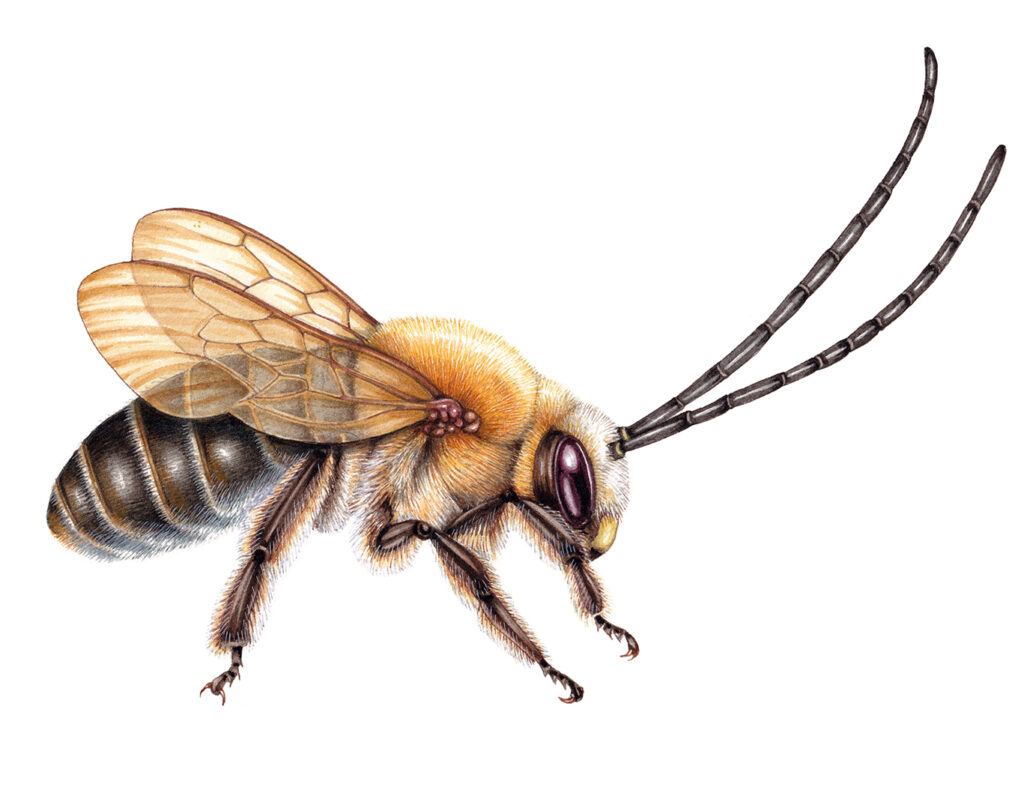
Long-horned bee Eucera longicornis
Although its’ a solitary bee, it nests in colonies, and freqeuntley visits the Twin-leaved everlasting sweet-pea, which S. Devon National landscape are encouraging.
Illustrating insects: Bees: The Ivy bee Colletes hederae
Also known as the Ivy plasterer bee, this species is about 10-13mm long and is seen late in the year, between September and November. It likes coastal habitats, towns, and playing fields, and is a newcomer to the UK, having first been recorded here in 2001.
As the name suggests, it feeds on the pollen of Ivy flowers.
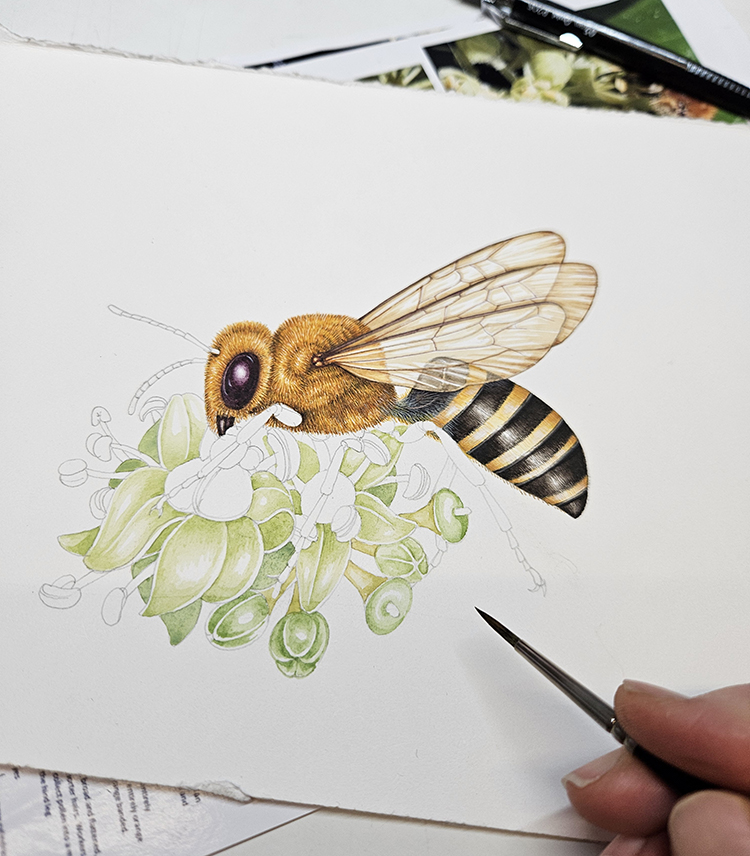
Ivy bee illustration in progress
The Ivy bee is orange-brown with clear stripes on the abdomen. They nest is south-facing sandy banks and are a solitary species.
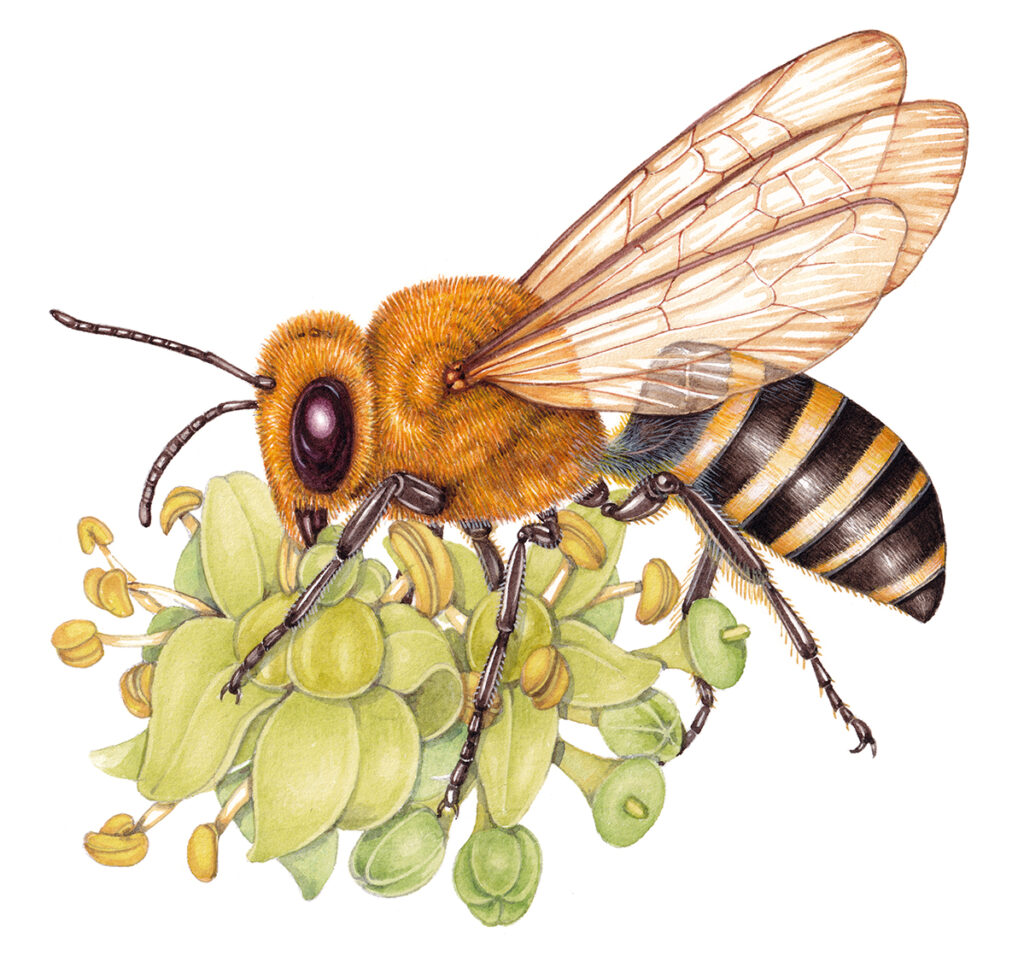
Ivy bee Colletes hederae
Males sometimes partake in frenzied mating clusters where many individuals cluster and wrestle to get access to females as they emerge from their nests. For more on this species, keep an eye out for my forthcoming blog on bees.
Illustrating insects: Moths: The Thrift clearwing moth Pyropteron muscaeforme
This moth has a 12-18mm wingspan, is a member of the clearwing or Sesiidae family, and flies in June and July. It can be found in coastal habitats and sunken lanes leading to the sea.
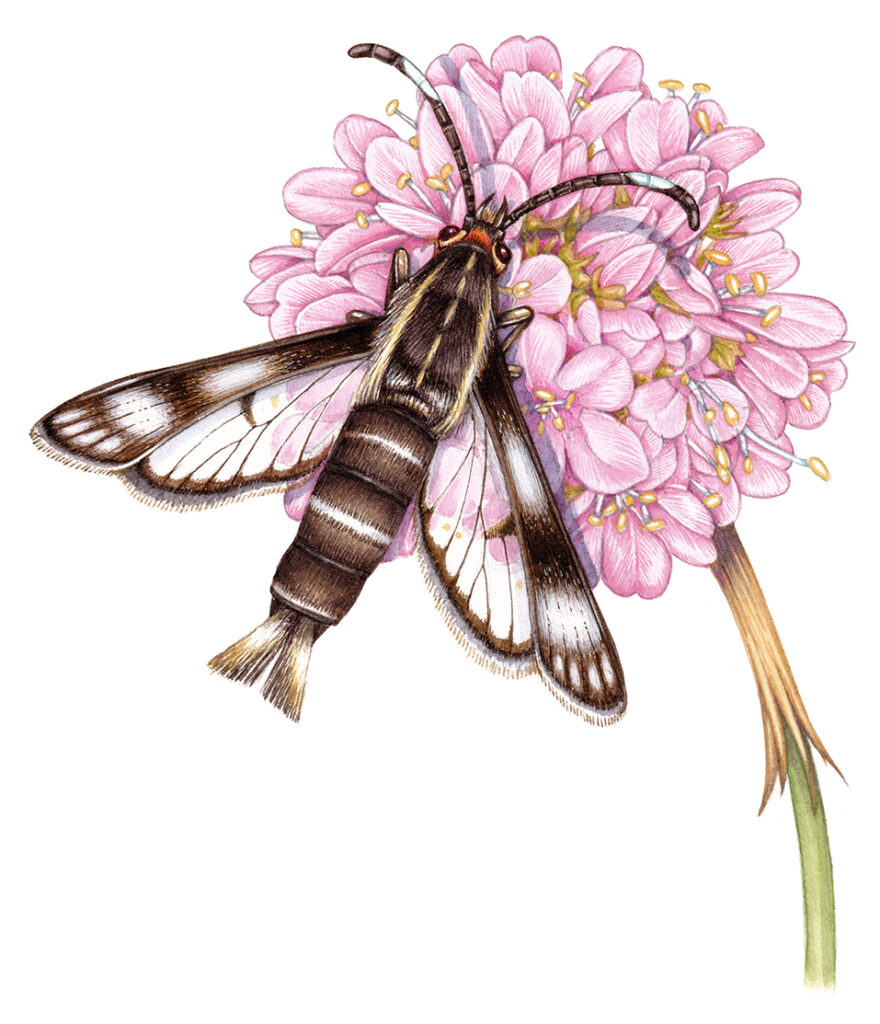
Thrift clearwing moth Pyropteron muscaeforme on Thrift
As the name suggests, caterpillars feed on thrift, eating the stems and roots. They overwinter as part-grown larvae. Affected plants may have lots of brown frass in their leaf cushions, and appear browned.
The adults have 3 or 4 cream abdominal bands and vertical thoracic stripes. Their forewings are scale-free, hence the name.
Illustrating insects: Grasshoppers and Crickets : The Great green bush cricket Tettigonia viridissima
the last insect I illustrated for the Spotter’s guide is the magnificent Great green bush-cricket. This enormous insect is up to 70mm long, and can be seen from May to October. It lives in woodland, grassland, and scrub, and is common across southern England and Wales.
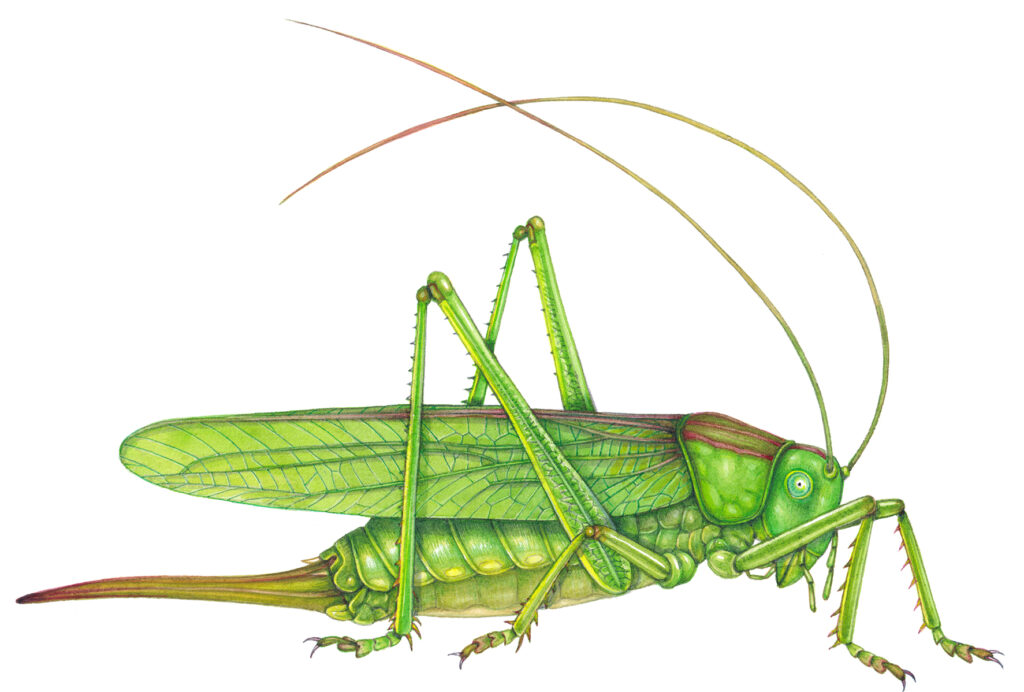
Great green bush cricket Tettigonia viridissima
It eats plants, and other small insects. Despite its’ size, it can be hard to spot thanks to it’s brilliant camoflague. both sexes are green with a red stripe down the length of their body and have very long thin antennae. They have long wings, and the female has a long down-turned ovipositor.
Males attract males by rubbing their forewings together.
Although they are harmless, if captured they are capable of delivering a sharp self-defensive nip!
Conclusion
Illustrating these invertebrates is an enormous treat. And it’s important to remember the reason why these ones made the list. They are insects who will benefit from the Life on the Edge project. Land will be managed with them in mind, some plants encouraged while others are cleared.
As Buglife puts it, “Life on the Edge is aiming to save species; giving them a safer long-term future by expanding and reconnecting the traditional coastal landscapes on which they depend. Restoring wildflower-rich cliff tops and highway verges, carefully managing scrub mosaics, strategic hedgerow connections, and more wildlife-friendly parks, churchyards, school grounds and private gardens.”
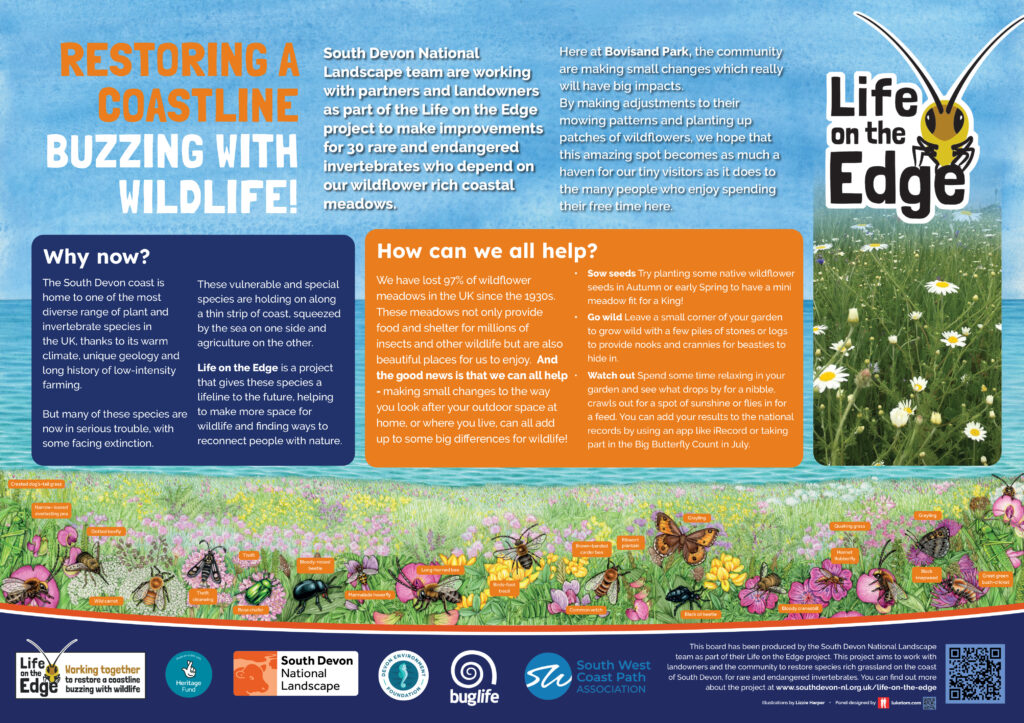
The first Life on the Edge information board with my illustrations at the base
It’s a project I’m proud to be a part of.
Information for this blog came from The Wildlife Trusts, Butterfly Conservation, UK Moths, and Buglife.
