




Painting Bumblebees
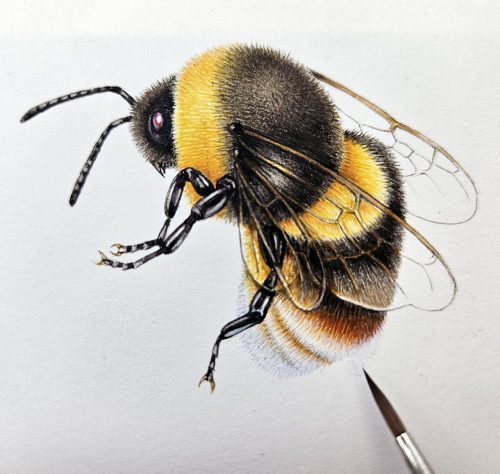
I often get asked to paint bumblebees. This blog takes a look at a few I’ve illustrated over the years, and talks about some of the challenges.
White tailed bumblebee Bombus lucorum: Description
White tailed bumblebees appear across all of Britain. Queens emerge in March and April, with workers appearing about 6 weeks later. Nests can number 200 worker bees, and are often in abandoned rodent holes. In fact, Babbity bumble (from Beatrix Potter’s Tale of Mrs Tittlemouse) is a White-tailed bumblebee, nesting in an occupied mouse burrow!
Workers have a right yellow band behind the head, and another broad one below the thorax. They have pure white tails. Queens are larger versions, while males have yellow faces and broader yellow stripes.
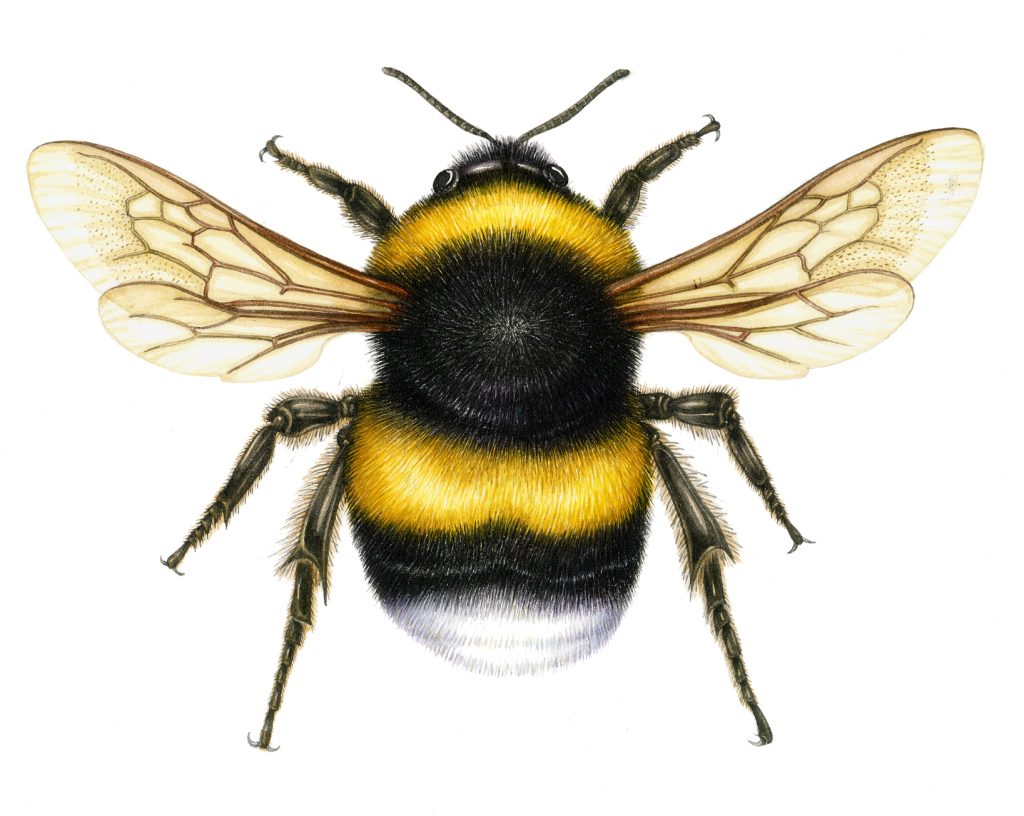
White tailed bumblebee Bombus lucorum
Illustrating the White-tailed bumblebee
The White-tailed bumblebee was one of the first I painted really large, back in 2014. It was completed for the Yorkshire Dales national Park, appearing on the outside of a visitor centre. I worked really big, which meant the illustration took quite some time. I wrote a step by step blog on the process, and made a short film:
A few years earlier, I had been commissioned to paint the life cycle of the White-tailed bumblebee, with the bee feeding from Knapweed Centaura nigra and Foxglove Digitaria purpurea. I enjoyed the contrast between the purples of the flowers and the yellow of the bee’s body.
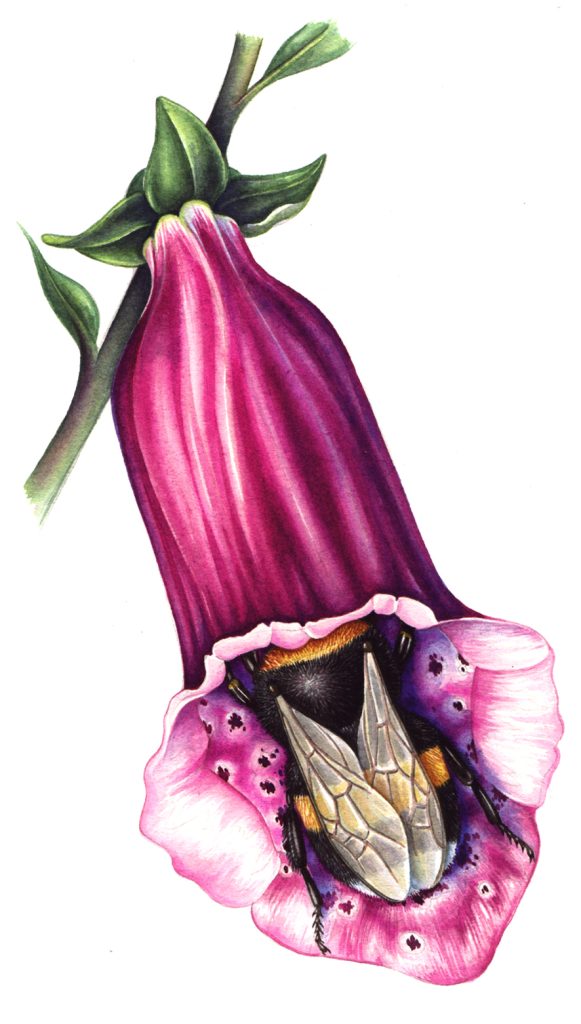
Detail: Foxglove Digitalis purpurea individual flower with white tailed bumblebee inside
It was hard to find images of what occurred within a bumblebee nest, but (as if often the case) old engravings were an excellent resource. Seeing the way the body of a larvae develops and changes is really interesting.
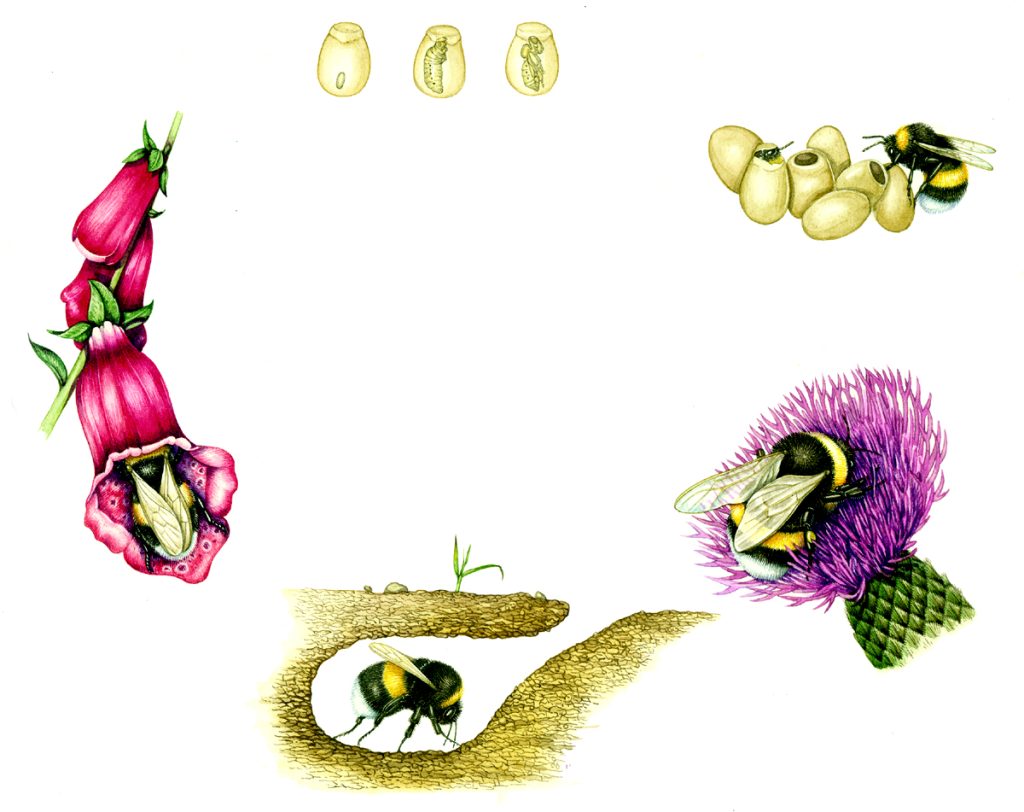
Life cycle of the White-tailed bumblebee
More recently, I illustrated this species to show how we can build homes for bumblebees in our gardens by putting very simple structures in place, such as inverted flower pots and pieces of hose.
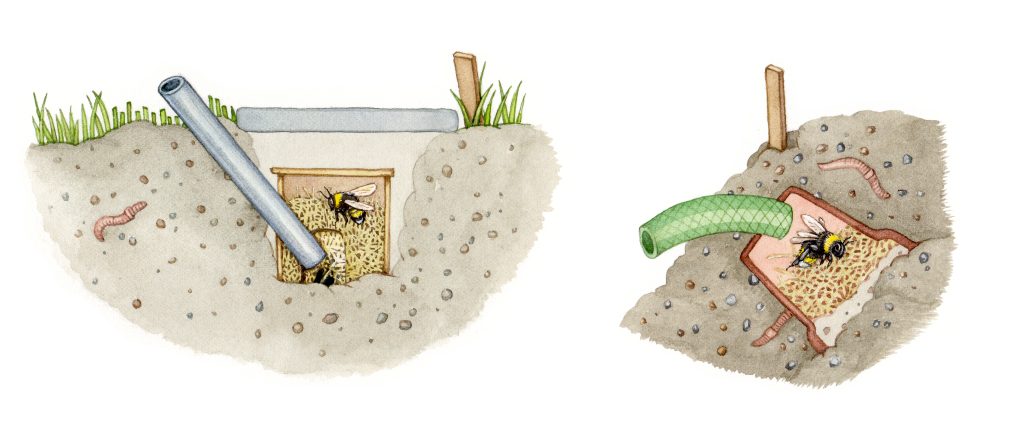
Diagrams of Bumble bee homes
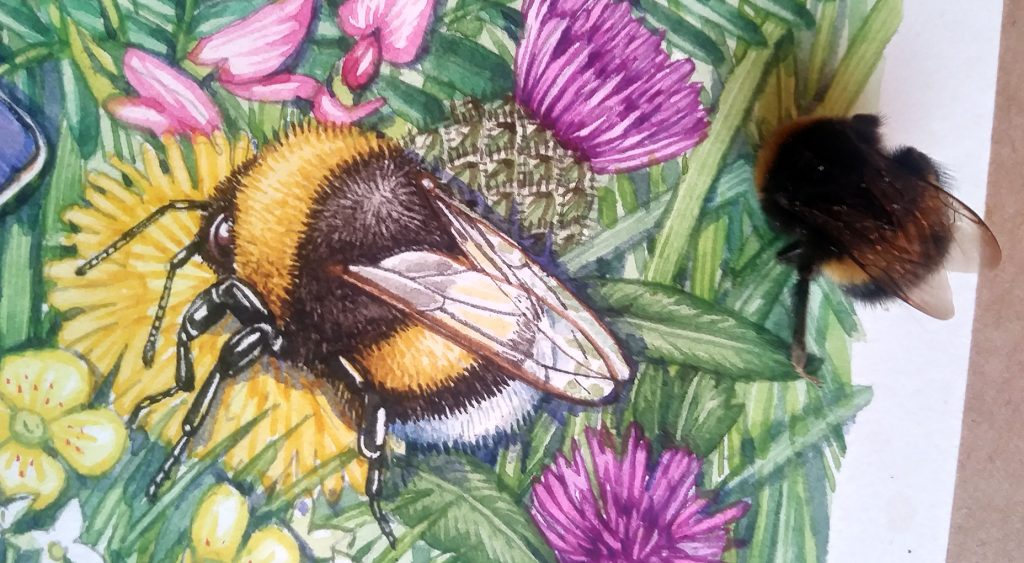
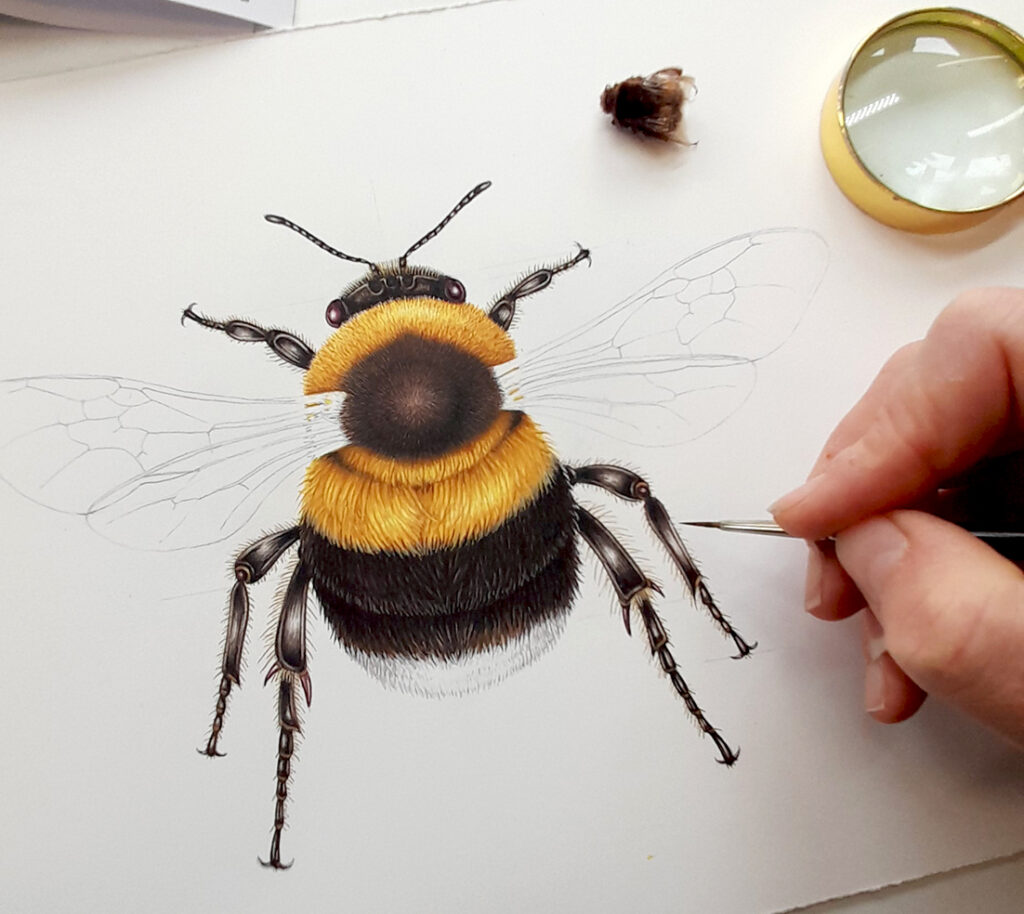
As with all bee illustrations, working from life is much easier than working from photographs. It really helps when tackling the transition between yellow and black abdominal hair. If you’re not careful, black to yellow can easily create a nasty optical mix where the two create a dirty green colour.
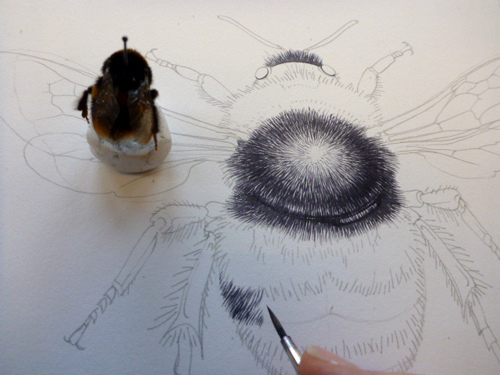
Illustrating the White-tailed bumble bee, with specimen.
Diagram of Bumble bee
When I was asked to complete a diagram of a generic bumble bee for David & Charles publishers, it was the White-tailed bumblebee I used.
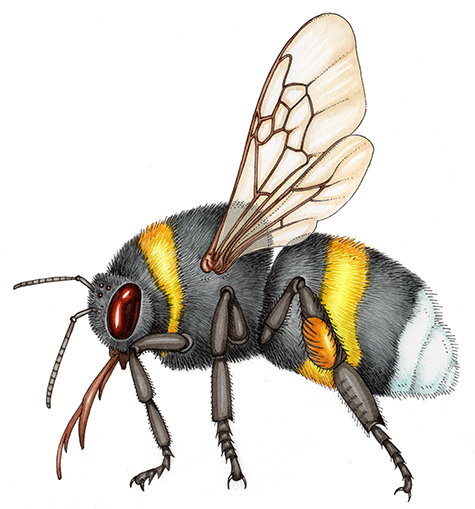
Schematic bumble bee illustration
The White-tailed bumblebee in my landscape illustrations
The White-tailed bumblebee is a frequent guest in my landscape illustrations, too. It needs to be simplified, but remain instantly recognisable.
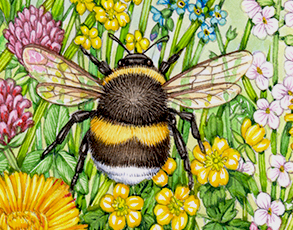
Here’s one that appears on the mug design I did for Hay Festival, back in 2022.
And below is another, this one is in the corner of a landscape focused on water meadows, specifically the water meadow habitat of Woodstock, in Oxfordshire. The area was designated a Local nature reserve in October 2025.
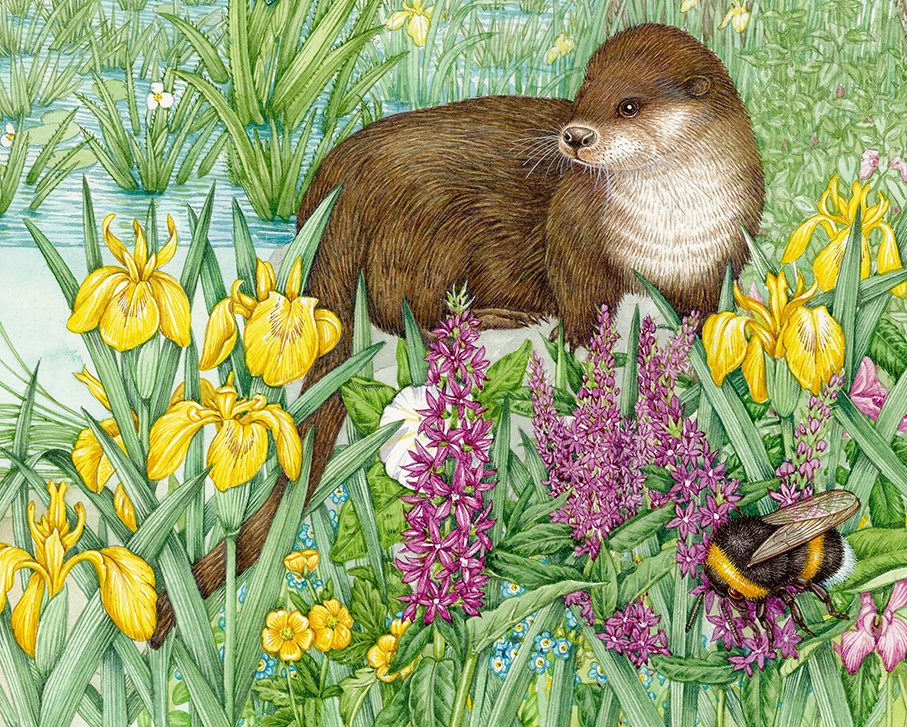
Detail from Woodstock water meadow landscape
She turns up again, this time on a Hawkbit, in a landscape illustration done of the Gilfach nature reserve in mid Wales. Even when illustrated small and within a larger context, having specimens to work with is very helpful.
Finally, another one pops up in the centre of a private commission featuring Long tailed tits, wild Cyclamen, and the Poplar hawkmoth.
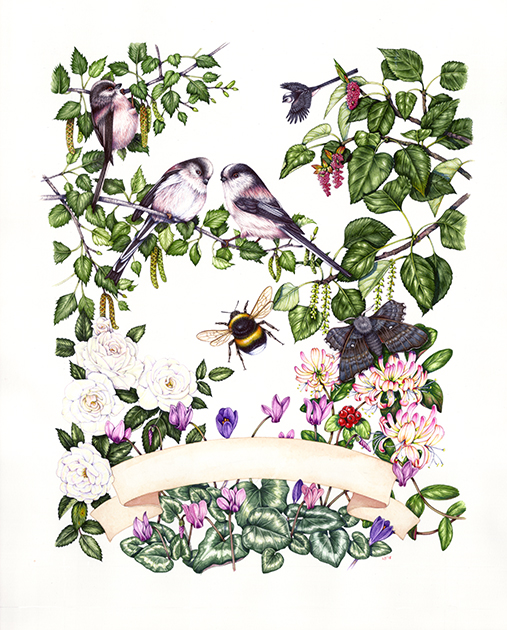
Illustration of Cyclamen, Long-tailed tits, honeysuckle, Poplar hawkmoth and a White-tailed bumblebee
Garden bumblebee Bombus hortorum
The Garden bumble bee is another species which is widespread across the UK, and pretty common. It has a longer face (and longer tongue) than the White-tailed bumble bee which allows it to exploit flowers with longer corolla tubes, such as clovers and honeysuckle.
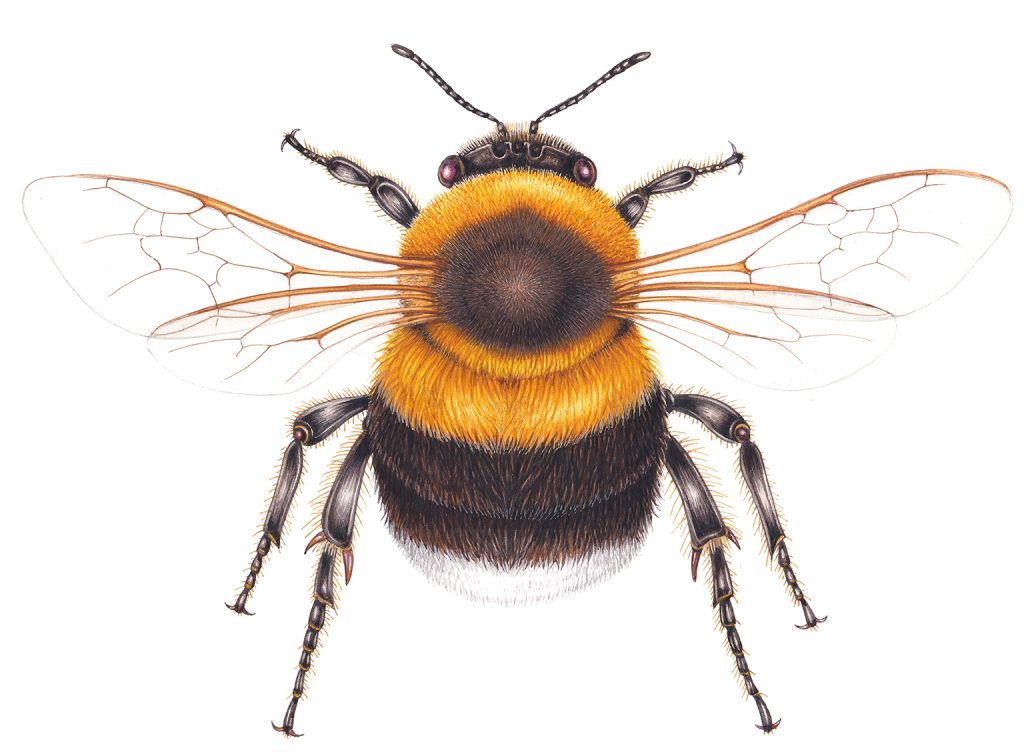
Garden Bumblebee Bombus hortorum
This illustration was completed for a company exploring the idea of making high-end porcelain products. The bumble bee featured on a saucer, a sprig of honeysuckle on the matching cup. I’m unsure if this test product ever got further than the sample stage.
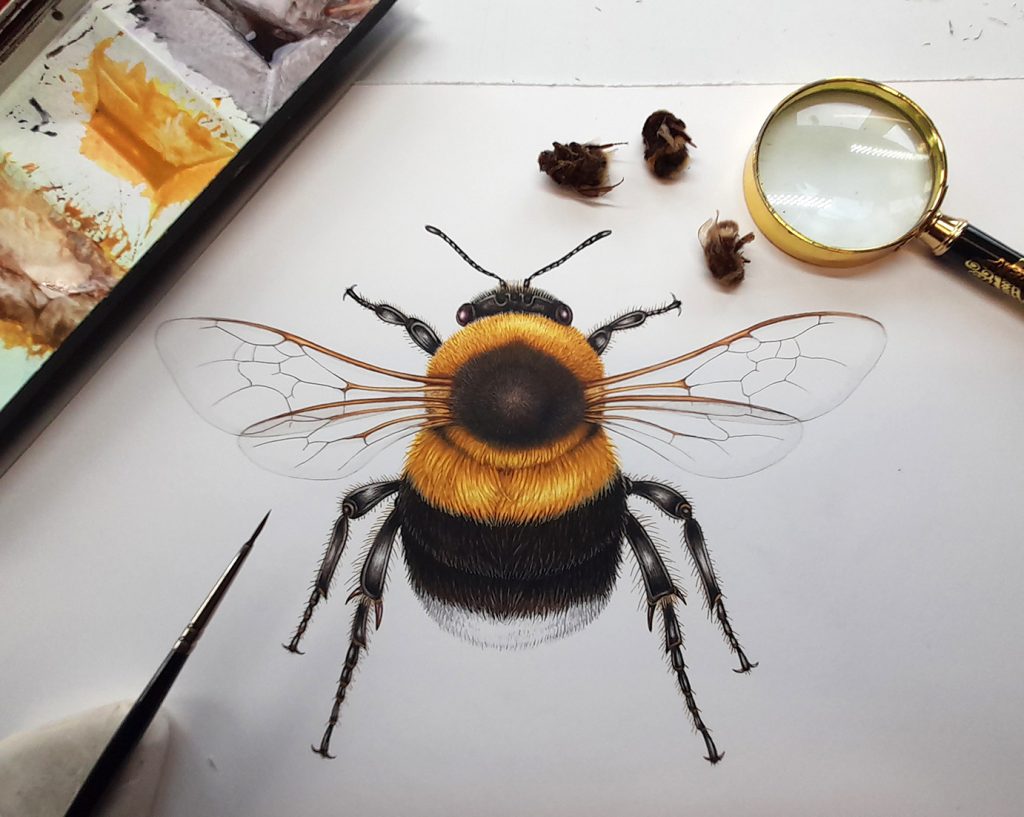
Garden bumble bee with specimens
It’s not difficult to collect samples of bumblebees, visit anyone with a conservatory or greenhouse and you’re likely to find lots of dead bees.
Putting up net screens over vents and doors helps prevent the bees getting in, and planting some bee friendly flowers nearby might distract them. Some advise opening holes in the corners where the bees struggle to escape. The Bumblebee Conservation trust gives a useful guide on how to rescue a trapped bumble bee. All the Bumblebee information in this blog comes from their excellent website.
Bilberry Bumblebee Bombus monticola
This is a heathland and upland species, found at higher altitudes and mostly in the north and west of the UK. The Bilberry bumblebee nests just below the ground, in amongst heather, tussocky grasses, and bilberry. Nests contain up to 70 workers. Queens, males, and females all look similar, although the males’ faces are brighter yellow and their hairs are longer.
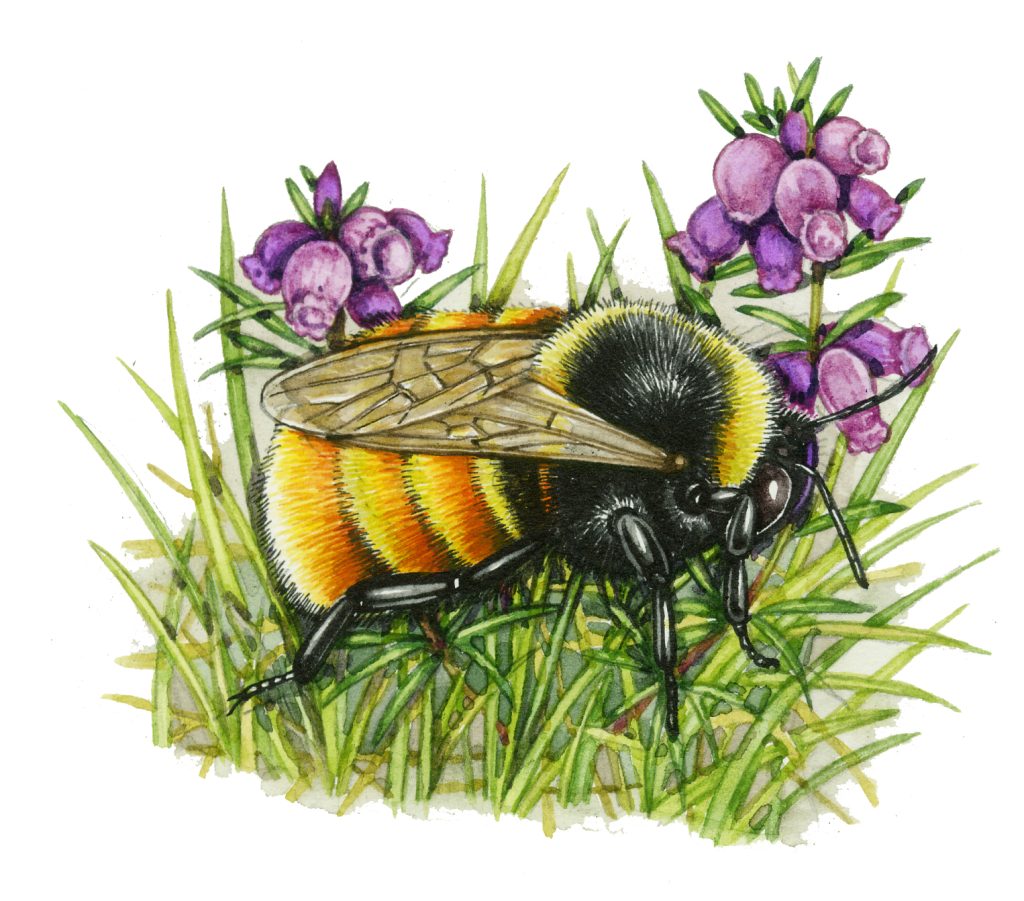
Bilberry bumblebee Bombus monticola
They have distinct orange-red abdomens and yellow bands at the top and base of their thorax.
Bilberry Bumblebees feed on Bird’s-foot trefoil, clovers, heather and (not surprisingly) bilberry.
This one was illustrated for Radnorshire Wildlife Trust, where it is found on some of their upland nature reserves. (RWT has produced an excellent guide to the bees and wasps of Radnorshire, well worth a look.)
Red-tailed bumblebee Bombus lapidarius
The Red-tailed bumblebee is another common UK species, found across much of the country, but less in the north of Scotland.
The queens and workers are black with a striking red tip to their abdomens. The males have golden bands on the thorax, missing in the workers and queen. Nests contain up to 300 workers. This species favours knapweed, lavender, and dandelions.
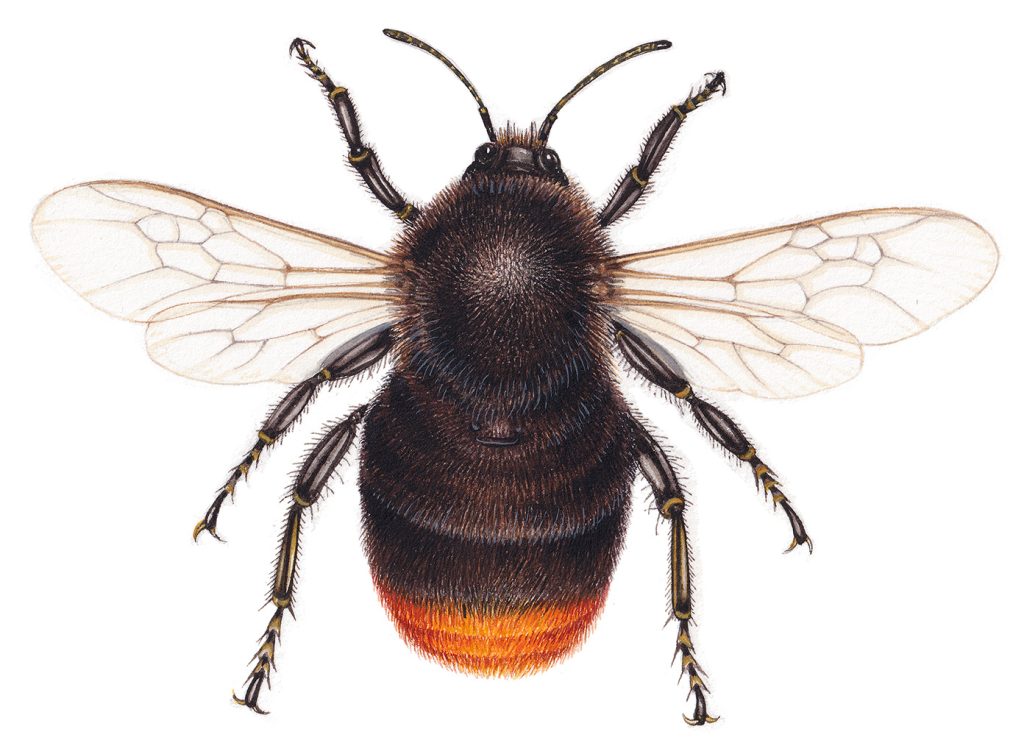
Red-tailed bumblebee Bombus lapidarius
This illustration was commissioned by Powys County Council’s Nature recovery officer, and was used in nature outreach work.
I painted another Red-tailed bumblebee, this time for Roselyn seeds. It featured on their wildflower seed packet for Cornflower, Centaurea cyanus. The bee does indeed visit these flowers, and the red tail looks stunning alongside the cornflower blue.
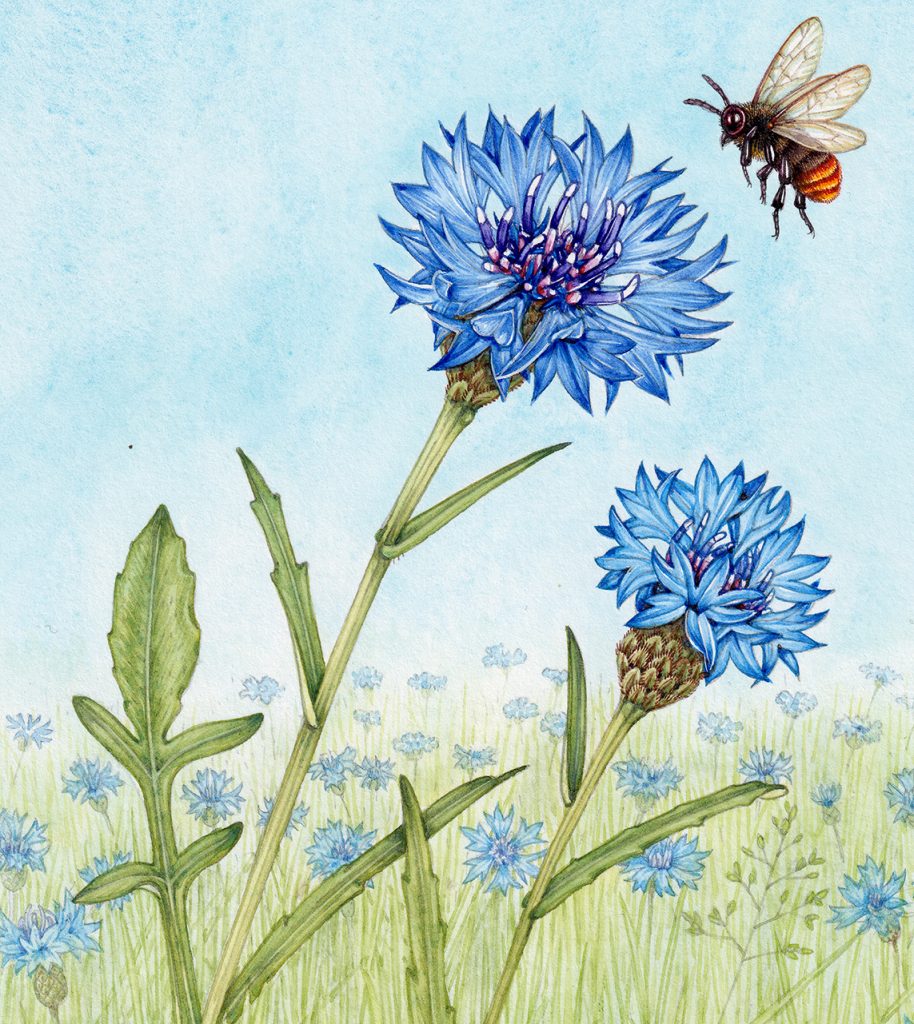
Cornflower Centaurea cyanus with Red tailed bumblebee Bombus lapidarius
The red tailed bumblebee had another outing. This time it featured in the illustration for a seed packet of mixed wildflowers, produced by the same company.
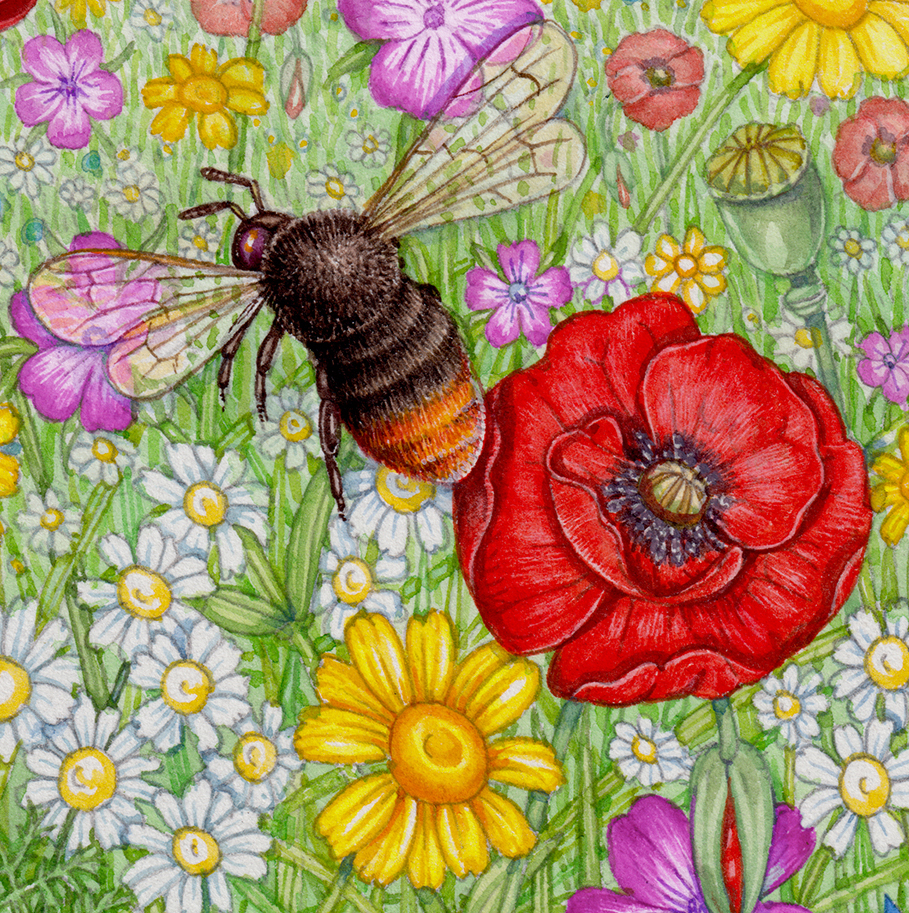
Red-tailed bumblebee with Corncockle, Poppy, marigold, and mayweed
Buff-tailed Bumblebee Bombus terrestris
The Buff-tailed bumble bee is one of the earliest to emerge in the spring, with queens seen from February on. In the south of the UK, Buff-tail bumblebees may not hibernate at all. They nest in underground burrows, and dis-used rodent nests, in colonies of up to 350.
The queens have the distinctive buff coloured tail. Workers and males have a thin buff line between the black and the white tail, or none at all. In fact, it’s virtually impossible to tell White-tail and Buff-tail workers apart by sight alone.
The only illustration I’ve completed of this species is on another seed packet design for Roselyn seeds. This time, the bee appears alongside an Ox-eye daisy, Leucanthemum vulgare.
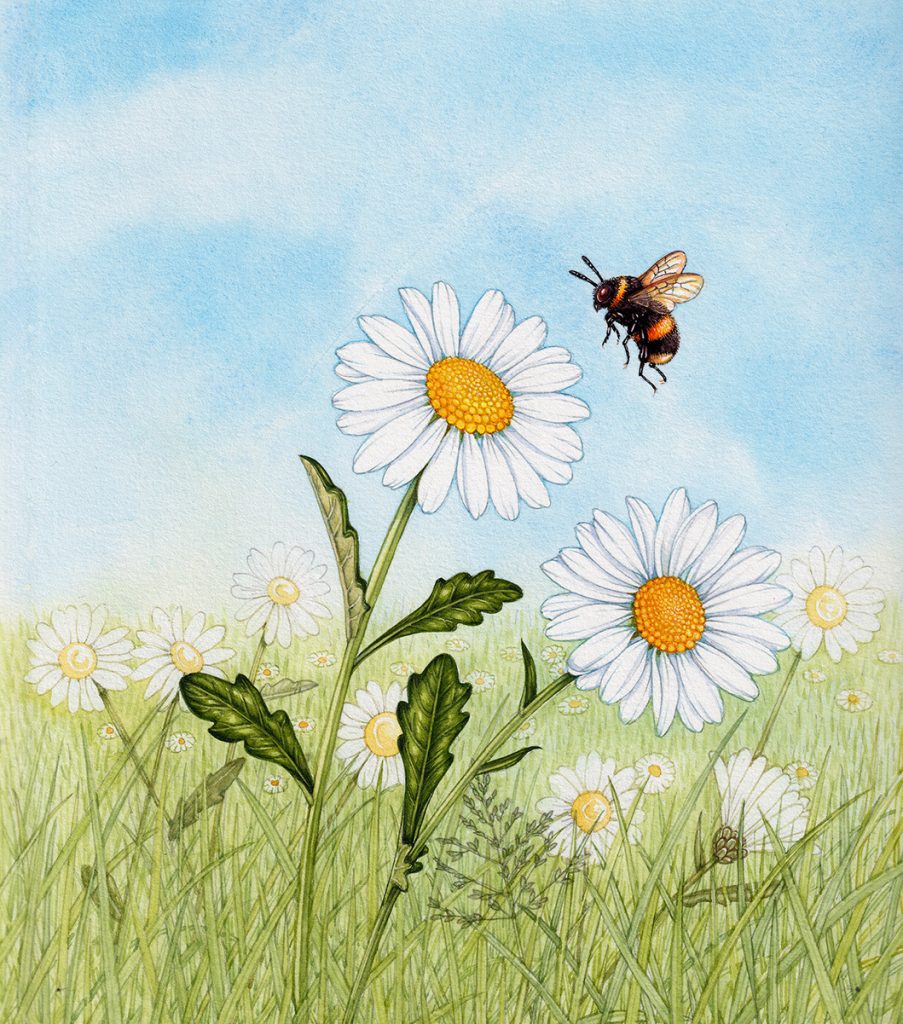
Buff-tailed bumblebee and Ox-eye daisy
Broken-belted bumblebee Bombus soroeensis
The Broken-belted bumblebee is rarer than many featured in this blog, predominantly in the north of the UK. It feeds on scabious and blackberry. Males, females, and queens all have a yellow band at the top of the thorax, one at the top of the abdomen, and (in females and queens) a white-ish tail. The yellow stripe on the abdomen is often sprinkled with black hairs, making it more of a crescent shape than a rectangular stripe. The yellow extends up the sides of the thorax, which can make the bees look like they have yellow armpits.
The white tail is tinged with reddish hairs, much more extensively in the males than the females.
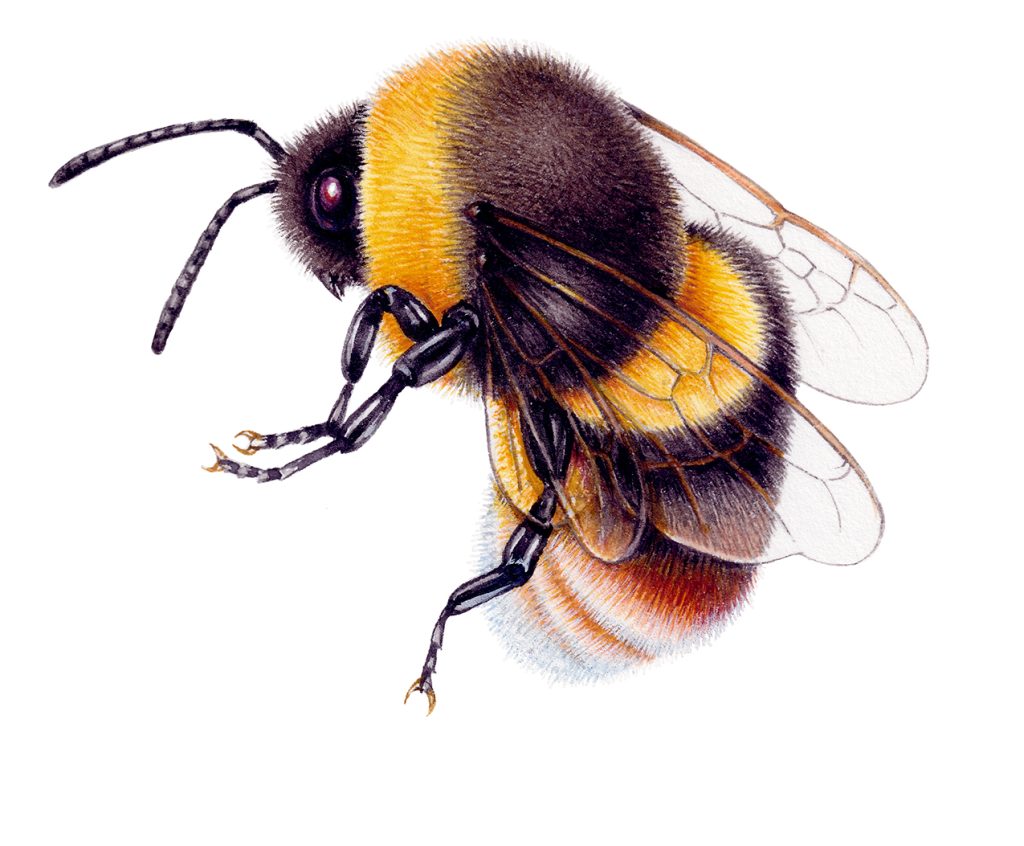
Broken-belted bumblebee Bombus soroeensis male
This bumblebee was illustrated in 2025 for the Scandinavian packaging of Flora spreads and products. I am yet to see it in context. The bee above is the one they chose to use. However, I wasn’t entirely satisfied, it had to be a little compromised to fit into a small pre-decided space on the packaging.
I preferred the first Broken-belted bumblebee I completed for them. Not only can you see the broken belt clearer, but the bee looks less confined.
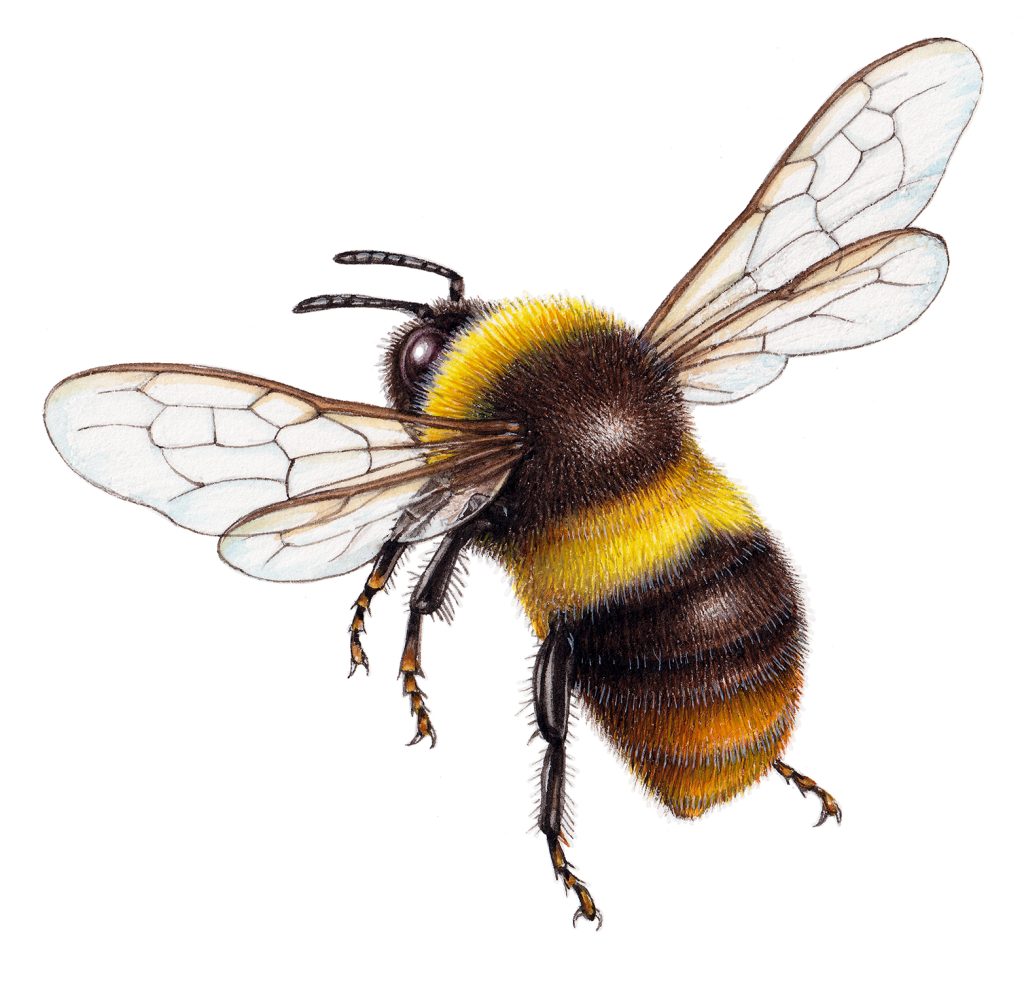
Broken-belted bumblebee Bombus soroeensis male
As with all the bumblebees I’ve illustrated, the process of getting them to look furry takes time, and an awful lot of tiny brush strokes!
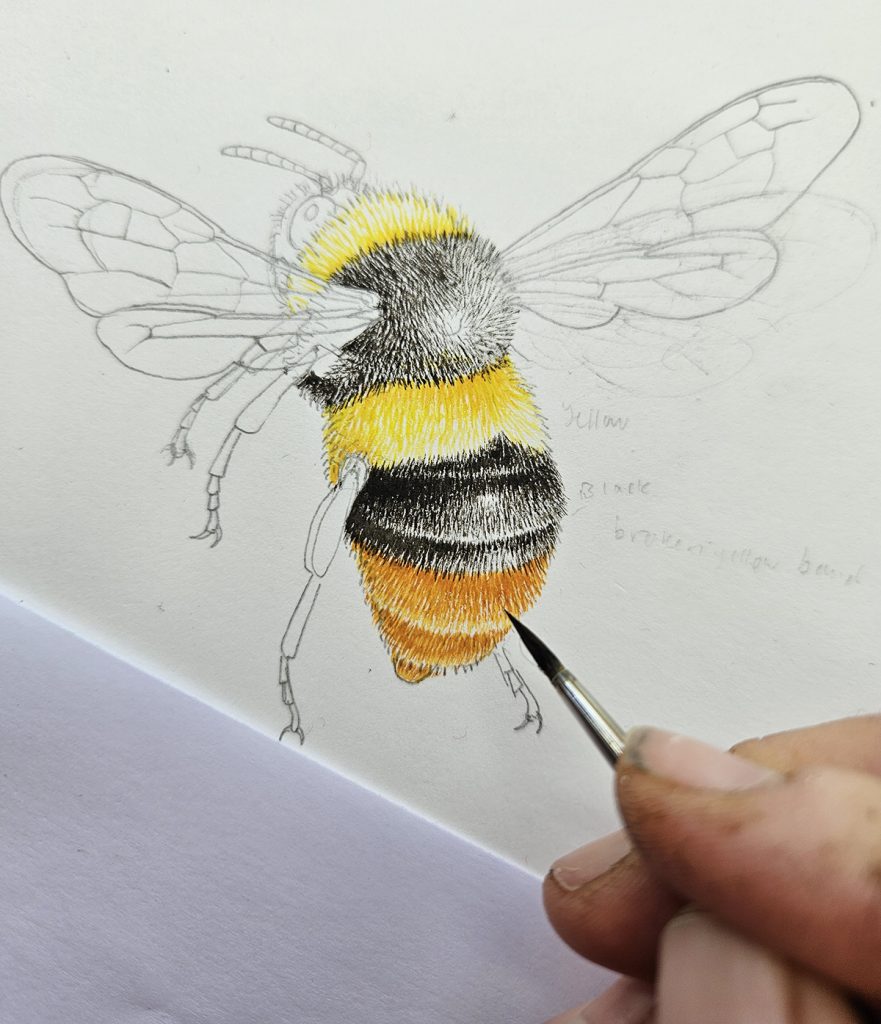
Broken-belted bumblebee male illustration in progress
Brown-banded carder bee Bombus humilus
The final bumble bee I have illustrated is the Brown-banded carder bee.
This is a pretty scarce bumblebee, only found along coastal areas in the south of England and of Wales. Nests number no more than 100 workers and are found amongst long grass and moss in un-improved rich grasslands.
The thorax is ginger, with paler hairs on the sides. There are a few black hairs around the bases of the wings. The abdomen is brown too, although the second segment may be gingery. There are no black hairs on the abdomen.

Brown-banded carder bee Bombus humilus
This illustration was completed in the last couple of months, for South Devon’s National Landscape. The bee will be part of a fold-out “Spotter’s guide” to help people recognise invertebrates as they walk along the coastline. This is part of the “Life on the Edge” initiative, referring both to the habitat and to the rarity of the invertebrates it aims to protect.
Brown-banded carder bees in the landscape
The bee appears again, this time as part of a larger landscape, the background to an interpretation board which is sited near the meadow land South Devon National Landscape manage in Bentham. As with the other bumblebees cited in context, it is simplified.

Brown-carder bee detail from Bentham Hay meadow board
It has another outing, this time in the base of a large “frame” style illustration. This allows South Devon Living Landscape to place text in the central area without hiding any of the detail. It will be used in several sites, with different information on the board.
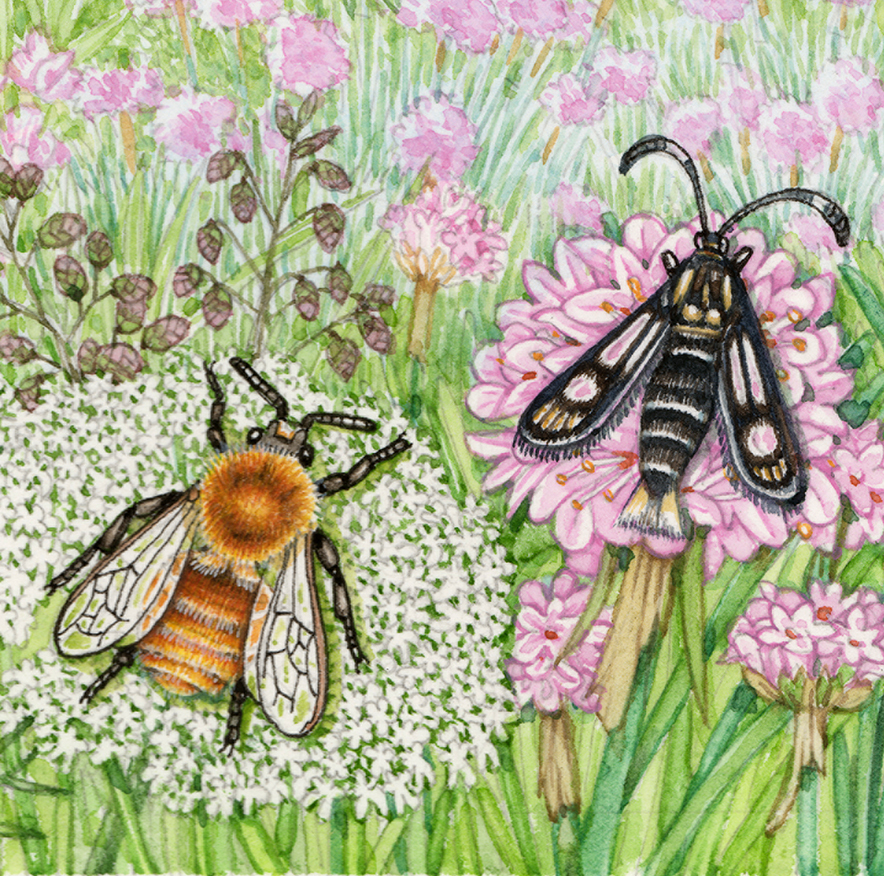
Brown-banded carder bee with Thrift clear-wing moth.
Below you can see the completed insect border in situ, with relevant information and logos overlaid. Our Brown-banded carder is toward the left-hand side.
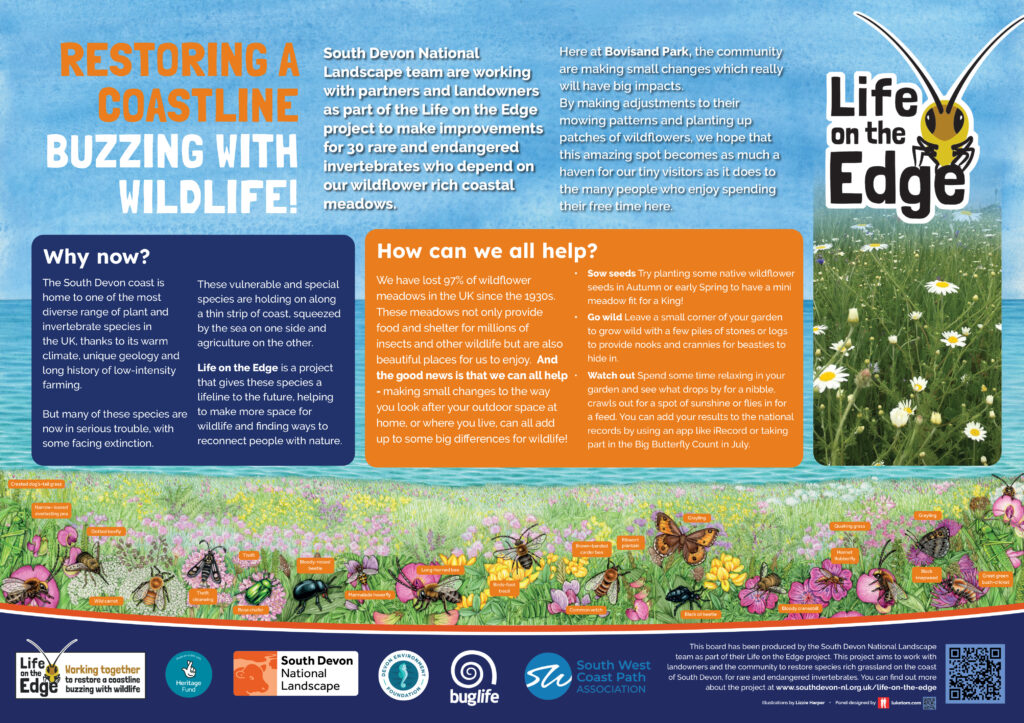
Life on the Edge information board (South Devon National Landscape)
Conclusion
Illustrating bumblebees is always tricky, but always enjoyable. It’s a matter of building up texture with tiny brush strokes, trying to get the colours close to life, and wanting the bee to appear life-like as well as appealing.
If seeing illustrations of bumblebees is of interest, I urge you to check out the work of other illustrators such as Richard Lewington, Carim Nabahoo, Shevaun Doherty, and Cheryl Hodges (I’m not certain Cheryl has done bumblebees, but her other bees are well worth a look). I’m not the only one with a penchant for Bombus! Enormous thanks is due to the Bumblebee Conservation Trust whose excellent website provided the identification pointers for the species.
Illustrating the Garden bumblebee Bombus hortensis
