




Bluebells
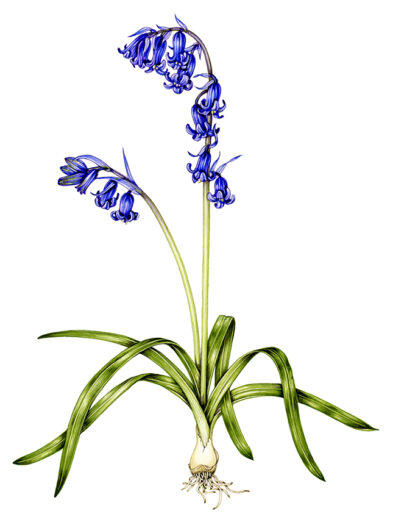
Bluebells are a favourite wildflower, carpeting broadleaf woodlands in the spring. They turn the forest floor a glowing purple, and are one of the most beautiful of Britain’s nature displays.
What is a Bluebell?
Bluebells are in the Asparagus family, their Latin name is Hyacinthoides non-scripta. It’s no surprise that they’re relatives of the garden hyacinth, they share the same heady scent.
They are monocots; a division of plant that includes all the grasses, lilies, orchids, and tulips. Shared characteristics include leaves with parallel veins, the distinct growth pattern of a seedling from a one-grained seed, fibrous roots, and flowers without differentiated sepals and petals. These in-between structures are known as tepals.
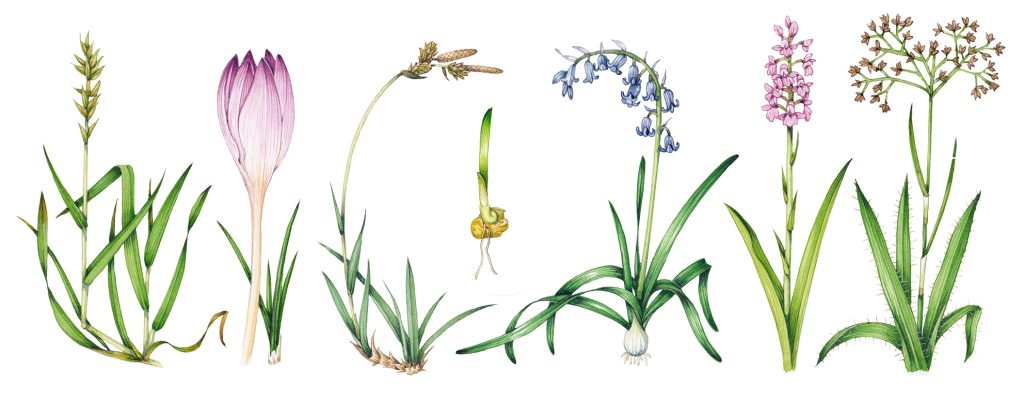
Monocot plant variety with seedling in centre
Bluebell Hyacinthoides non-scripta
The native Bluebell can grow up to 30cm tall.
It has glossy green strap-like leaves which are 7 – 15mm wide, with a pointed tip. They can be 45cm long and there tend to be 3 to 6 leaves per plant. These start erect, but may flop and twist as the plant grows.
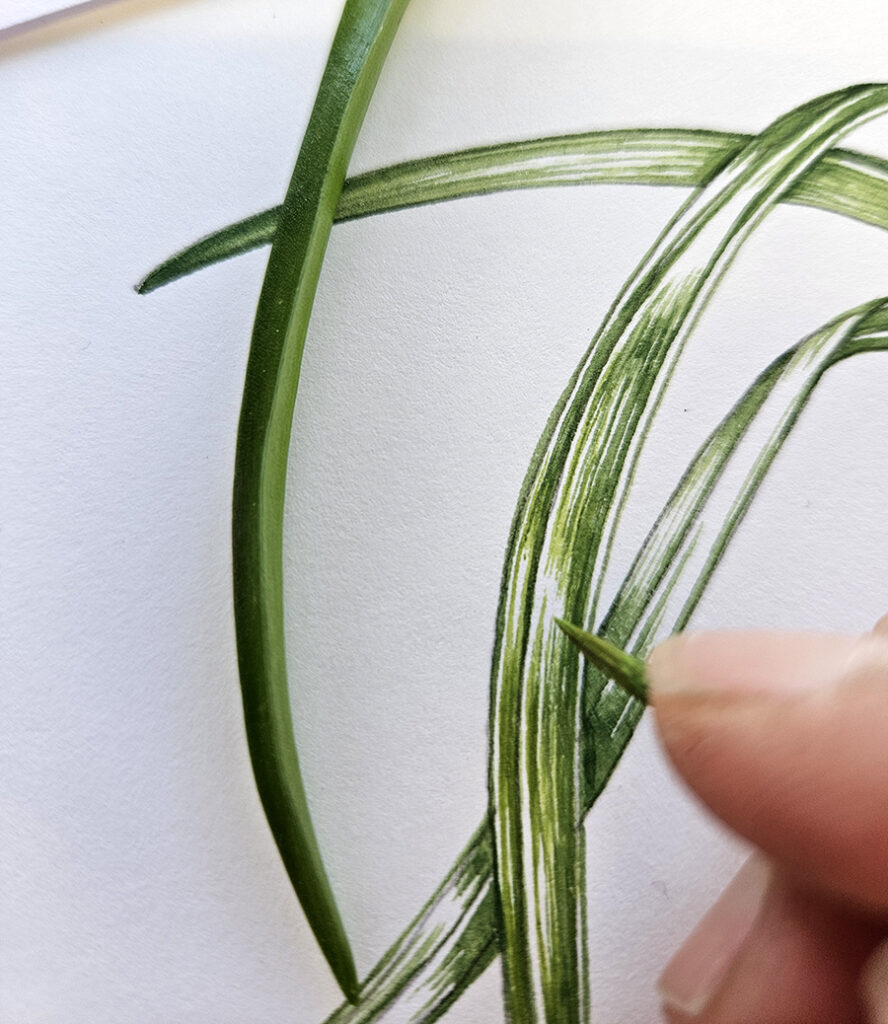
Illustrating a Bluebell leaf
The flowers are all on one side of the stalk, which often curves and droops at the top. When mature, individual flowers dangle; as buds they can be more erect, often flushed with green.
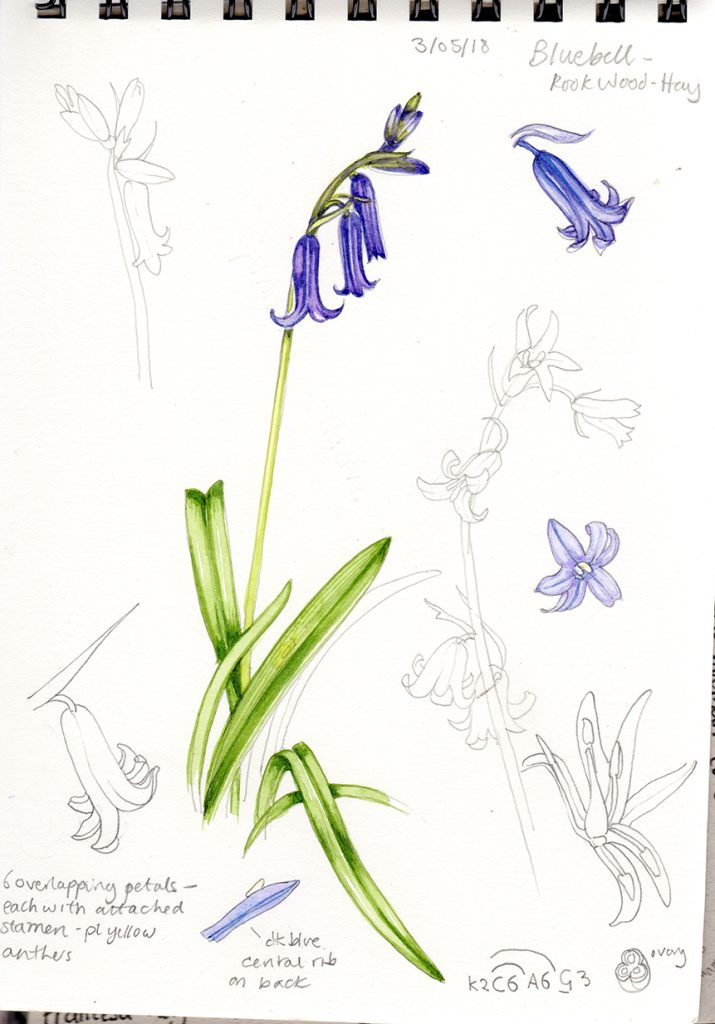
Sketchbook study of Bluebell flowers
The flower shape is bell-like, but with parallel sides, and only opening at the mouth of the flower. Each flower has 6 tepals, and tepal tips are strongly recurved which gives the plants that distinct frilly appearance. They tend to be a deeper, darker blue than other Bluebell species.
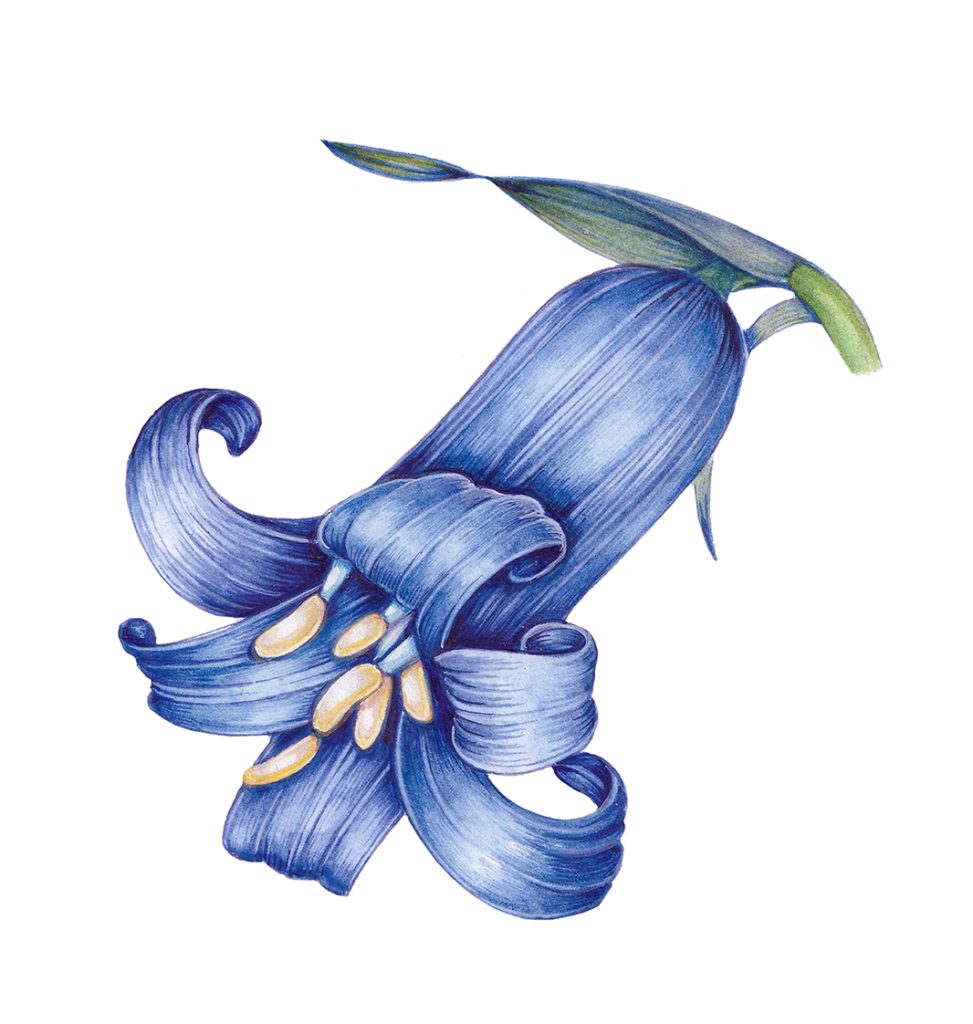
Bluebell flower Hyancinthoides non-scripta
Anthers and the pollen they produce is a pale cream.
This matters because there are other species of Bluebell which can be confusingly similar.
Spanish Bluebell Hyacinthoides hispanica
The Spanish bluebell has flowers that grow all around the stem, and which point upwards. They are often a far paler blue than H. non-scripta. At maturity they gape with a much wider mouth than the native species. Anthers are dark blue. Leaves are significantly wider, up to 35mm across.
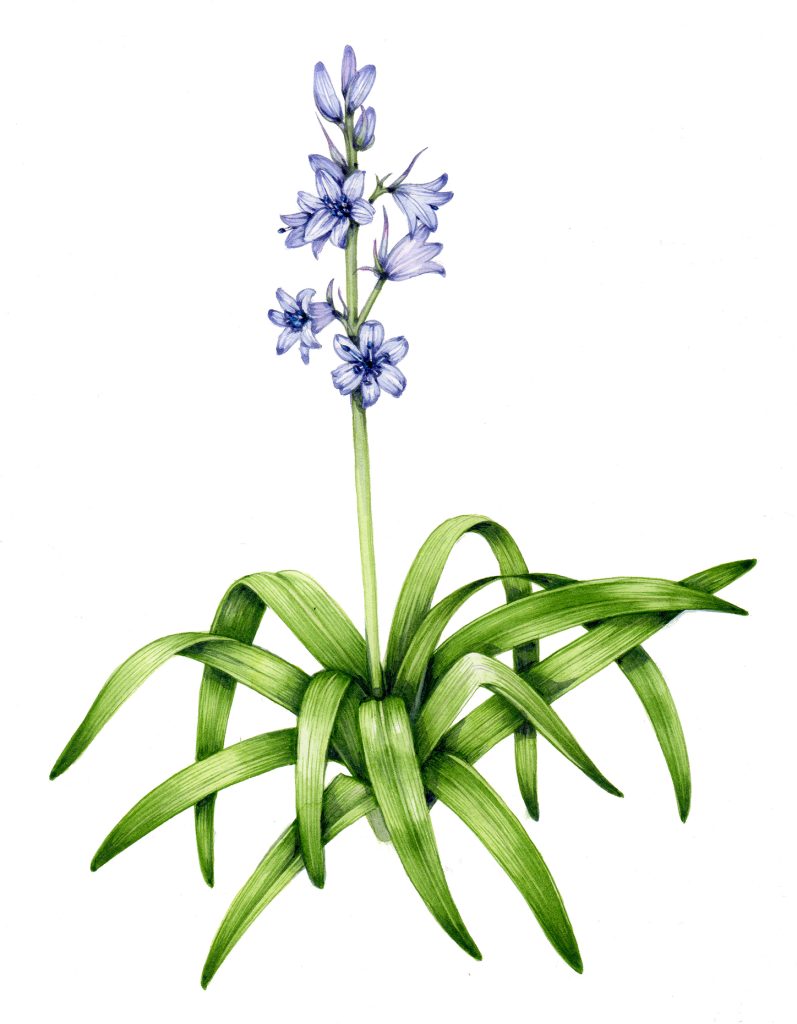
Spanish bluebell Hyacinthoides hispanica
Hybrid Bluebell Hyacinthoides x massartiana
Recently botanists have come to the conclusion that most flowers sold, and grown in gardens, are not Spanish Bluebell at all, but various hybrids. This is because there is so much H. non-scripta pollen in the air that cross-fertilization, and back cross-breeding is almost inevitable. (Cumbria Botany – Telling Bluebells apart)
Hybrid Bluebells have erect stems with flowers growing all around them. The mature flowers may droop, but don’t dangle vertically down as with H. non-scripta.
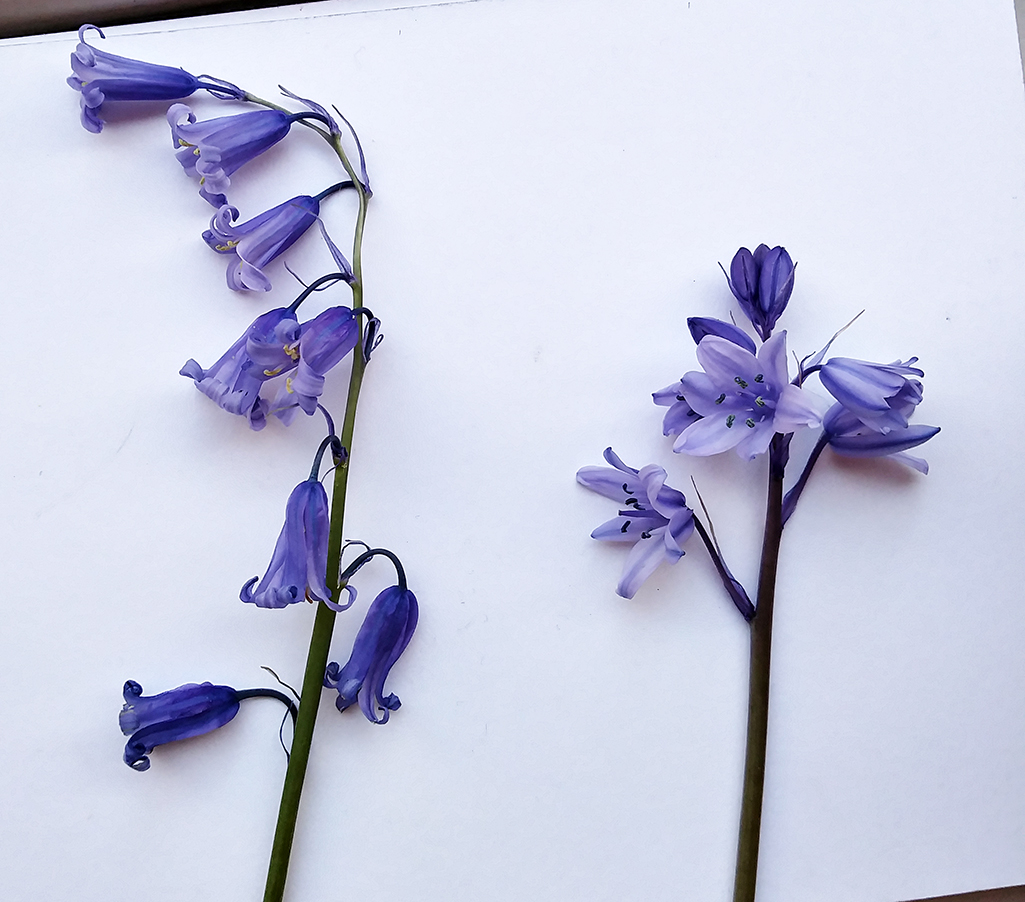
Flowering spikes of native Bluebell H. non-scripta vs the Hybrid Bluebell H. x massartiana
The mouth opens wider than the native species, but less wide than H. hispanica. Tepal tips don’t curve back on themselves as much as with H. non-scripta, and anthers and pollen vary in colour from blue to dark grey, to a dirty pale yellow. The flowers have a far weaker scent than the native Bluebell.
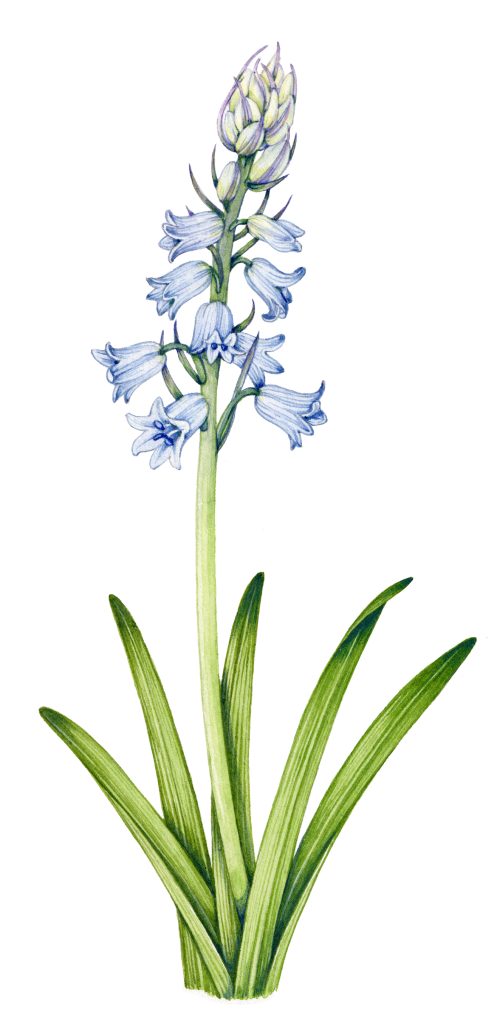
Hybrid bluebell Hyacinthoides x massartiana
For more on this, check out these useful guides to telling Bluebell species apart: Webidguides, and Cumbria Botany. My Telling bluebell species apart blog, may be useful, although readers should substitute “Hybrid Bluebell” for “Spanish Bluebell”.
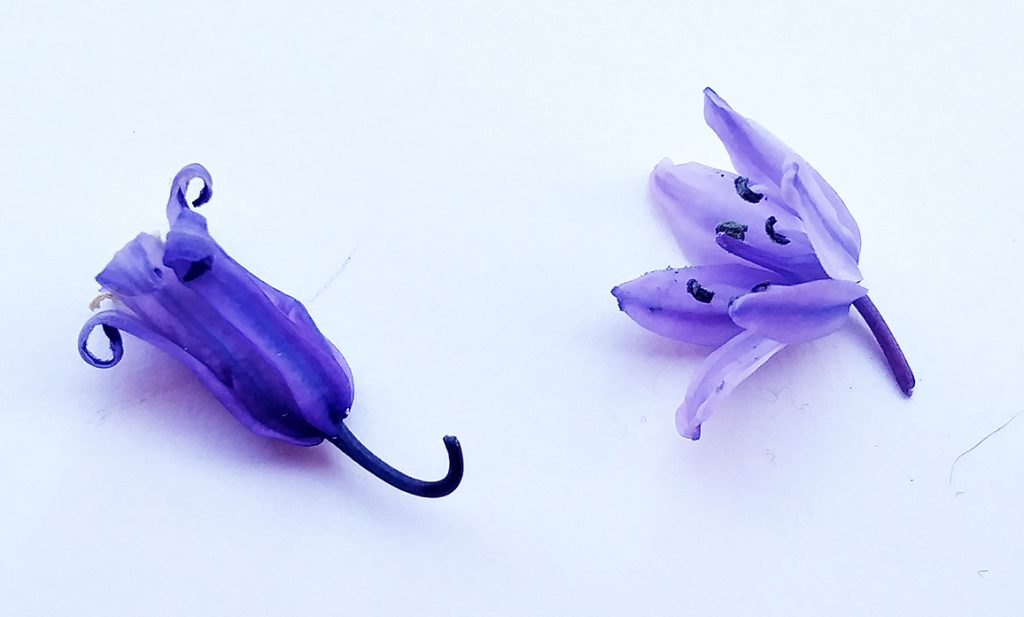
Flowers of H. non-scripta and H. x massartiana
Other names for Bluebells
Bluebells and Bluebell woods have been a part of the landscape in Britain for hundreds, or thousands of years. They have a vast array of alternative names including English harebell, Wild hyacinth, Cuckoo’s boots, Granfer griggles, Witches’ thimbles, Lady’s nightcap, Fairy flower, and Cra’tae (Crow’s toe). In Welsh, it’s Clychau’r Gog which translates as “Cuckoo’s bells” and references the fact that Bluebell flower around the same time that the first cuckoos come in from over-wintering in Africa. (It’s important to note that the true Harebell Campanula rotundiflora is in a totally different family, it’s not even a monocot!)
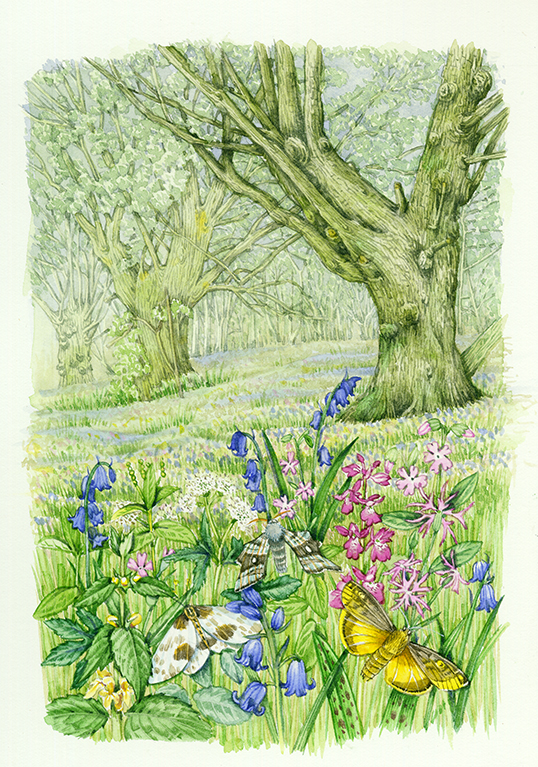
Ancient oak woodland with Bluebells
Folklore of Bluebells
These flowers have long been associated with fairies and folk lore. It’s said that if you pick a Bluebell flower the fairies will lead you astray, and you will be lost forever. If you hear a bluebell ring, a bad fairy will visit you and you’ll die soon after.

Native Bluebell H. non-scripta
On a happier note, in the language of flowers they represent humility, gratitude, and constant love. If you can turn a Bluebell flower inside out without it tearing, you will capture the heart of your one true love.
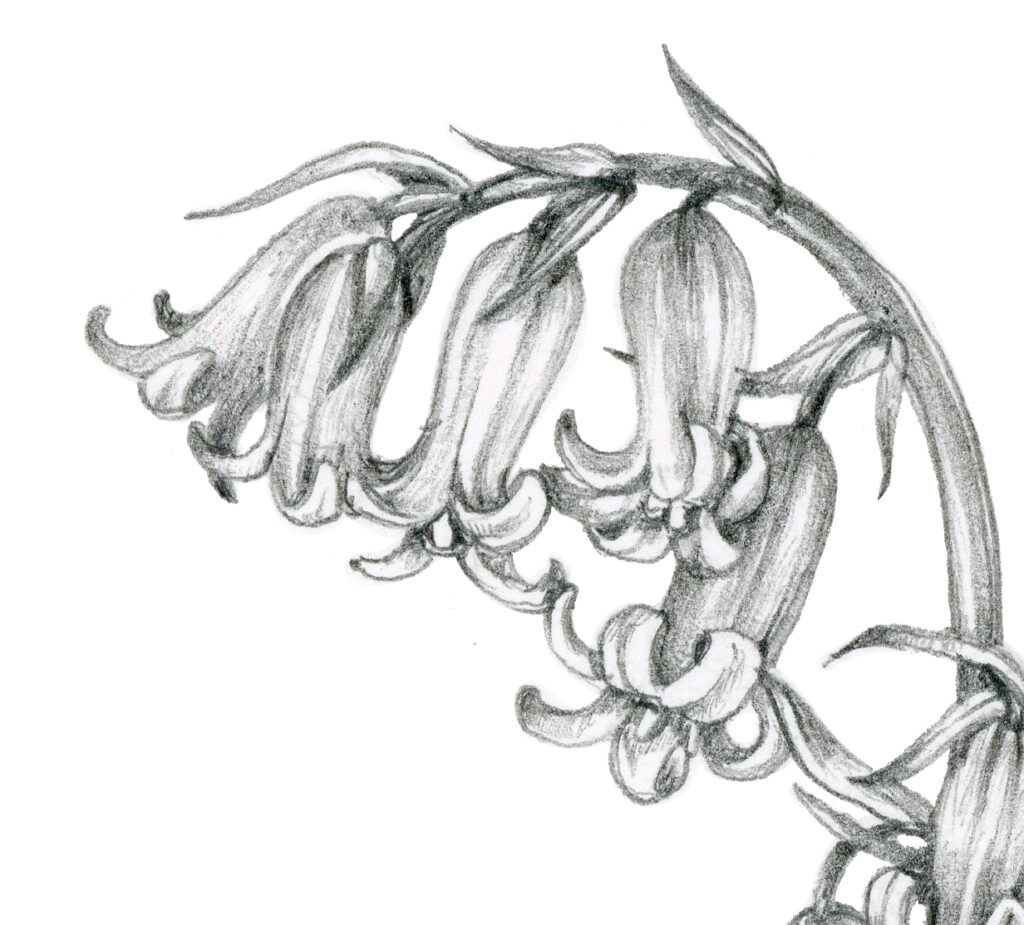
Bluebell Hyacinthoides non-scripta in pencil
Finally, if you wear a wreath made of bluebells, you will be unable to lie. Worth remembering. (All these folklore facts come from the Woodland Trust’s website.)
Uses of Bluebell
Bluebells have been put to some unusual uses over the years. In the Bronze age, arrow flights made of feather were glued on with Bluebell paste. Bookbinders used glue made from Bluebell stems.
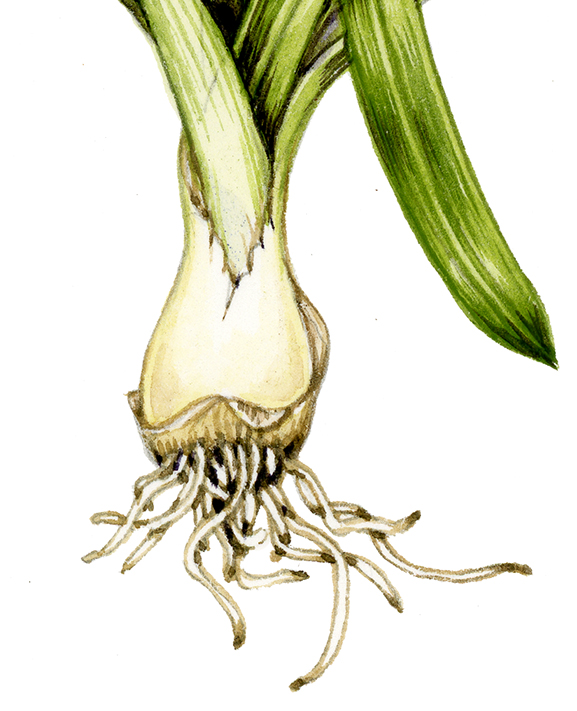
Starch-rich Bluebell bulb
Elizabethan times saw enormous ruffs and collars which had to be starched. Bluebell bulbs did the job perfectly.
Although Bluebells contain poisonous glycosides and can cause contact dermatitis, they have been used medicinally in the past. They are diuretics, causing an increase in urination; and styptics too. Styptics stop bleeding.
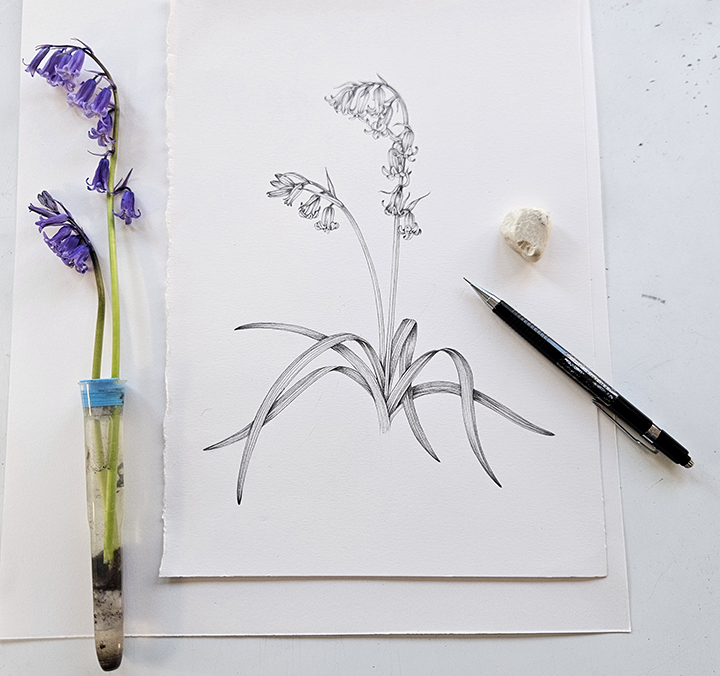
Pencil illustration of native Bluebell with specimen
The perfume industry sells perfumes claiming to be Bluebell scented, but the fragrance has proved too delicate and complex to reproduce commercially. Bluebell perfumes are derived from their cousin, the hyacinth. (Premierpeu).
Bluebells and the law
When you walk through a woodland in April or May, it seems extraordinary that Bluebells need our protection. But they do.
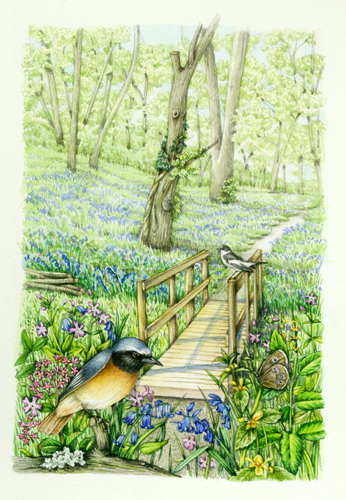
Bluebell wood with Redstart
Since the 1981 Wildlife and Countryside act, it has been illegal to dig up any bluebell bulbs in the UK. It is also illegal to trade in H. non-scripta seeds and bulbs. Although not against the law, it’s unnecessary and destructive to pick hand-fulls of the flowers. Not only does this deprive insects like butterflies, bees and hoverflies from early spring sources of nectar, it also damages the leaves. Once trampled, leaves struggle to recover and can no longer photosynthesize. So tread with care!
Bluebells as indicators
The Bluebell is an indicator species, growing in areas which were once ancient woodland. If you see native Bluebells growing in a field or by the side of a road, it’s proof that the area was once wooded with broadleaf species like Ash, Oak, Beech, and Birch. They thrive in woodland over 400 years old, and are invaluable for ecologists trying to map habitats, and habitat loss.
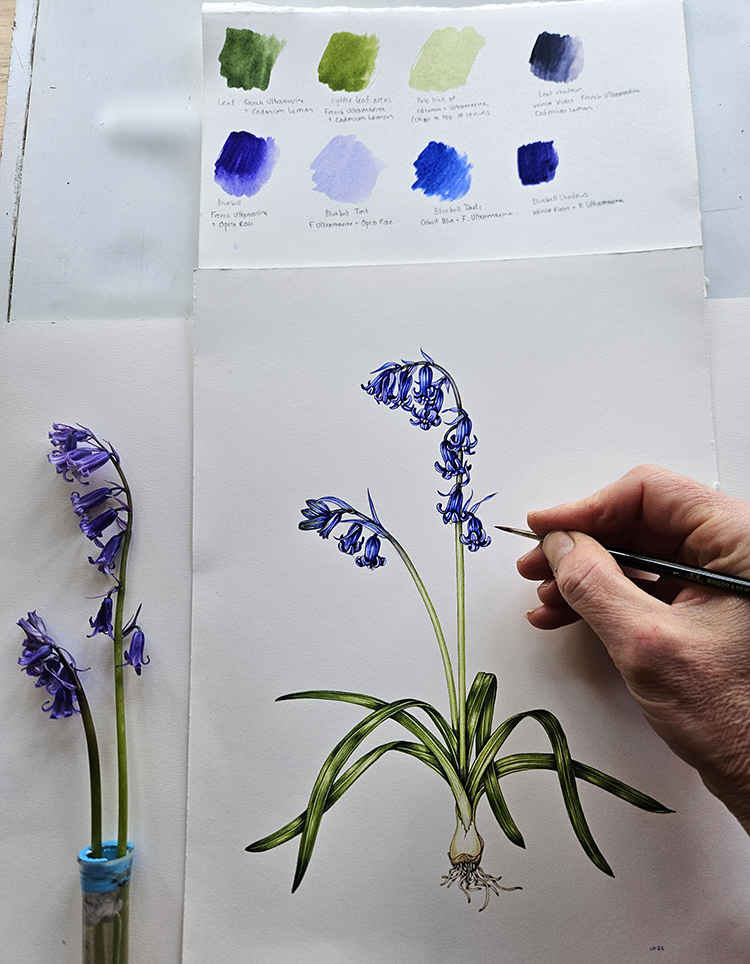
Illustrating a Bluebell (bulb illustrated from 18th C engraving)
Kew gardens has been tracking the first opening of a Bluebell flower for 50 years, and use this data to help understand climate change. Bluebells are opening 2 weeks earlier than they did 30 years ago.
Conclusion
Despite threats of habitat loss, climate change, and hybridization; Bluebells remain a firm fixture of the British countryside. With over 50% of all native Bluebells growing in the UK, Bluebell woods are a visual treat to savour, and be proud of.
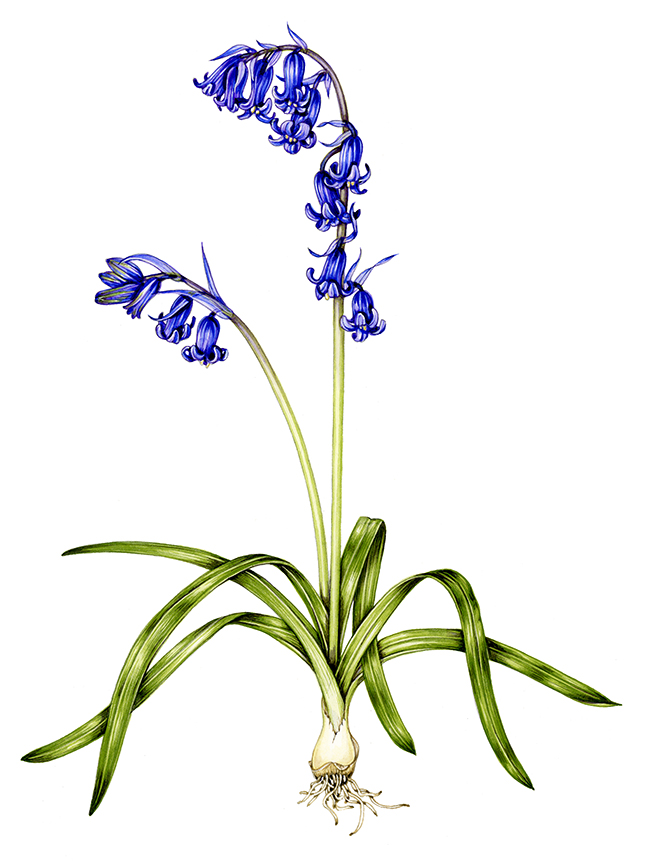
Bluebell Hyacinthoides non-scripta
