




Wonderful Waxcaps

Waxcaps are grassland fungi, although they also grow in forests in the Americas and Australasia. Over 50 species have been recorded in the UK, most producing fruiting bodies in the autumn. Not only are they easy to spot, like jewels in the turf, but they are also incredibly beautiful. I wrote a blog on fungi before, many years ago, but one on a specific genus of fungi is new.
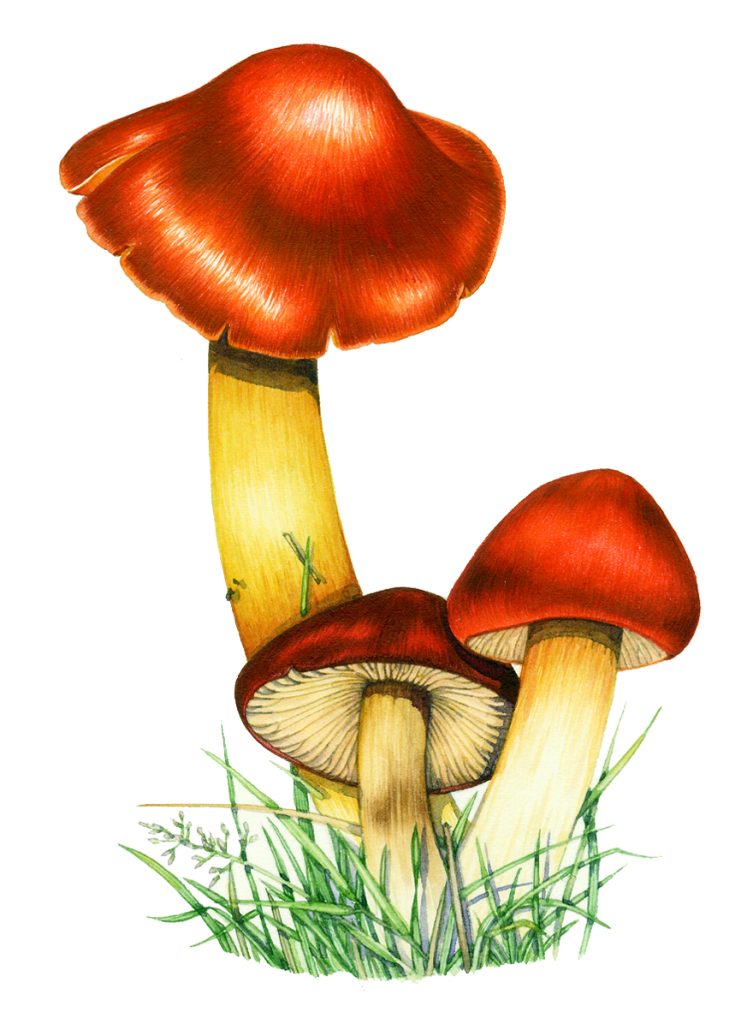
Crimson waxcap Hygrocybe punicea
What’s in a name?
The Latin name for waxcap is Hygrocybe. This is from the Greek hygros = water, and cybe = head. It’s a good description as they often have distinctly wet, shiny, or slimy caps.
Features of waxcaps
Although they come in a wide array of colours, as they age waxcaps often become a faded buff colour. Many species start with sharply convex caps, but these frequently flatten at maturity. Splitting of the caps is common place.
Their caps are sticky, satin-like, shiny, or dry. Waxcaps absorb water, allowing them to retain these textures even when it’s not rainy or damp.
Gills are waxy and often brittle, they are quite widely spaced, and some are decurrent, blending down the stipe (stem). There are inter-connecting cross gills in some species. All waxcaps produce white spores.
Waxcap nutrition
Some species of waxcap are detritivores, feeding off dead matter. Others get nutrients from dung. Lots have mutually beneficial mycorrhizal relationships with the plants that grow with them. These vary from species to species. Recent research suggests a possible relationship between the common Springy turf-moss Rhytidiadelphus squarrosus and waxcaps. I’d not considered a moss – fungi relationship before, it’s interesting.

Meadow waxcap Cuphophyllus pratensis
Ecology and waxcaps
The numbers of waxcap species present is used to help classify the importance of grassland sites (Rald’s system 1985). If there are 4 – 8 species it’s locally important, 9 – 16 makes it regionally important, 17 – 21 gives it national importance, and a grassland supporting 22 or more waxcap species is internationally important. In the Lower Wye Valley, near my home, many fields have 17 or more waxcap species growing.
Grassland fungi often fall into a category called CHEGD. As Penny Anderson of ERHC SIG explains, “this stands for the key fungi groups involved: spindles, club and coral fungi (Clavarioids), the waxcaps Hygrocybe genus (although recent DNA investigations have split up the genus), pinkgills (Entoloma), earthtongues (Geoglossum and relatives), and crazed caps (Dermoloma and relatives).”
And it’s true, numerous waxcaps of different species do all grown in close proximity to each other.
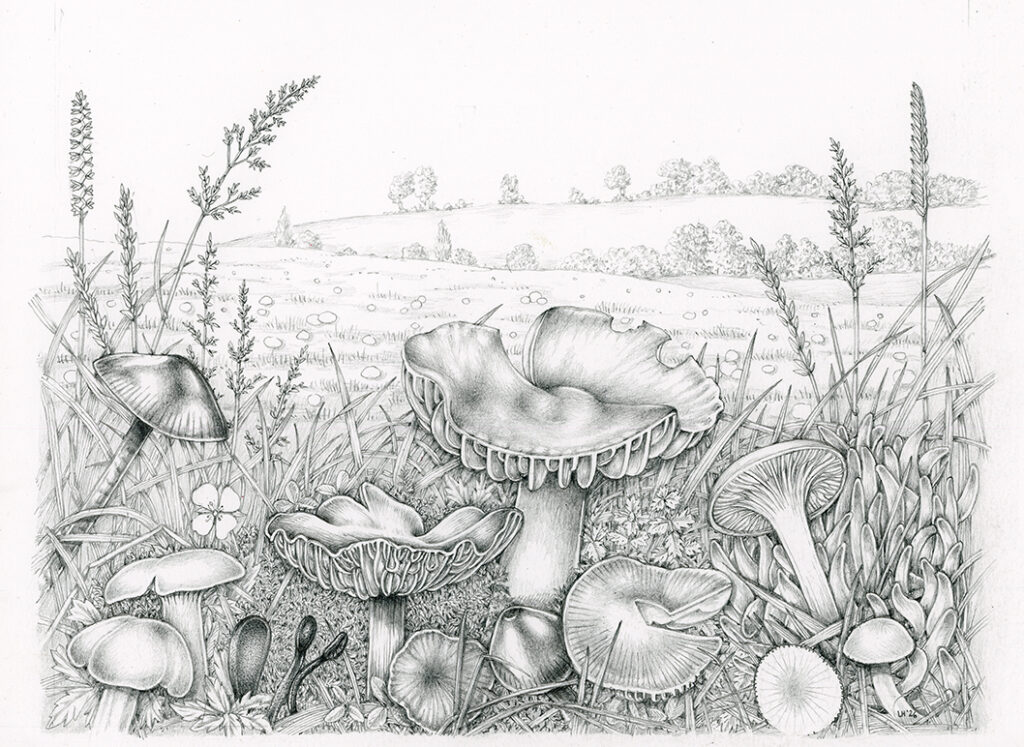
Waxcaps in grassland meadow
In my pencil illustrations above, species shown include Parrot, Meadow, Scarlet, and Ivory waxcaps. Other fungi from the CHEGD group also appear; Earth tongue and Smoky spindles.
Some common waxcap species: Meadow waxcap
The commonest species is the Meadow waxcap. It has a large buff cap with an orangey centre, which can grow to 10 cm across. Texture is smooth and dry. It starts convex but flattens out at maturity. The stem is white, and thick for a waxcap. Gills are decurrent.

Meadow waxcap Cuphophyllus pratensis
Some common waxcap species: Scarlet waxcap
Scarlet waxcaps Hygrocybe coccinea, are striking, bright red against the turf. Their caps are a little greasy, drying out with age. They’re vivid red, often with yellowing margins. The colour frequently fades and becomes patchy with age. Caps start convex but flatten out. An umbo (like a central pimple) may be present.
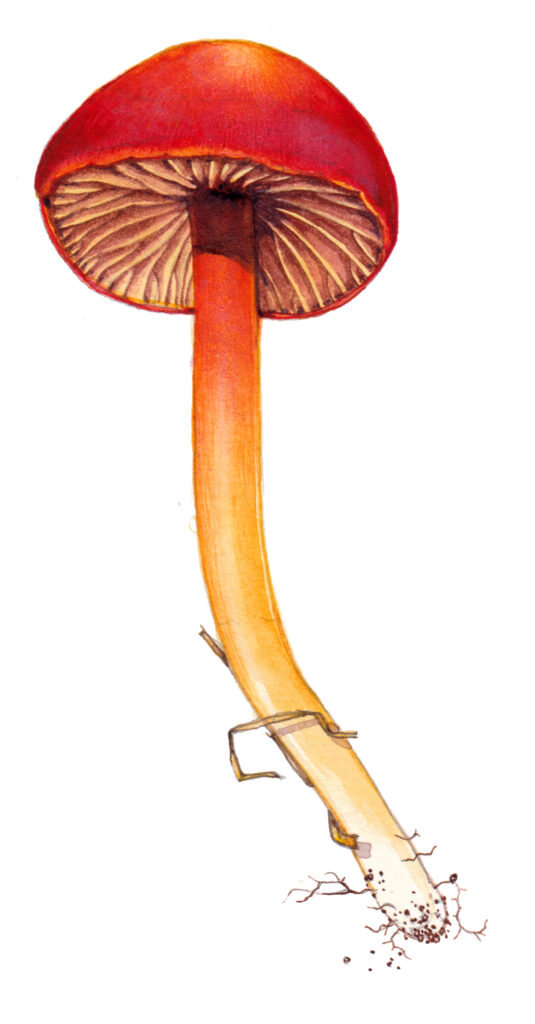
Young Scarlet waxcap Hygrocybe coccinea
The stipe is scarlet, fading to yellow or cream at the base.
Gills are wide-spaced and broadly attached. They are red with yellow margins, but like all waxcaps produce white spores. There are intermediate gills present.
Some Common waxcap species: Crimson waxcap
Crimson waxcap Hygrocybe punicea is similar to the Scarlet waxcap. However, it has larger fruiting bodies and is more fleshy than its cousin. It tends to be a deep crimson, rather than bright scarlet, and the stipe has a white base.
They grow in groups or rings, each cap measuring up to 12cm across. The texture is leathery, sometimes a touch slippery when it rains. They are, as the name suggests, crimson. This colour fades over time, becoming patchy and ending up a pale yellow colour. Cap margins may remain pink or red. Cap shape starts convex, then flattens, and often has upturned margins at maturity.
The stipe is stout and orange, fading to white near the base.
Gills are waxy, and widely spaced. They are yellow, and occasionally have a red or pink tinge.
Crimson waxcap Hygrocybe punicea
Some Common waxcap species: Pink waxcap
This species is the only truly pink British waxcap. It’s also called the Pink Ballerina.
Unlike the other waxcaps mentioned, the cap starts conical and opens out like an umbrella. It tends not to become flat. The margins are irregular and wavy, and splitting is common. It’s a dusty pink or pink tinged apricot with a darker centre, and fades to pale pink with age. Unlike many waxcaps, it’s only slimy right after rain, and even then only a little tacky.
The stipe is white and cylindrical.
Gills are pink or white. They’re thin and waxy, and in a distant arrangement.
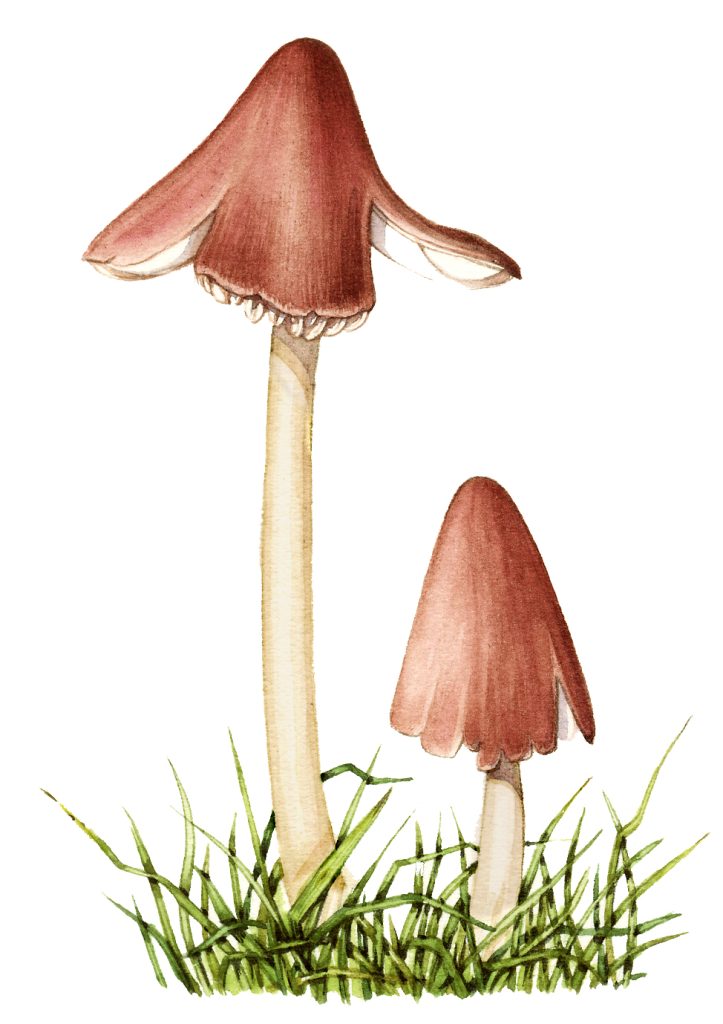
Pink Meadow Waxcap Porpolomopsis calyptriformis
Other waxcaps of note
In illustrations I’ve completed of groups of waxcaps, a favourite is the Parrot waxcap Gliophorus psittacinus. This fungi is very slimy, and glistens. The shine makes it fun to illustrate. It is green when young, laid over a yellow or pinkish colour. The green fades in sunlight, and with age. Cap edges are often clearly striated.
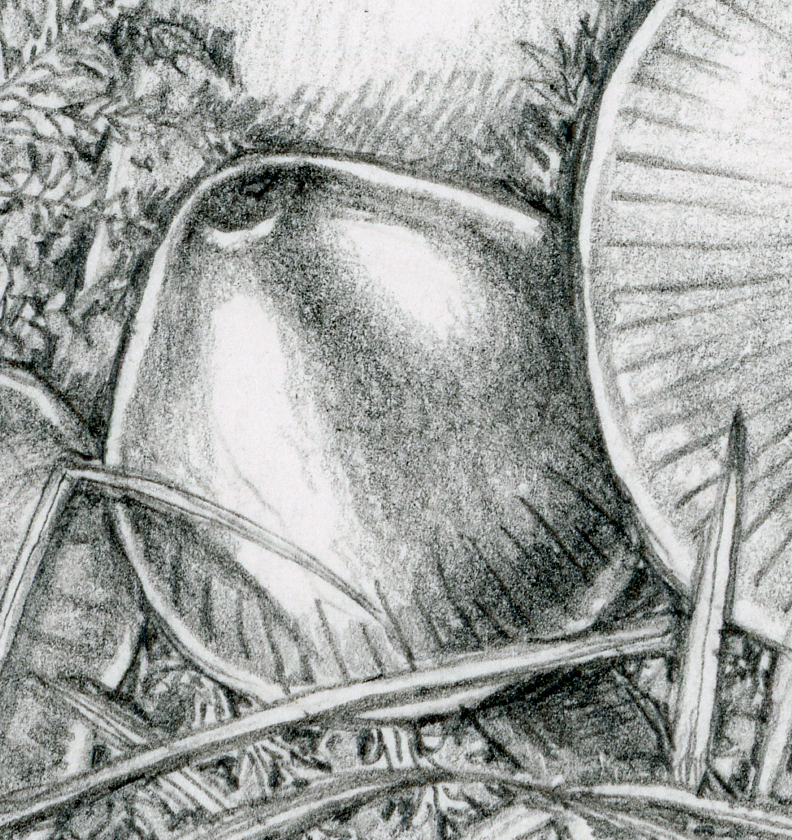
Detail of a young Parrot waxcap
The Snowy waxcap Cuphophyllus virgineus mostly grows in association with Ribwort plantain, Plantago lanceolata. It’s small and elegant, with white caps and decurrent gills. Older fruiting bodies often have concave caps, which showcase the gills beautifully.
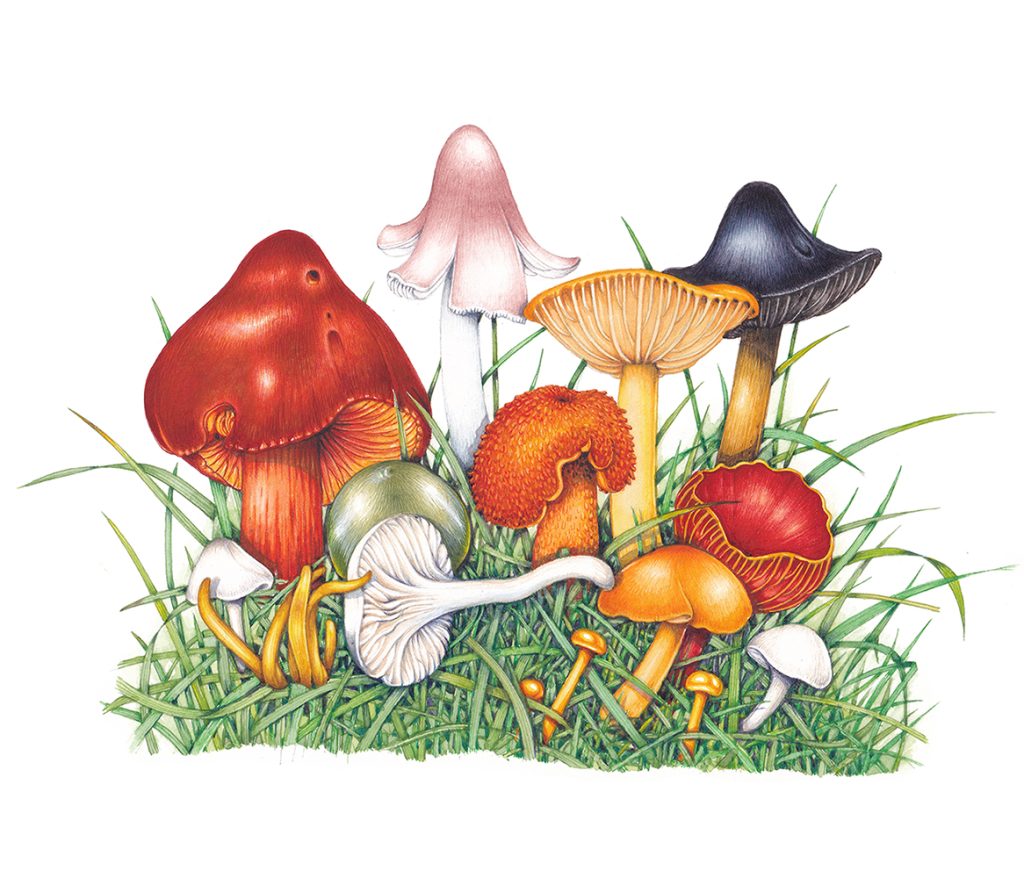
Ivory waxcap, picked, at the front of the illustration. Parrot waxcap (green) behind it.
Threats to waxcaps
Waxcaps are threatened by changes to their habitats. These come from climate change, animals no longer grazing the grassland, manure and fertilizers being added, and development. In unimproved grasslands they continue to thrive.
Conclusion
I hope this whistle-stop tour has whetted your appetite, and inspired you to go out foraging for waxcaps in the autumn. They truly are a stunning genus, and well worth spending time examining, sketching, and painting.
References include Naturespot, The Botanic garden of Wales, and Grassland Fungi: A Field Guide by Elsa Wood and Jon Dunkelman.
