




Wildflower families: Apiaceae
Wildflower families: Apiaceae, the Carrot family is my latest blog in this series on common flower families. I was inspired to write this series by my online Field Studies Council course. I spend a lot of time drawing wildflowers, so it’s important for me to learn more about their family similarities and differences.
As a background, you may want to look for explanations of terms used on my the basics of botany blog, and fruit types. What’s in a name 1 and part 2 discuss how Latin names work and why they matter. Some of the other families I’ve examined include the Ranunulaceae (Buttercups), Caryophyllaceae (Campions), Rosaceae (Roses), Fabaceae (Peas), Brassicaceae (Cabbages), with Asteraceae (Daisies), Orchidaceae (Orchids) and Lamiaceae (Dead-nettles) yet to come over the coming months.
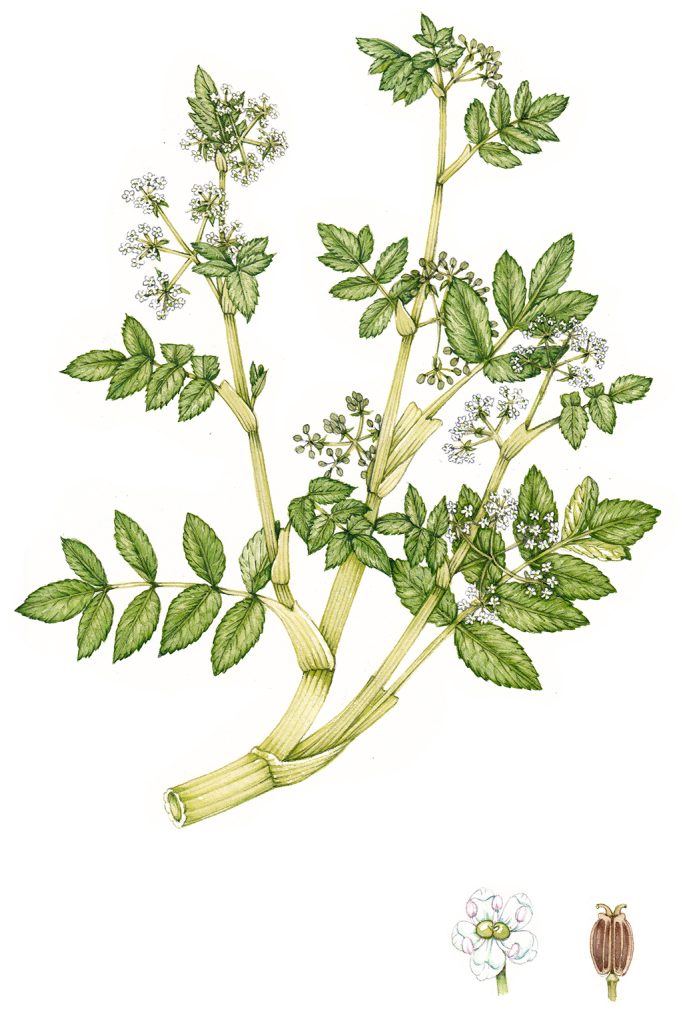
Fool’s water-cress Apium nodiflorum
I am not a trained botanist, but a botanical illustrator and keen amateur. So if you see a mistake, please let me know, thanks.
Wildflower families: Apiaceae
The Carrot family has 420 genera and over 3,100 species. The flowers are held in distinctive inflorescences called umbels, are small, and have curved petals. Leaves are deeply divided and sheath the stem (which is often hollow). Fruit are a 2 celled schizocarp. As well as Cow parsley, Apiaceae contain lots of herbs like parsley, chervil, dill, fennel, cumin and coriander. Celery is also a member of the Carrot family. Decorative garden plants include showy Eryngium.
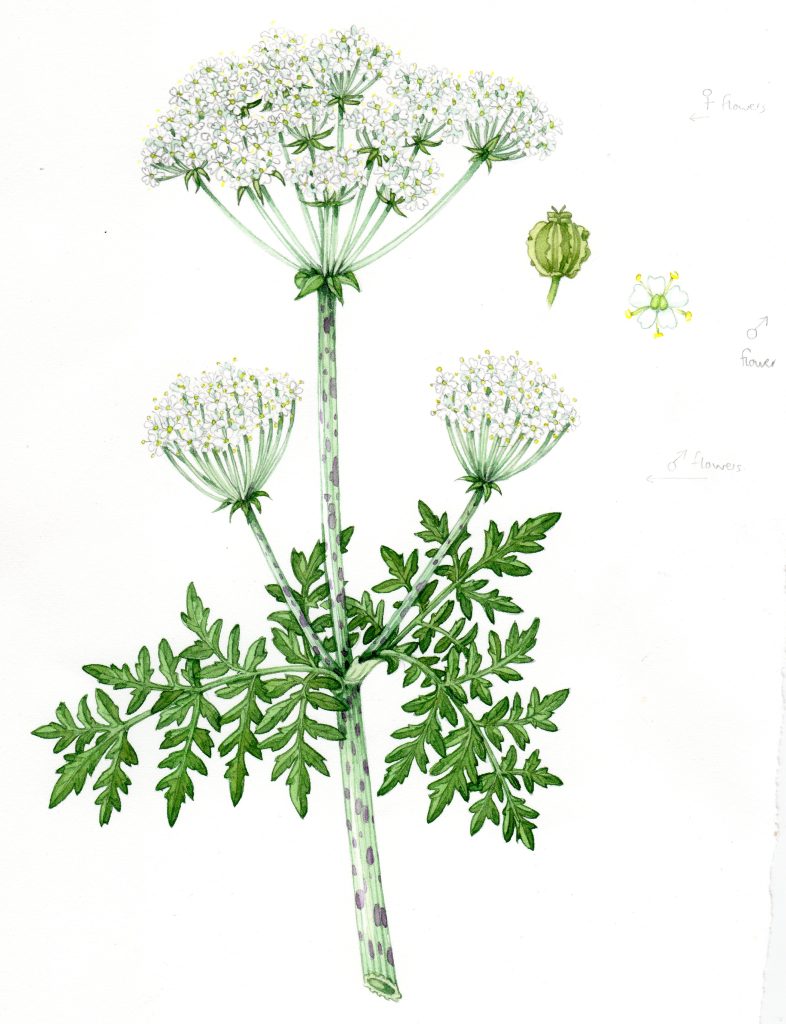
Hemlock Conium maculatum
Economically, carrots and parsnips are vital crops, with the tap root being the edible part. There are loads of wildflowers in this family, in the UK hedgerows are frothy and white with Cow parsley in early summer. I dedicated a blog and a step by step youtube film to cow parsley, such a beautiful wildflowere. Pignut grows in woodland, sanicle and wild angelica are common, and giant hogweed (an invasive – for more on this take a look at my blog) is easy to spot.
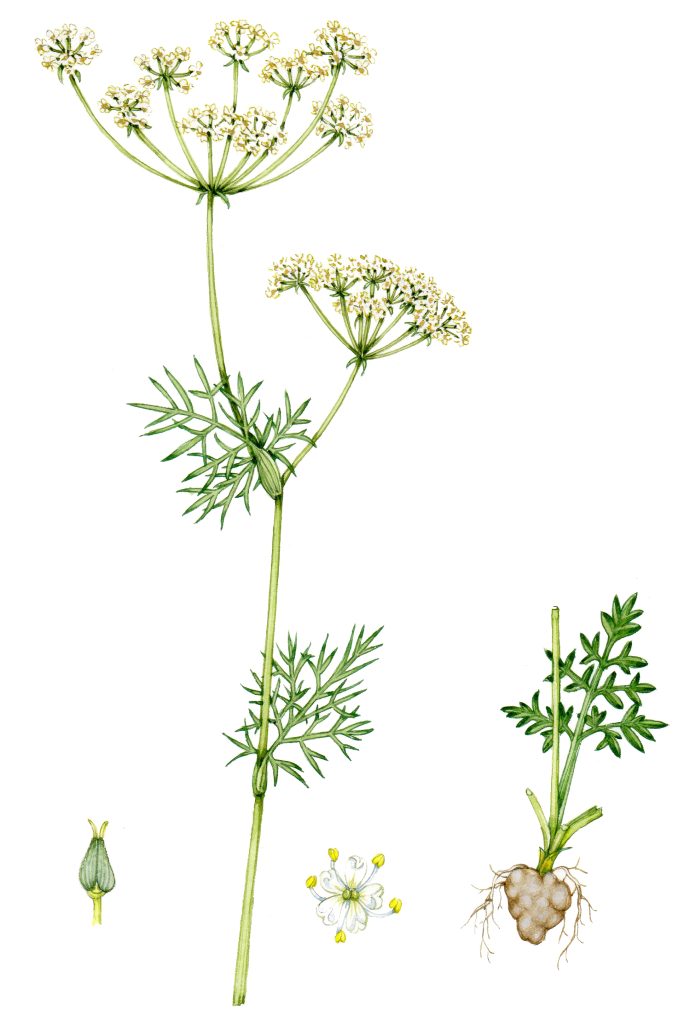
Poisonous plants like Hemlock and Water dropwort are members this family, and the sap of some other species (like the hogweeds) can cause skin irritations, especially when exposed to sunlight.
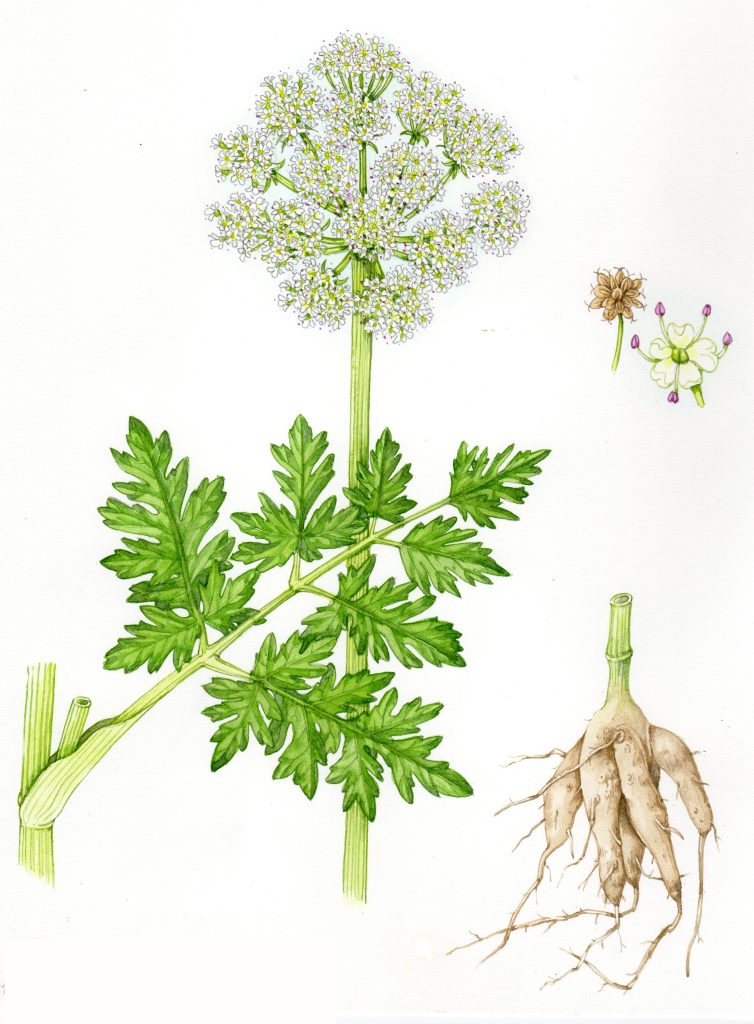
The poisonous Hemlock Water dropwort Oenanthe crocata
Apiaceae overview
Plants in this family have alternate leaves with wide bases that enclose the stem. Leaves are mostly divided, often sub-divided several times (these divisions are known as being Pinnate). This makes them look feathery and fern-like. The Marsh pennywort and Sea holly, however, have non-divided leaves.
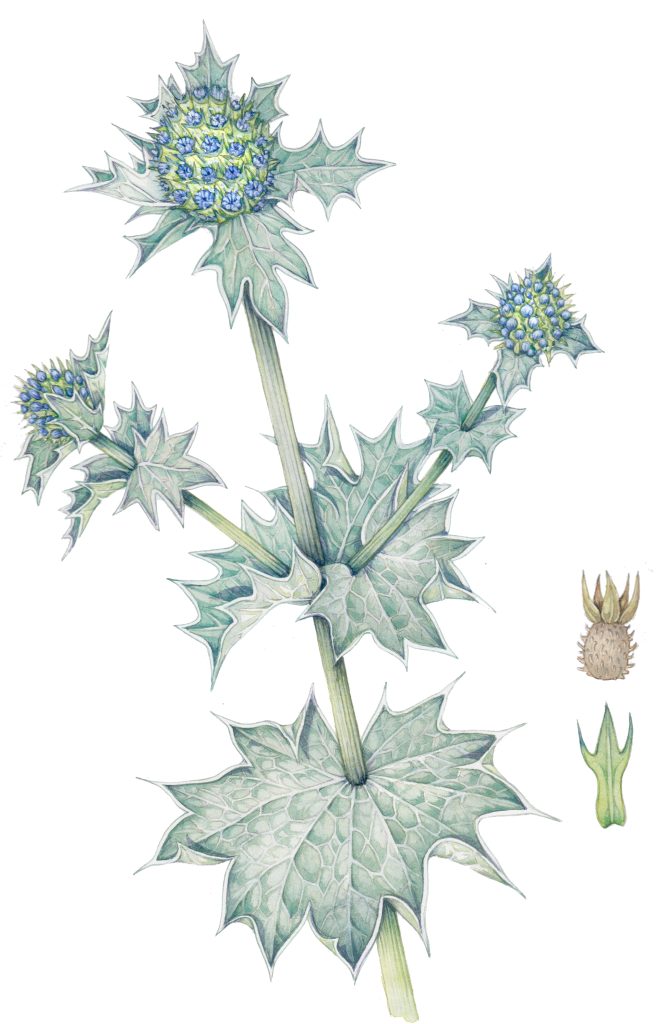
Sea holly Eryngium maritimum
Flowers have five petals. They are borne in compound inflorescences known as umbels, which look a bit like umbrellas, and the umbels may be further branched. The schizocarp is a 2-celled dry fruit, vital for identifying an Apiaceae to species level.
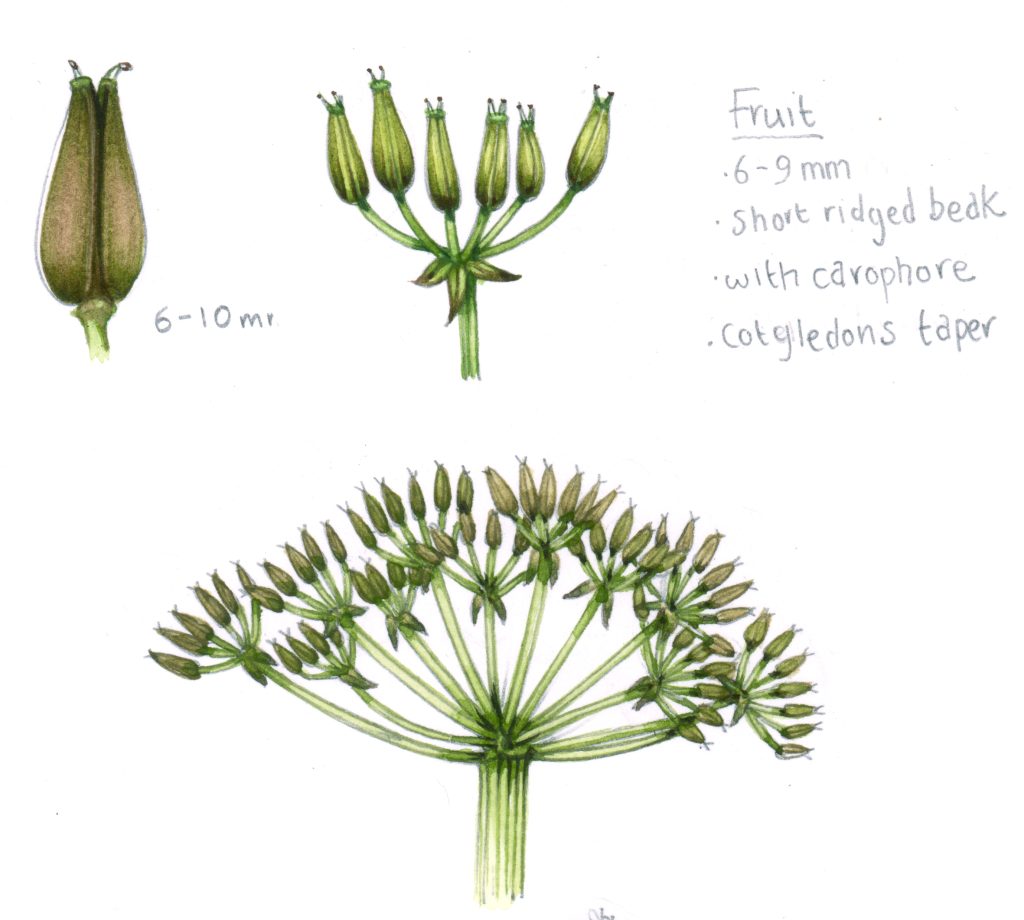
Cow parsley Anthriscus sylvestris fruit
The name Apiaceae is based on the term Apium, coined by Pliny the Elder around 50AD, referring to celery-like plants. This family used to be called the Umbelliferae, referencing the inflorescence shape.

Cow parsley Anthriscus sylvestris sketchbook study sheet
This family can be very tricky to key out to species as many look superficially similar. Characteristics of the schizocarp including wings, markings, and even scent are frequently needed. The BSBI guide by Tutin is an invaluable aid.
Apiaceae Leaves
Apiaceae leaves are mostly divided and sub-divided. This makes them quite tricky to illustrate. Sometimes the leaves are so divided that they are almost linear, like dill. In other species the pinnate sections are heftier, as with the lower leaves of the Hogweeds. In many species, leaves at the base and higher up the plant are different shapes.
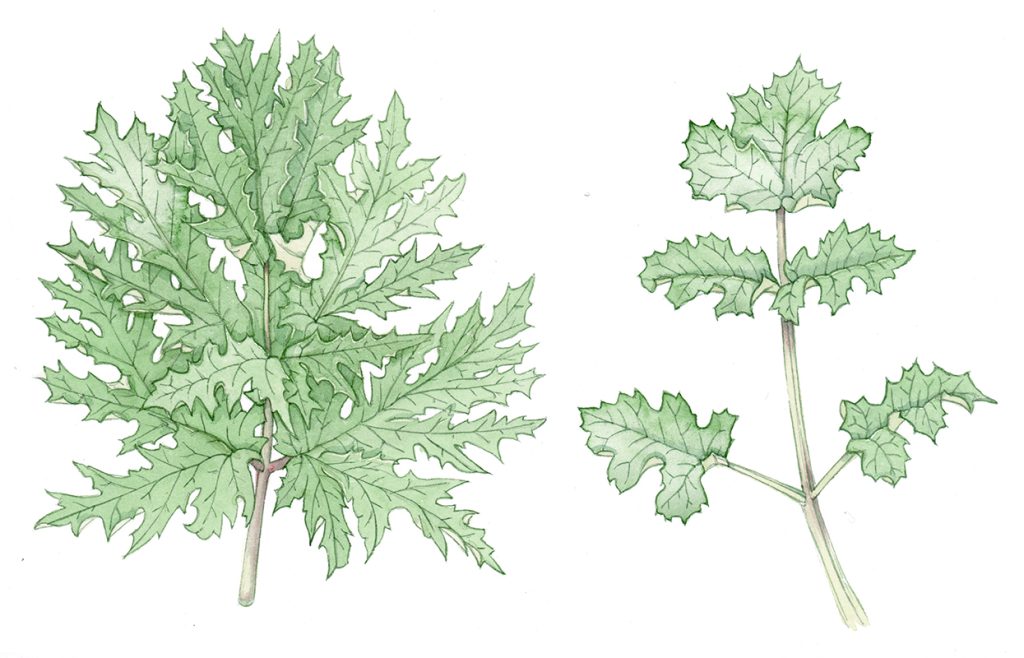
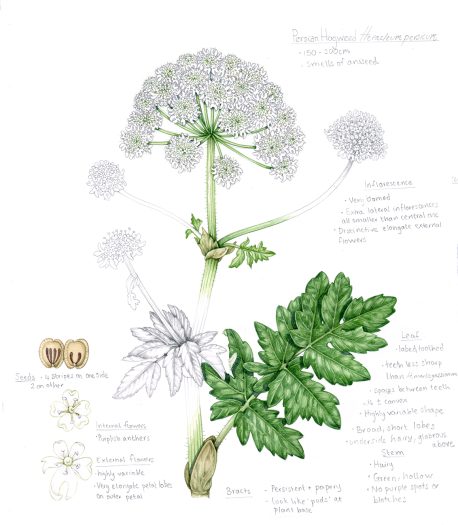
Persian Hogweed Heracelum persicum and Giant Hogweed Heracelum mantegazzianum comparison of lower leaf shape
Carrot family species don’t have stipules (leafy paired processes at the base of a leaf, present in other families like the Roseaceae).
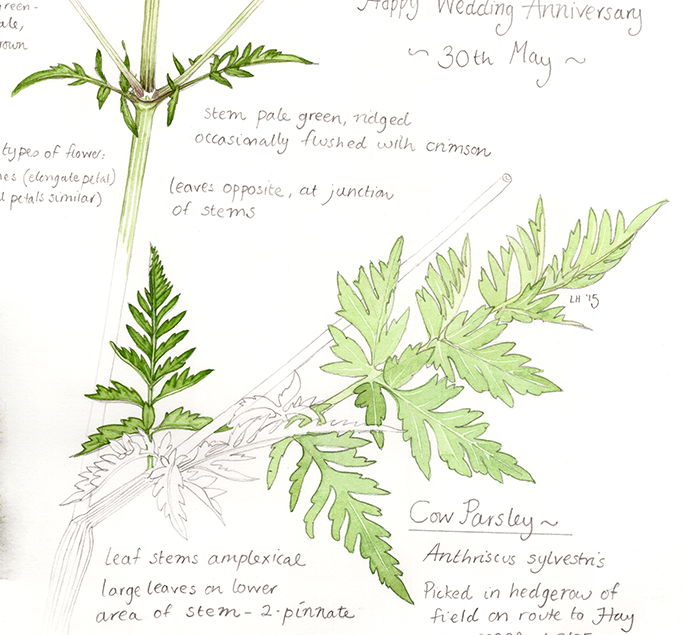
Sketchbook notes on Cow parsley Anthriscus sylvestris leaves
The base of the petiole encases the stem, and is often inflated. It can be flushed red, and some species have spotted leaf bases and stems (Hogweeds). Stems are frequently ridged.
Leaves can be hairy or smooth, and often look pretty similar across species.
Apiaceae Flowers
Firstly, flowers of the Carrot family can be tiny, and are borne on the end of branches which grow from a central stem into umbrella-like umbels. It’s worth seeing how many sub divisions of umbel branch you can spot as this can help identify a species. The shape of the umbel is important, it can be highly domed or almost completely flat.
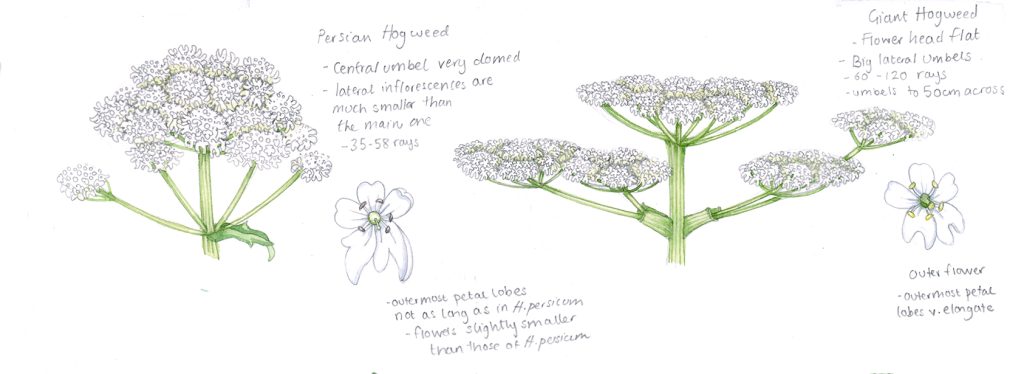
Persian Hogweed Heracelum persicum and Giant Hogweed Heracelum mantegazzianum comparison umbels
Secondly, the flowers have five free petals, which are mostly white. They often curve backward, making each flower a little convex in shape. Parsnip flowers, Dill, and some other Apiaceae are yellow, and you will often see one or two deep purple flower in the middle of an umbel (as with the Sea carrot Daucus carota gummifer).
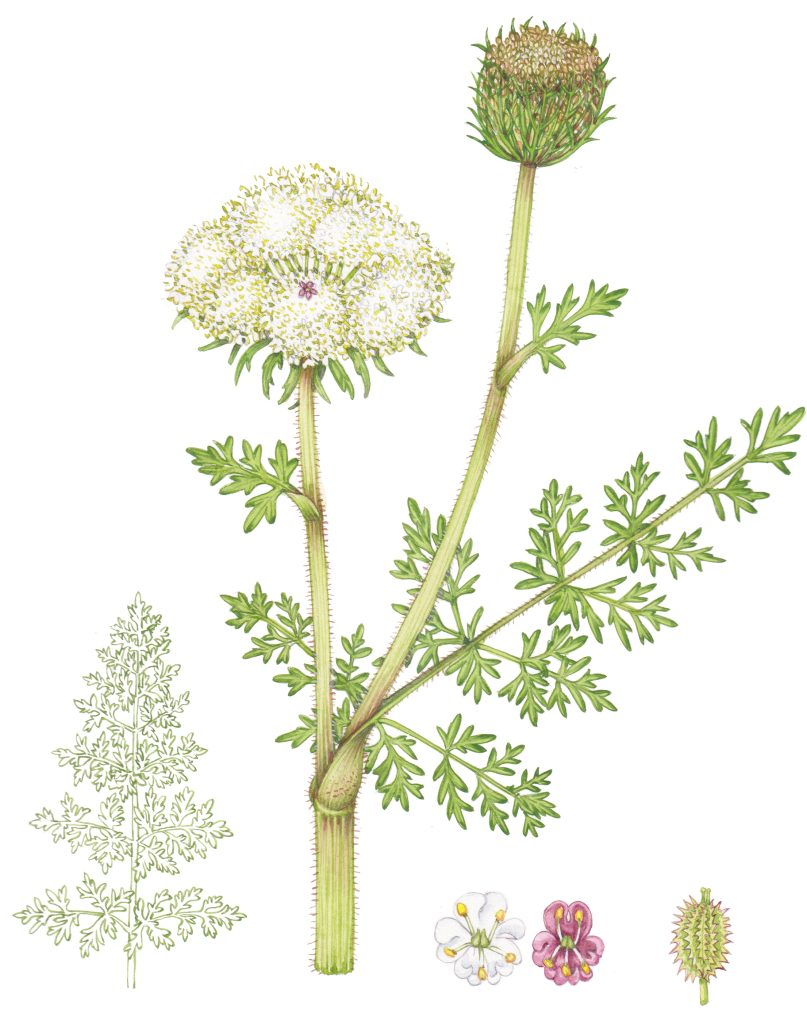
Sea carrot Daucus carota gummifer showing distinctive one or two purple flowers in the centre of an umbel
Thirdly, most of the flowers in an umbel are regular, with radial symmetry. Those on the outside edges are often irregular, with the outermost petals elongate and lobed.
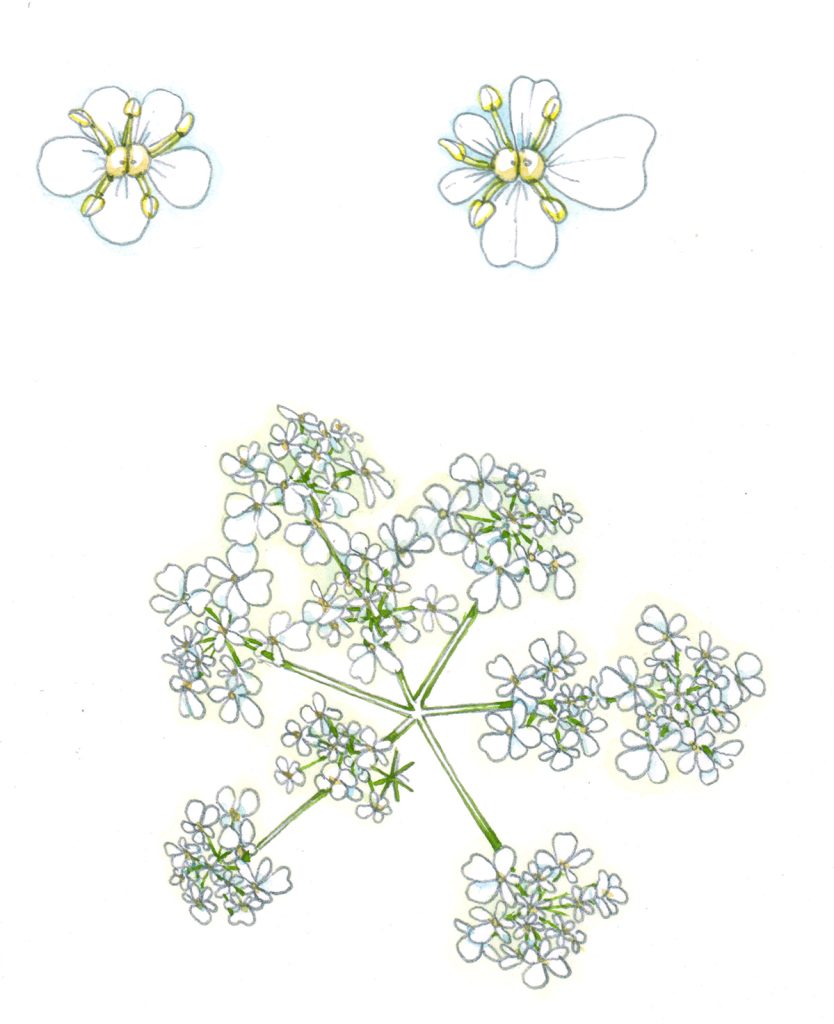
Cow parsley Anthriscus sylvestris showing flowering head from above and inner flowers (on left) and outer ones (on right)
Fourthly, there are five sepals which do not fuse, and flowers have five unfused stamens. These may unfurl at different times, and the anthers point inwards.
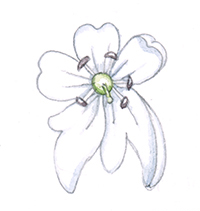
Persian Hogweed Heracelum persicum outer flower
Finally, they have inferior ovaries and two fused carpels.
Apiaceae Fruit
The schizocarp is a two celled dry fruit which splits at maturity into two mericarps and releases tiny seeds.
The schizocarp may have wings, be ridged, or have hooks. Some have structures which make them easy to identify, like the Shepherd’s needle, with its’ long beaks on top of each fruit.

Sheperd’s needle Scandix pecten-veneris showing beaks on fruit
Each mericarp has five ridges, the outermost of which are the seams along which the mericarp splits. There are often oil-canals called vittae between the ridges.
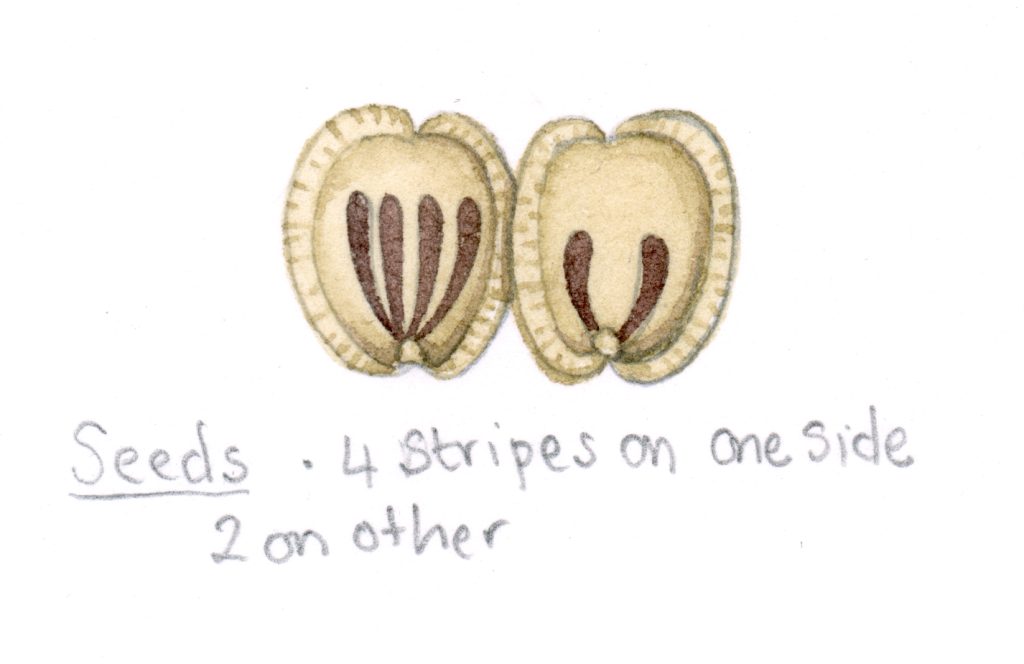
Persian Hogweed seeds showing vittae Heracleum persicum
The shape and position of all these features is quite variable, and vital in telling similar species apart.
Apiaceae: Roots
Carrots and parsnip are the roots of Apiaceae plants. In the past, Pignut root was also foraged and eaten. It’s these species with a swollen main tap root that have proved useful as food crops.
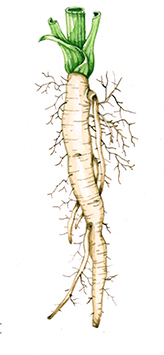
Wild Parsnip Pastinaca sativa
Conclusion
In conclusion, I hope my Apiaceae wildflower blog was helpful. I’ll be doing more of these blogs over the coming months. My references included my FSC botany course, the Common Families of Flowering Plants by Michael Hickey & Clive King, and the excellent Naturespot website.
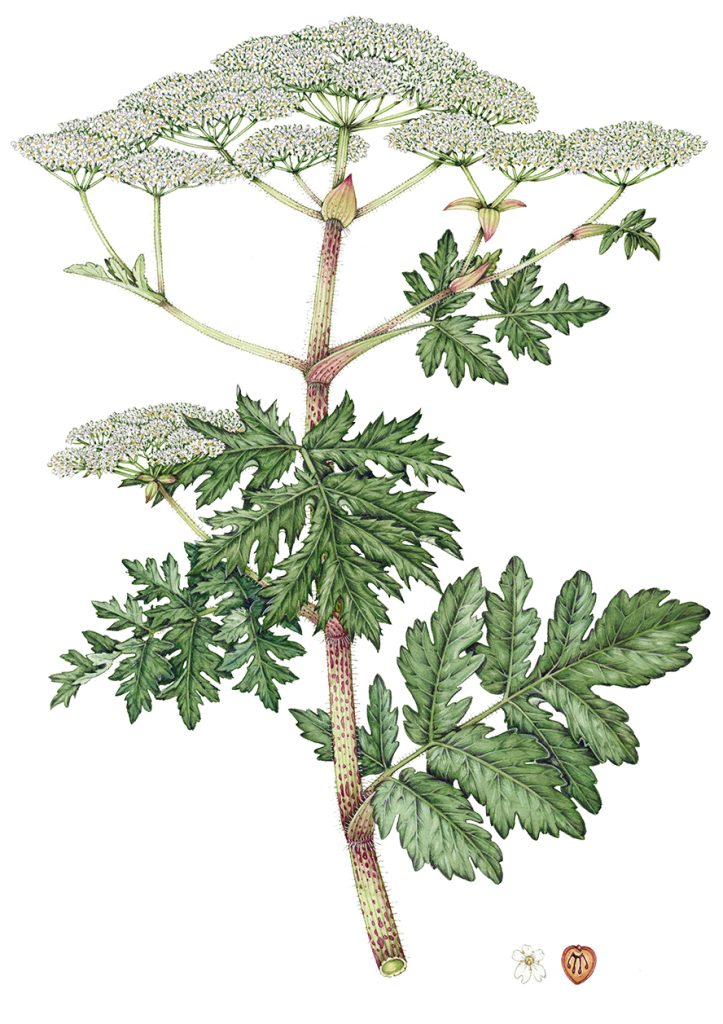
Giant Hogweed Heracleum mantegazzianum

Very good illustrations. Well done and thanks from a botanist
Thank you, Karen!
Thank you for explaining what those flowers were that I see everywhere locally.
I was also not aware that so many other plants and herbs are in the same family.
I’m so glad to have opened your eyes to them. They’re everywhere once you start looking!