Dandelions: Why to love them
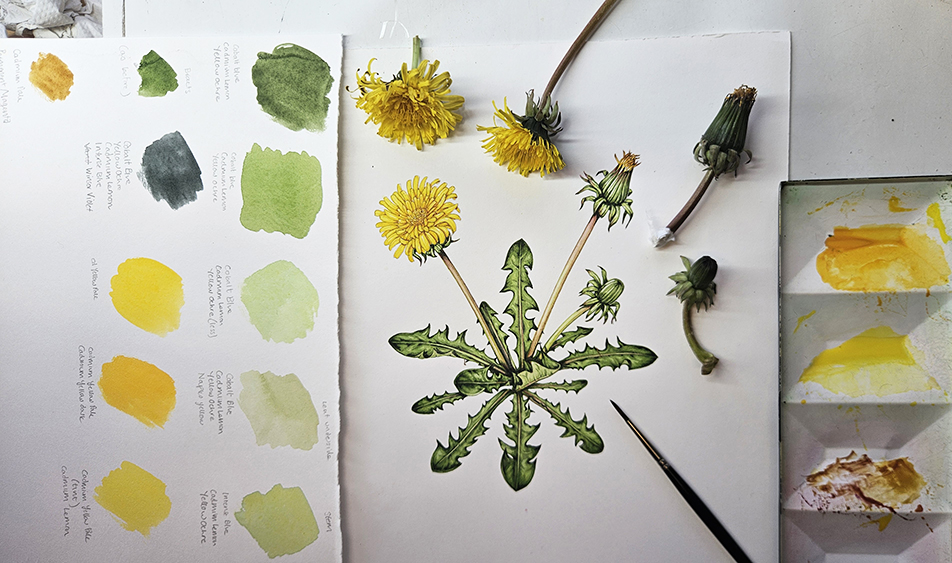
I’ve been illustrating a Dandelion, Taraxacum officinale, recently, and want to do a blog about why they are such beautiful and successful wildflowers.
Distribution and adaptability
Dandelions are incredibly common, growing in meadows, gardens, cracks in the pavement, and almost anywhere with enough soil for them to establish themselves. They’re adaptable and brilliant at colonizing new environments. They grow fast. However, they’re not great at competing against other plants, unless the area they grow in is repeatedly mown or damaged.
They can handle being mown because, unlike many wildflowers, they have really long tap roots. When a mower destroys the plant above ground, dandelions can re-grow from the submerged root. This re-growth happens long before other wildflowers can begin again, germinating and emerging as seedlings.
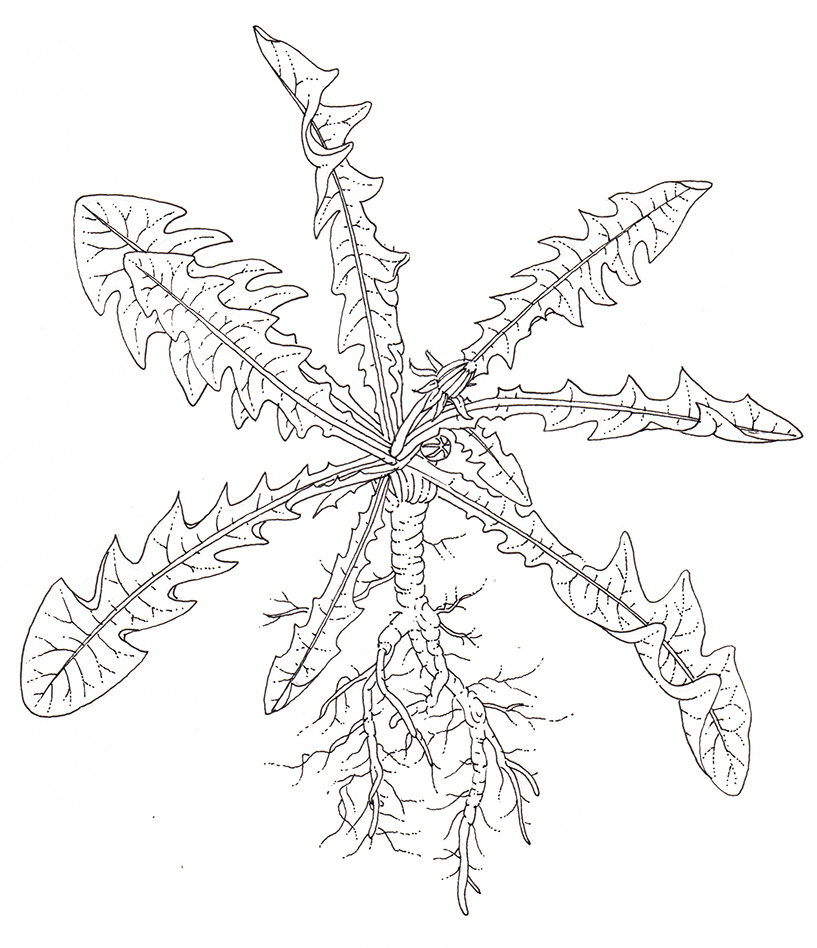
Dandelion plant showing tap root
Dandelion flowers: Ray florets and the Asteraceae
One of the things that makes dandelions so beautiful is their vivid bright colour. Slightly paler on the outer edges, they are often off-set by verdant grass, and really glow.
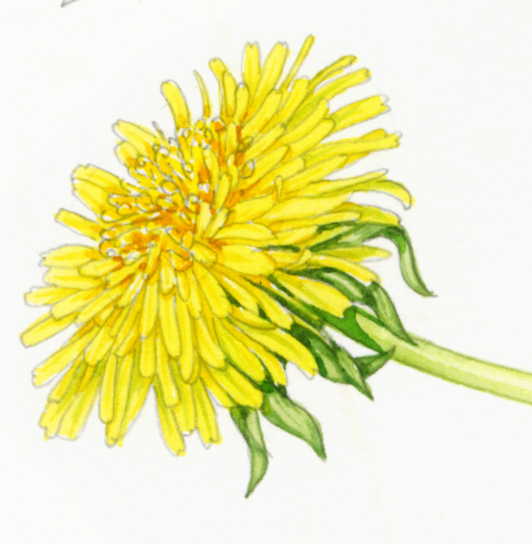
Dandelion flowering head
Dandelions are members of the Asteraceae family, they are composite flowers. This means that every yellow “petal” you see is actually a flower in it’s own right, complete with miniscucle reproductive structures.
If you look at a daisy (another composite flower) with a hand lens, you can see little yellow disc florets (which make up the central yellow part) and white ray florets which encircle it. The whole assemblage of flowers is called the capitulum and is held within tiers of involucral bracts, which serve the same protective purpose as sepals and the calyx.
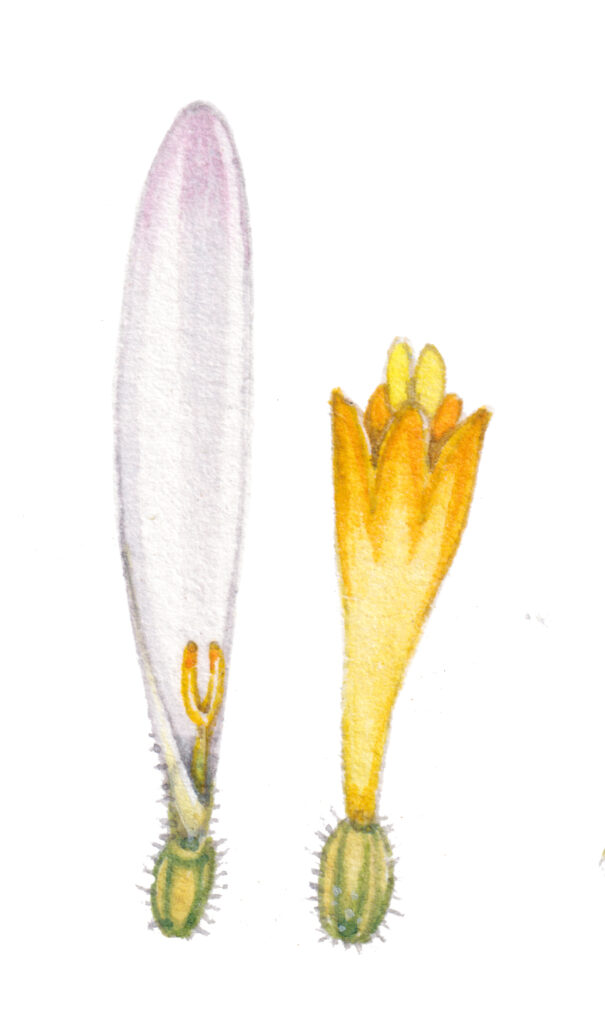
Daisy florets: Ray and disc types.
Unlike many Asteraceae
Unlike many members of the Asteraceae, Dandelions do not have disc florets, only ray florets with the one long, distinctive ligule. Get a magnifier and look closely. You’ll be able to see the tiny stamens in each and every one.
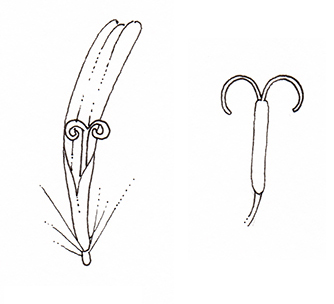
Ray floret and close up of the stamens and reproductive structure.
Dandelion involucral bracts
Dandelion buds are beautiful things. Compact and slightly square, they are neatly encased in the involcural bracts. these are sometimes called phyllaries, or tegules. Below the capitulum there are leafier bracts, arranged in two rows.
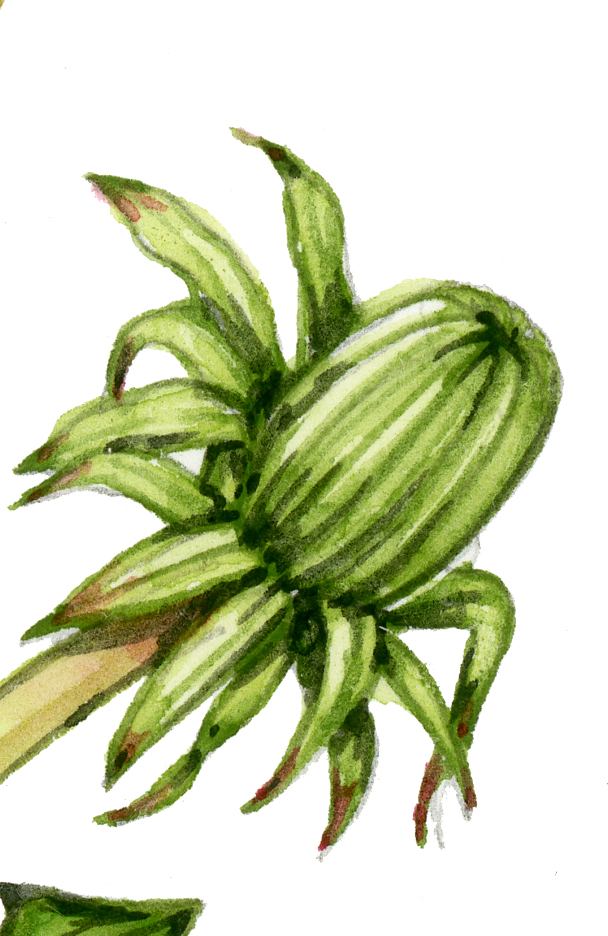
Dandelion bud
The involucral bracts are really important for species identification. Sometimes they have glands or are striped. Those of dandelions have slightly darker tips. They remain after the flower has wilted, encasing the structure until the seeds emerges as the instantly recognizable dandelion clock.
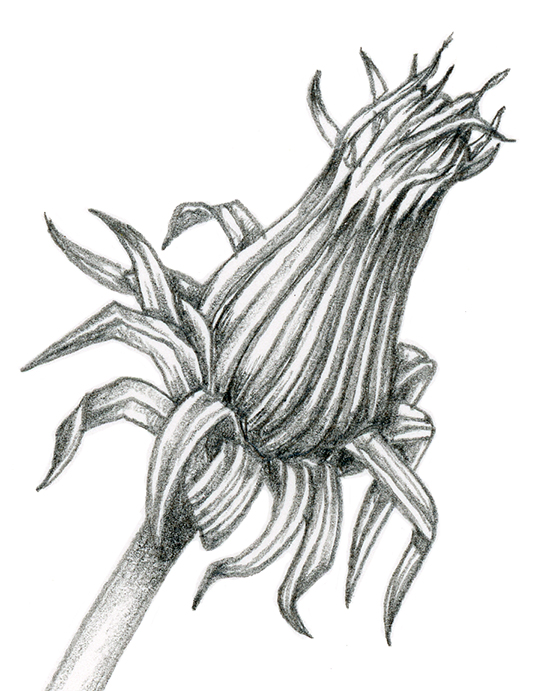
Dandelion flower after wilting and before becoming a seed head.
Dandelion seed heads
One of the most familiar things about dandelions is their beautiful spherical seed heads, sometimes called clocks. Telling the time with a dandelion clock is much a part of growing up as plucking daisy petals and saying “loves me, loves me not”, or playing conkers. How many blows does it take until every seed is dispersed? That’s what time it is.
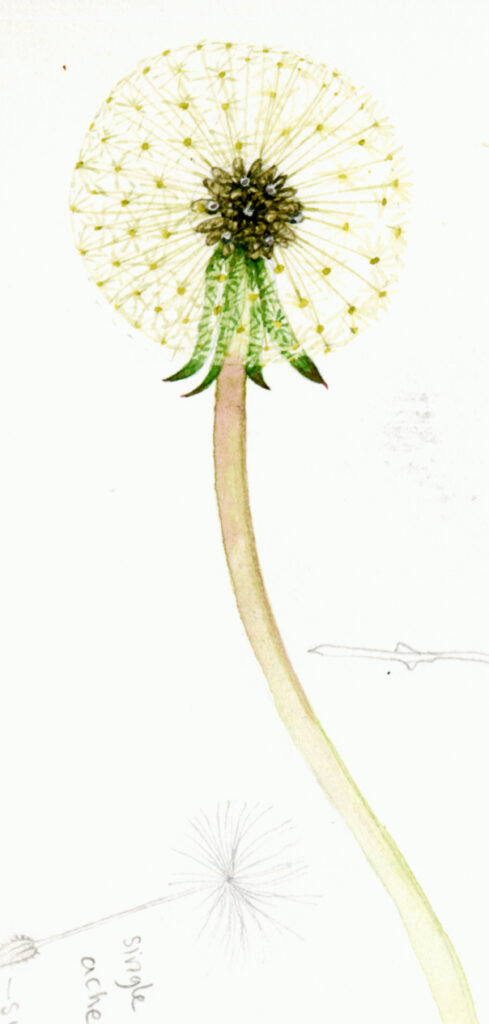
Dandelion seed head
Their little brown seeds, known as achenes, are attached to the remains of the capitulum at the centre of the structure. The globe is created by the umbrellas of fluff, or pappas, that are held erect on a stalk above each seed.
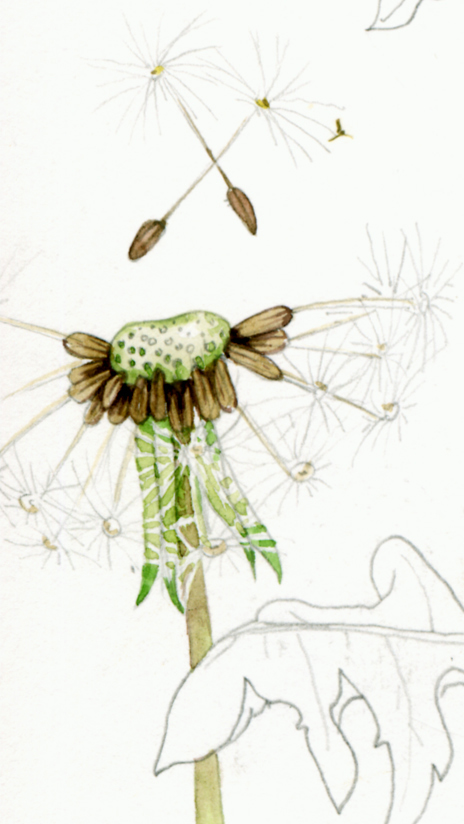
Dandelion clock with most of the seeds dispersed
Dandelion seeds
Each seed is carried by the breeze, on a windy day they can travel 5 or 6 miles. According to the Smithsonian, some are recorded as having travelled 500 miles! Seeds are viable for several years, although most will be dead within 5 years (Garden organic). Each flowering head produces about 400 seeds, so over one season, a lone dandelion plant could make several thousand of them. With a 90% germination rate, that’s impressive.
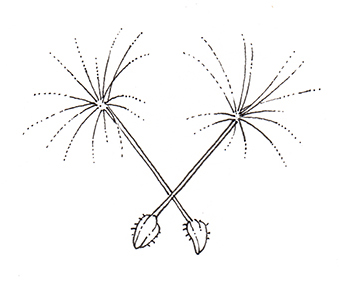
Dandelion seeds
This dispersal, viability, and the sheer numbers of seeds helps explain why dandelions appear on every continent but Antarctica.
Dandelion leaves
The leaves of dandelion are lobed. They have pointed side teeth, not neccesarilly opposite each other, which vary in size. In most cases they have a larger terminal lobe.
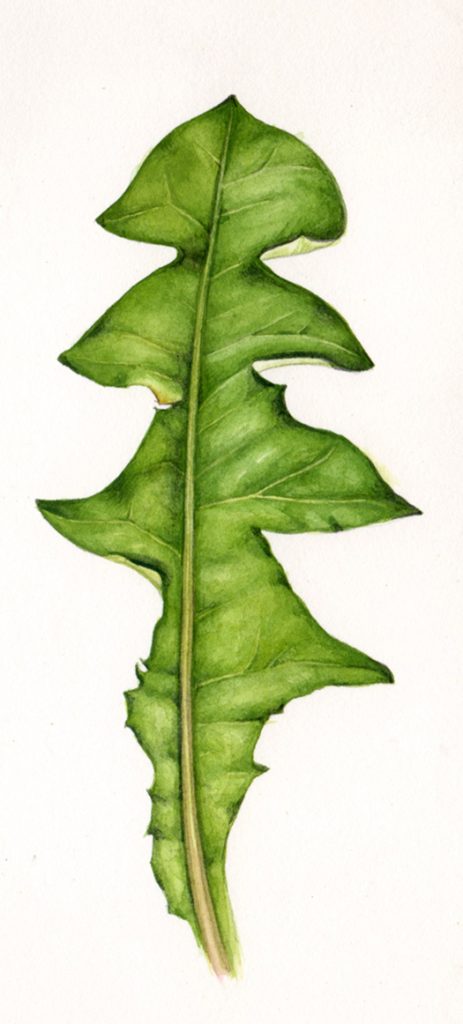
Dandelion leaf
Leaf shape is enormously variable in dandelions, both within species (more of which later) and within one plant. Each dandelion species, and each individual plant, has a distinct leaf shape that it replicates, but this alters as the season progresses. Botanists identify dandelions early in the year, relying on the outermost (oldest, and first emerging) leaves as a guide.
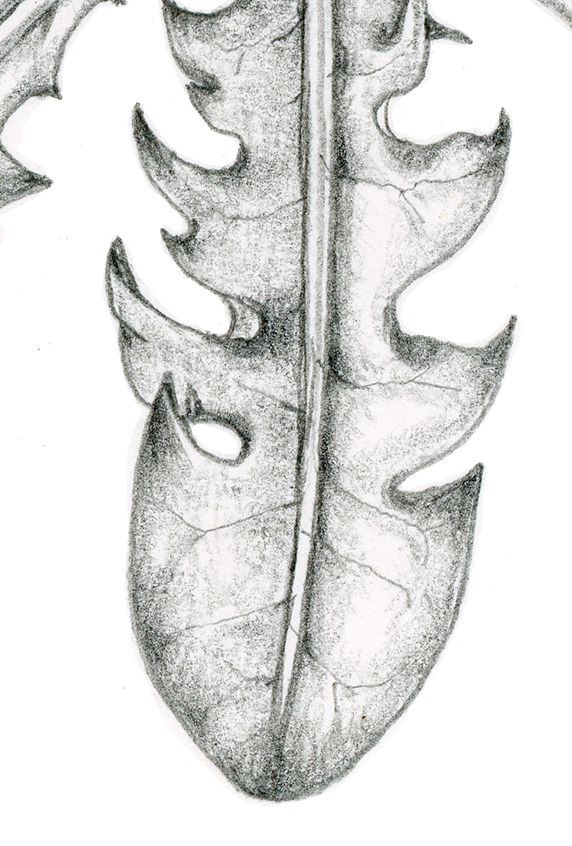
Pencil dandelion leaf
Environmental conditions affect the leaves. They tend to be simpler in shaded conditions, and may even be undivided. Leaves grown in arid conditions, or where there is lots of mowing and high foot traffic tend to have a more complicated pattern of teeth. Leaves that grow later in the season tend to be more complex shapes, although, as mentioned above, they are still based on the same blueprint. These late leaves may have much larger terminal lobes.
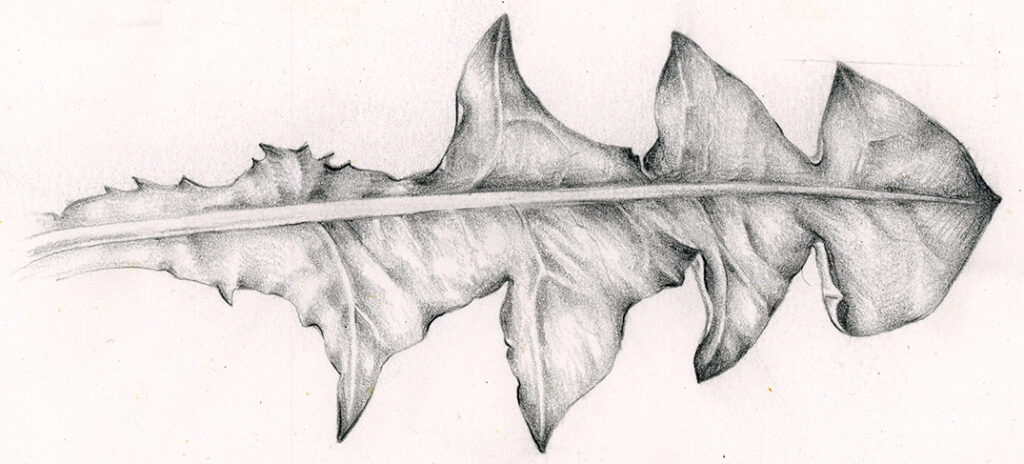
Dandelion leaf study
The teeth of the leaves explain the etymology of the name. Dandelion comes from the French, “Dent de Lion” or Lion’s teeth. The bastardization is easy to see.
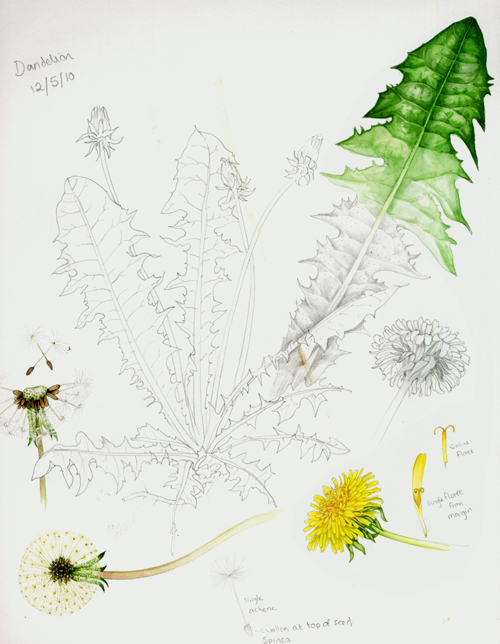
Asexual reproduction and dandelions
Almost all British dandelions reproduce asexually, every seedling is an exact clone of its’ mother, This process is known as Apomixis.
Drawbacks mean that if a damaging mutation develops, it will not be diluted through reproductive gene mixing, and that particular plant will die out swiftly.
However, if a mutation is advantageous, it can dominate the population in no time. Did you know that 16% of dandelions in the UK don’t produce pollen? If you’re practising apomixis, pollen production is a costly and entirely unnecesary process. Plants which don’t waste energy this way have a competitive edge.
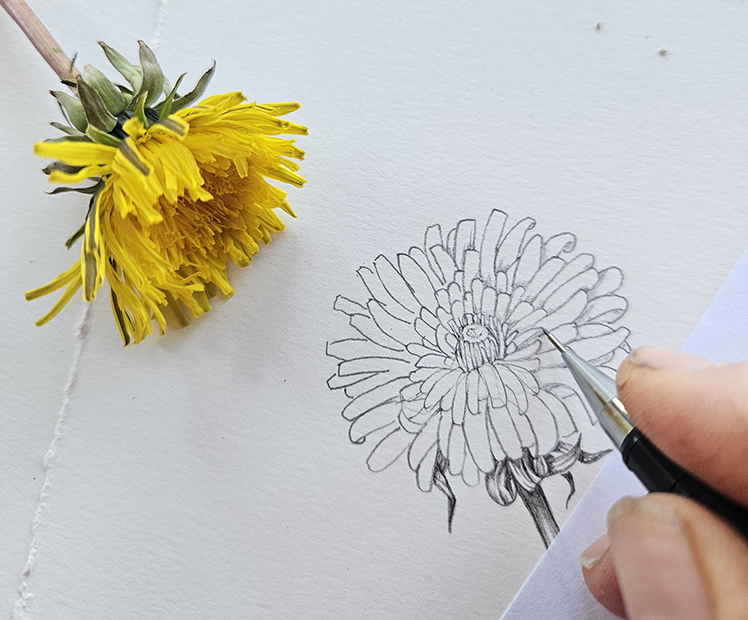
Drawing a dandelion flower
Why botanists despair of dandelions
In the UK alone, there are 235 species or subspecies of dandelion, 150 of which are native. Telling them apart is incredibly difficult as the differences between species is not constant. Dandelions are incredibly plastic, adapting to changes to their environment. One plant will have many phenotypes. This explain why the task of separating dandelions to species level is so hard.
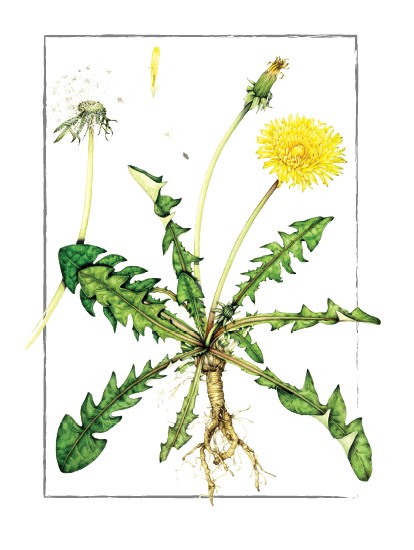
Dandelion plant
In Field handbook to British and Irish Dandelions (Richards 2021), there were only 51 dandelion experts listed worldwide, the earliest from 1798. Compare this to botanists whose field of expertise is roses. There are 39 Rose societies in the World Federation of Rose Societies. The US branch has over 8,500 members while the National Rose Society in the UK had over 100,00 members at it’s peak.
As the BSBI, (source of much of the dandelion information in this blog) states, “dandelions are almost virgin territory for anyone wanting to research this plant group.”
Finding and recording Taraxacum luteum
When out with the Brecknockshire Botany county recorder recently, we found a wonderful species of dandelion, Taraxicum luteum. Its’ main distinguishing feature was meant to be a bright, almost fluorescent yellow colour. However, we found the pinkish bracts being pressed against the capitulum, and the absence of any dark lines on the back of the ray florets a far more useful indicator. They also all seemed to have purplish stems, and central ribs of the leaves were flushed red too.
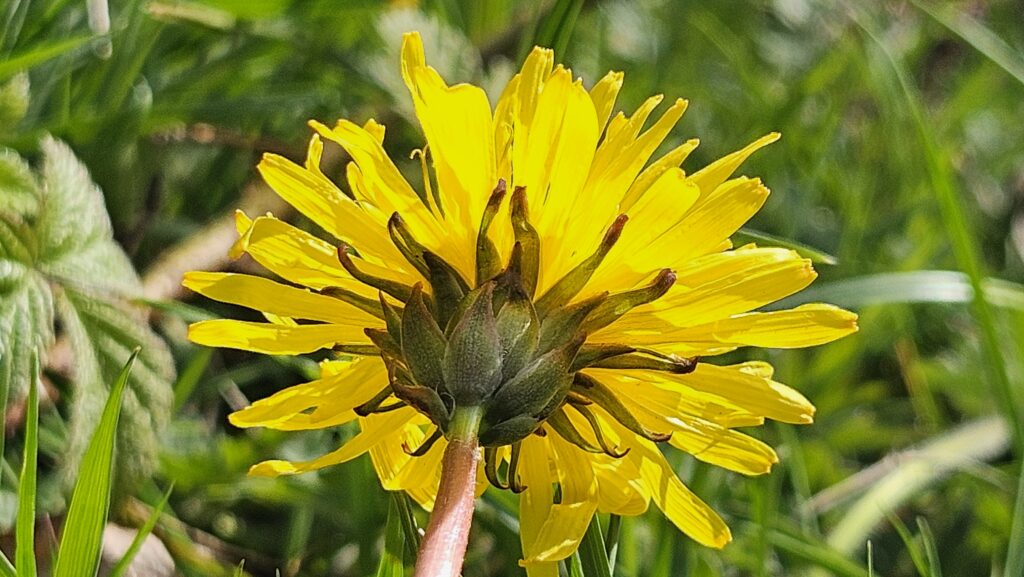
Taraxacum luteum from below
This species appears in the Flora of Brecknockshire, on the same site. This comprehensive book (which I was lucky enough to collaborate on), was published last month. Luckily the book won’t have to be updated for this species of dandelion!
Health and Eating dandelions
Dandelions are natural diuretics, and can help fight cellulite and water retention. In fact, the French name for dandelion is “Pissenlit”, which literally translates as pee in the bed. This reflects their diuretic properties! The roots can be made into a coffee substitute; the leaves can be eaten raw if young, and fried with butter when older. Buds can be mixed into a pasta sauce with olive oil, garlic and salt and pepper. Even the flowers can make decorative additions to salads and deserts.
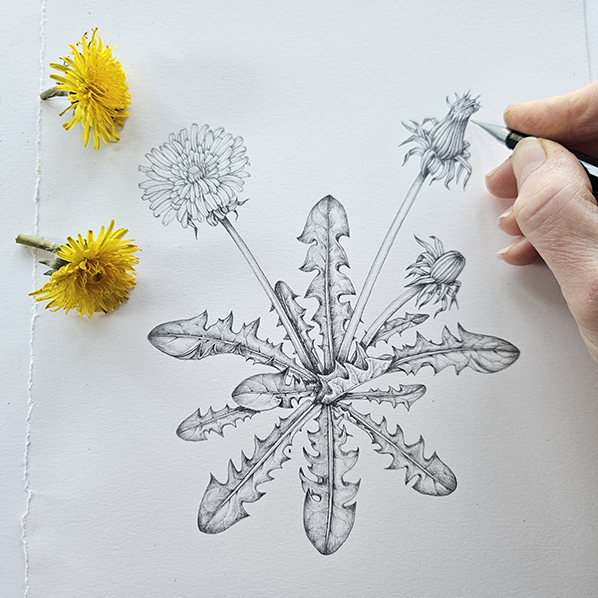
Illustrating a dandelion in pencil
Conclusion
It’s easy to like dandelions. Vilified by gardeners, disregarded as weeds, ignored by botanists. They are beautiful, tenacious, adaptable, fascinating, edible, and instantly recognizable. Harbingers of spring, and excellent for pollinators like the honey bee, there’s so much more to dandelions than meets the eye. And a whole lot to love.