




Grasses of Montserrat and the Eastern Caribbean
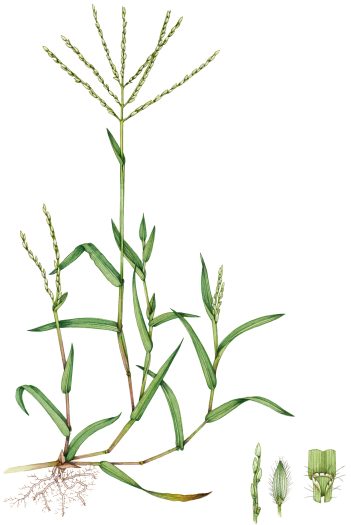
I was recently commissioned to illustrate some common grasses of Montserrat and the Eastern Caribbean by UKOTCF. As regular readers will know, this is something of a dream job for me.
I first illustrated grasses way back in 2014, for the HarperCollins Flower Guide by David Streeter. Not knowing that I was planting the seeds of an obsession, I volunteered to take on the Graminaceae pages. A passion was born, which accompanied an extremely steep learning curve! For more on grass anatomy look at my blog, and at one which explains how you can tell grasses, rushes, and grasses apart.
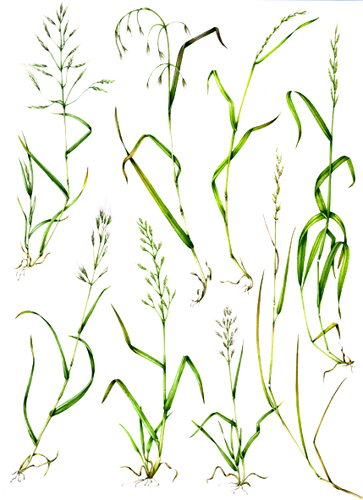
Grasses plate completed for the HarperCollins field guide
Researching the species list
As with most jobs, the first step is to research the species list provided by the client. When this covers European species I can often go and find the plant growing in the wild. Not so for Caribbean species. Despite having spent some time looking at grasses in the spring, during my visit to teach on Montserrat, I didn’t have the chance to take visual or written notes.
The internet, especially iNaturalist, is a valuable resource in these situations. So too is Kew’s online plant atlas, scans of herbarium specimens, and any number of US colleges’ agricultural resources.
I need written descriptions as well as illustrations of the grass inflorescence, and photos of the plants growing in situ. For more on how to illustrate a plant when you can’t get your hands on it, take a look at my blog.
Another thing to remember is that there are numerous English names for each species, and obsolete Latin ones too. To fully trawl all the information, you need to search all of the names relating to that one species.
Drawing up roughs
It’s always a relief to have botanists on board who can check my illustrations for accuracy, and the team working with Montserrat’s branch of UKOTCF are excellent. They look at the pencil drawings and give feedback. Once I get the go-ahead, I can start adding colour.
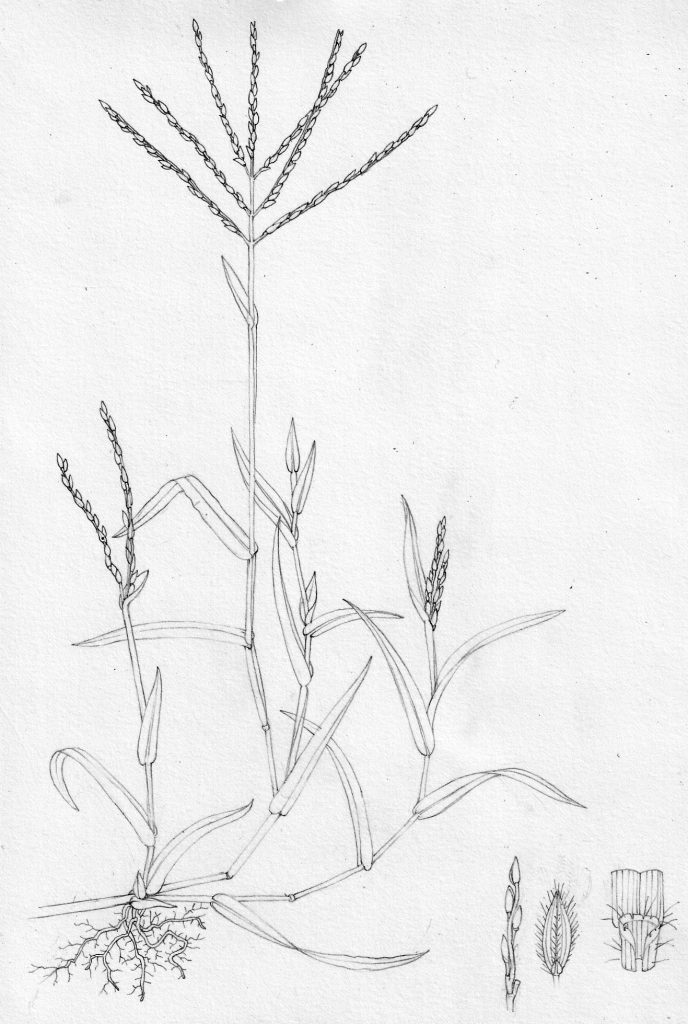
Crab grass Digitaria ciliaris
Each illustration shows the plant with roots, the habit (the way it typically grows), and details of the ligule and individual spikelets (grass flowers). These are crucial to correctly identifying grasses at species level.
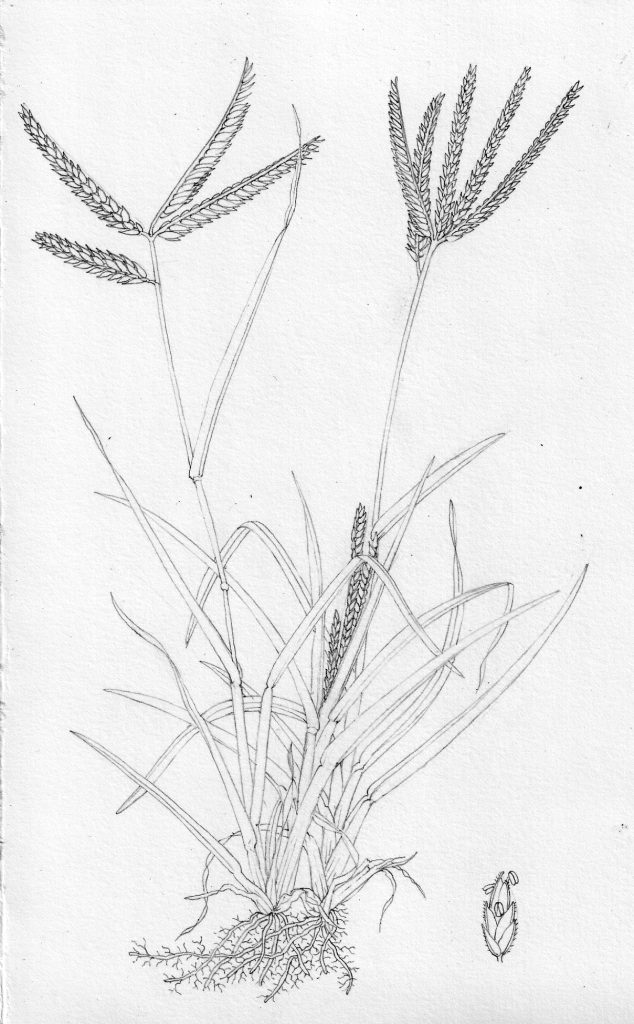
Dutchgrass or Crowsfoot Eleusine indica
Grasses of Montserrat: Generalisations
Many of the grasses were far bluer than the species we get in the UK. They also tended to have sprawling habits.
It’s interesting, and possibly ecologically significant, that the inflorescence structure of many of these grasses is digitate, like outstretched fingers. In fact, many of these species are known as finger-grasses, or Digitaria. The spikelets are often one-sided and compressed against the rachis. The same can not be said of most British and Northern European species, although of course there are many digitate species amongst those with more open panicles .
I found myself wishing over and over again that I’d paid more attention and taken visual notes when I was there in February. Even little things like the way a grass blade discolours is so much easier to illustrate if you’ve seen it, and taken notes.
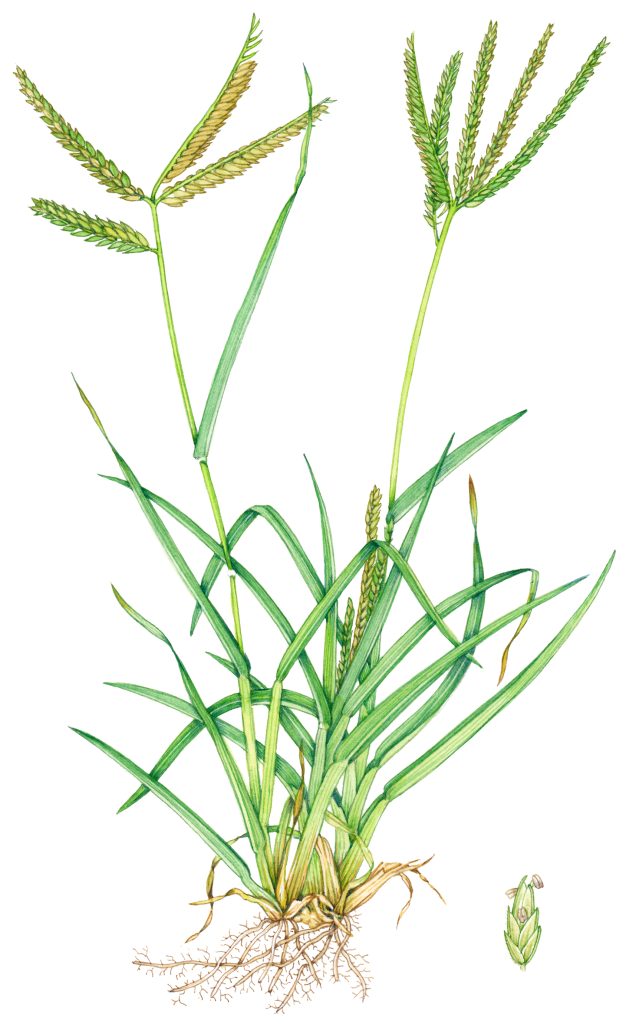
Dutchgrass or Crowsfoot Eleusine indica
Eleusine indica is also known as Indian wire-grass.
Montserrat grass species: Sourgrass Digitaria insularis
Sourgrass is a large, perennial grass that grows across the Americas. It can be up to 4ft tall, and is a fast-growing and troublesome weed for farmers in South America; especially Brazil, Paraguay, and Bolivia.
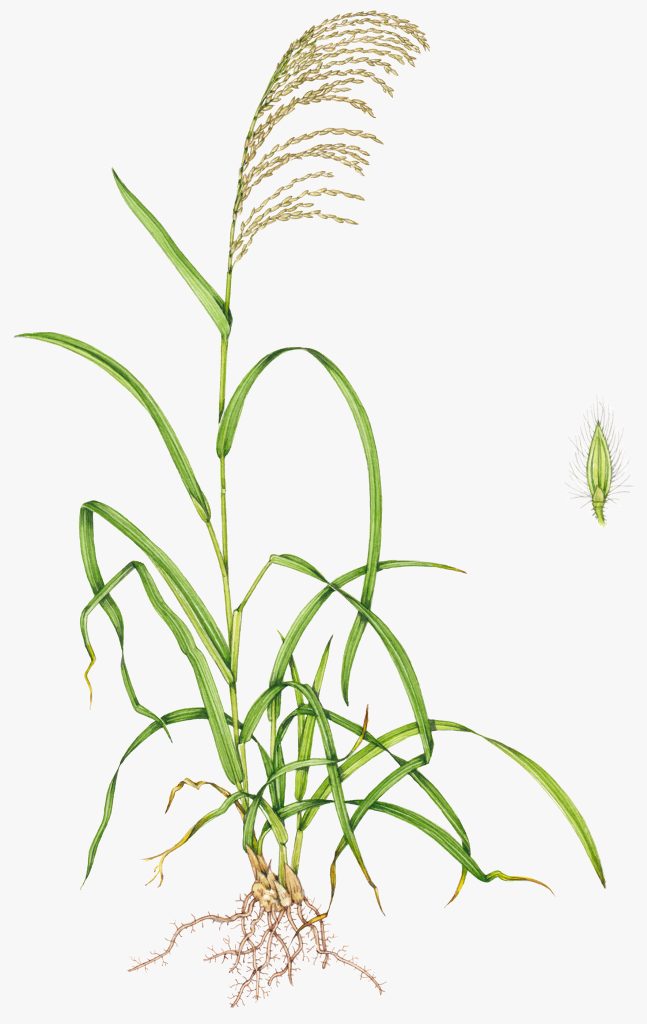
Sour grass Digitaria insularis
Unlike lots of the other grasses on the list, Sourgrass has a loose raceme. It grows on low open ground.
Although it’s seen as a weed in many places, I love this plant. The flowering head is so elegant, and the swoop of the long leaf blades is a treat to illustrate.
Montserrat grass species: Lemongrass Cymbopogon citratus
Another species with a loose panicle is Lemongrass. Yes, this is indeed the same plant that can be bought in grocery stores as a delicious cooking ingredient. The part used is the base of the grass stem where the flavour is concentrated, although the whole plant smells lemony.
Leaves are quite long, and the base of the plant often bears a brown or reddish flush.
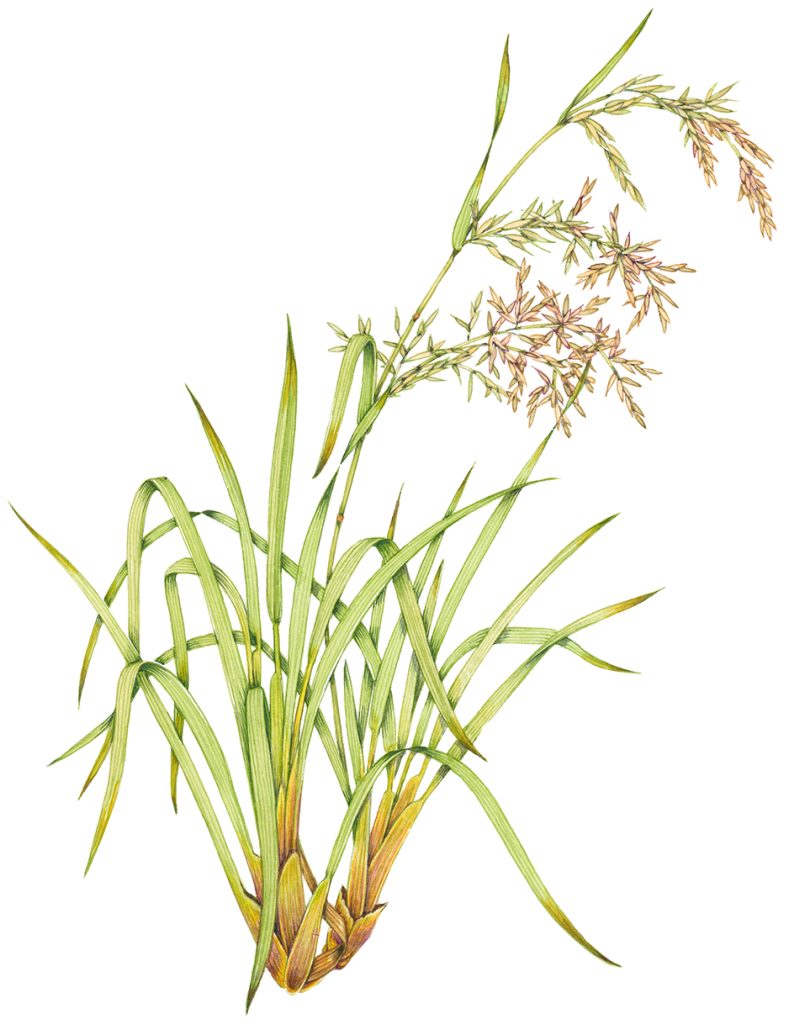
Lemongrass Cymbopogon citratus
Lemongrass is used in traditional medicine as well as cooking, treating digestive complaints. There is some research that suggests it might also be of use in phytoremediation, where a plant helps remove toxins from polluted soil.
Montserrat grass species: Purple top Chloris barbata
Purple top is also known as Swollen fingergrass, Airport grass, Swollen windmill grass, or Purple chloris. Originally from Africa and South-east Asia, it’s now pretty ubiquitous across the Americas. It grows well on Montserrat, and in some places outcompetes other species.
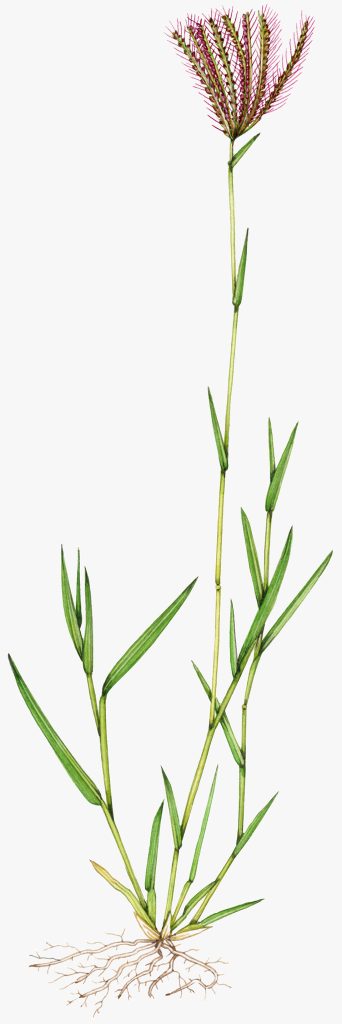
Purple top Chloris barbata
The disadvantages associated with this plant aren’t directly relevant to Montserrat, as since the volcanic eruptions of the 1990s, there’s been little economically significant agriculture. If this changes, the Purple top’s role as a host for pests of rice; and threat to sugarcane, tree crops like guava; and as an invasive on lawns may prove more problematic (CABI).
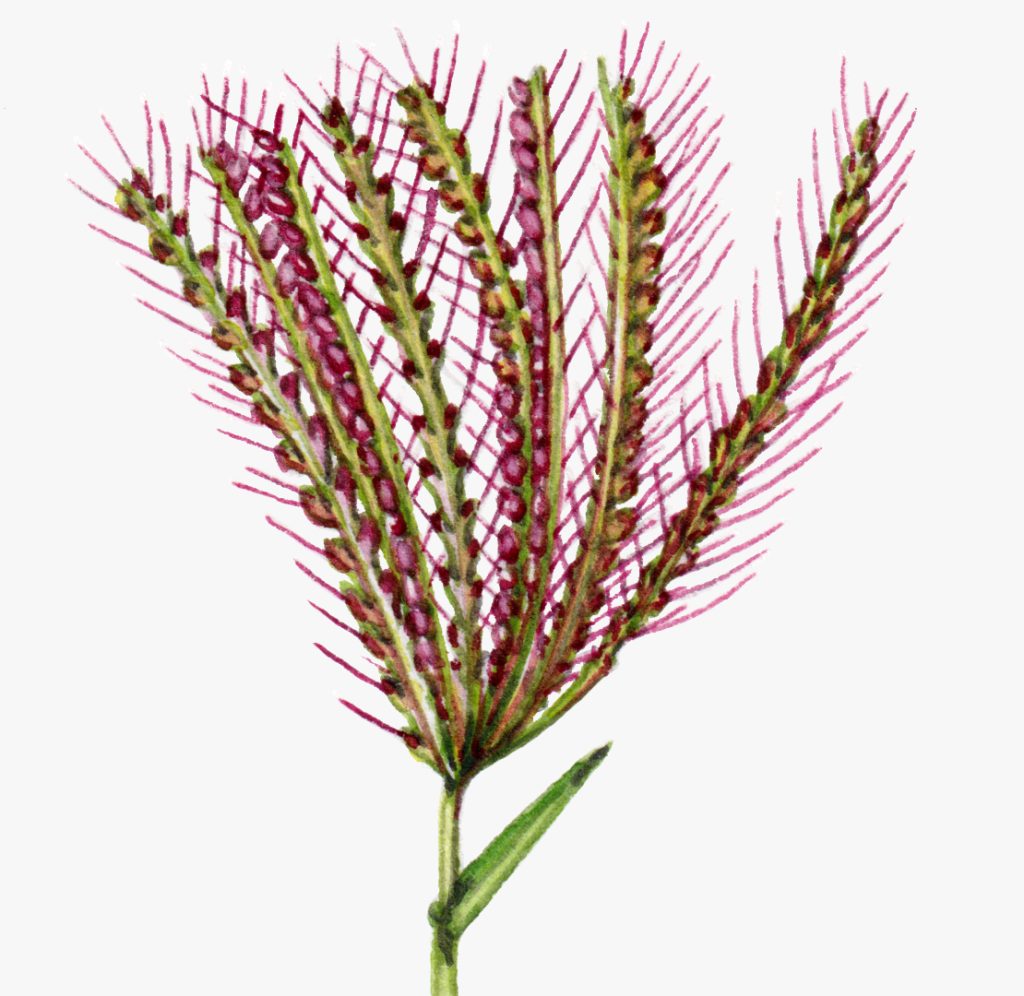
Inflorescence of Purple top
Although animals will graze on young plants, as it matures it becomes increasingly tough and is therefore no good as a pasture grass.
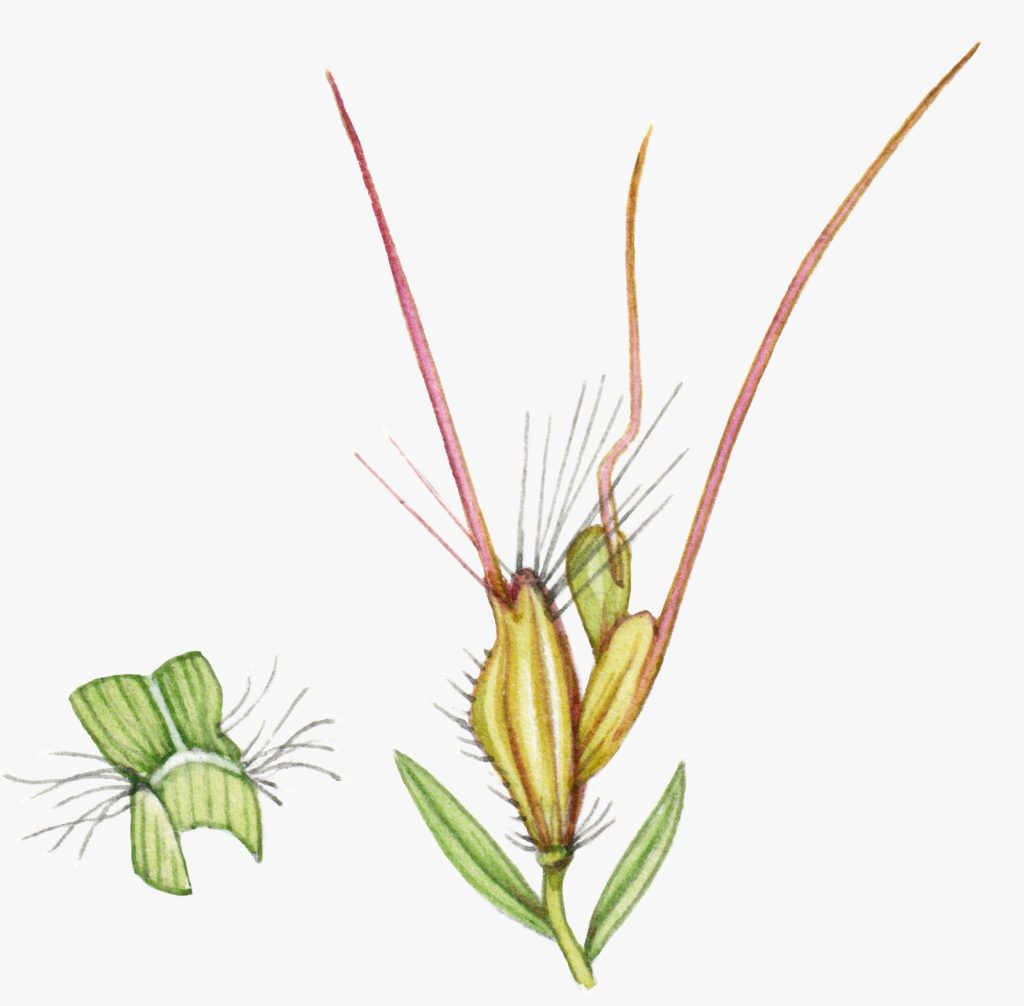
Single spikelet of Purple top
Irrelevant of its’ status, it was a lovely plant to illustrate. The rich purples of the spikelets and the long awns made it a fabulous subject.
Montserrat grass species: Carpet grass Axonopus compressus
Carpet or Blanket grass is native to the Caribbean. Although the grass flowers can reach 45cm, most of the vegetative growth is at low level. The leaf blades are wide and green, and provide good ground cover. It is used for lawns, and to help limit soil erosion.
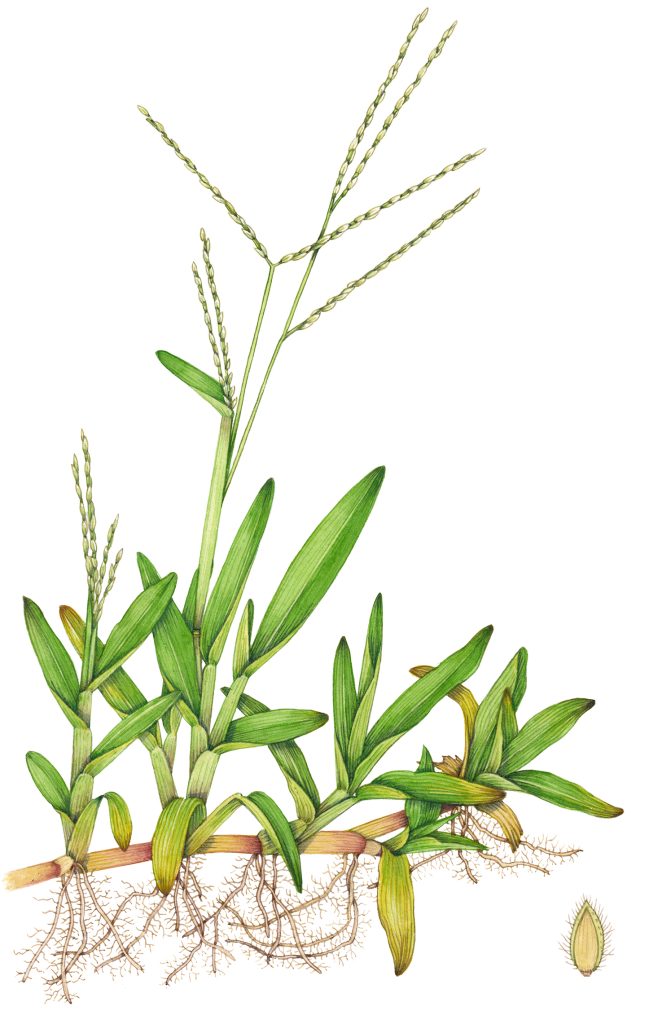
Carpet grass Axonopus compressus
It can also be used medicinally, as a herbal bath and to cure heart problems (Medicinal plants of Guyana by DeFilipps). I am unsure if it’s used in this way on Montserrat.
Unlike Purple top, it’s good for grazing animals and doesn’t seem to have any negative effect on fruit crops (CABI).
Montserrat grass species: Jungle rice Echinochloa colona
This grass is another introduced species, originating in Africa and Asia. I like it because of it’s geometry, and somewhat unusual flowering head.
The grains can be harvested and used as food when times are particularly tough, and it is the ancestor of Sawa millet. In India, it is made into Khichdi, a dal eaten on fasting days or when you’re ill (click here for a recipe), and can be ground into a flour.
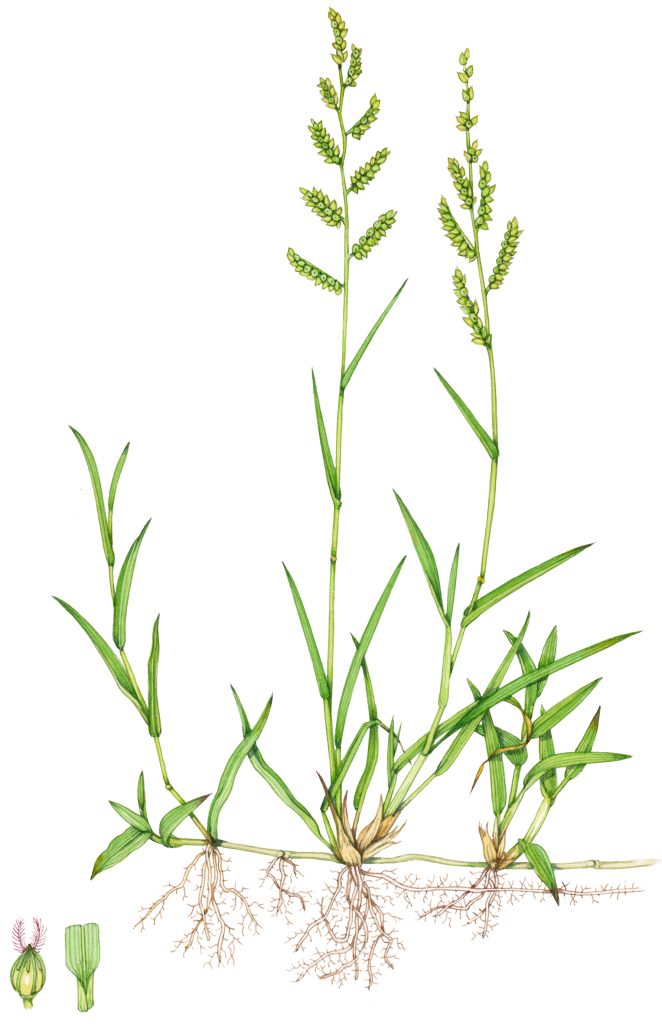
Jungle rice Echinochloa colona
Montserrat grass species: Bamboo grass Lasiacis divaricata
Bamboo grass is also known as Wild cane, Cane grass, and Tibisee. It looks really unusual for a grass because of the broad leaves and the dark seeds, which resemble berries.
It’s a native species, favouring forests of broadleaf evergreens. Although it grows in the undergrowth, it can also climb and grow amongst the trees.
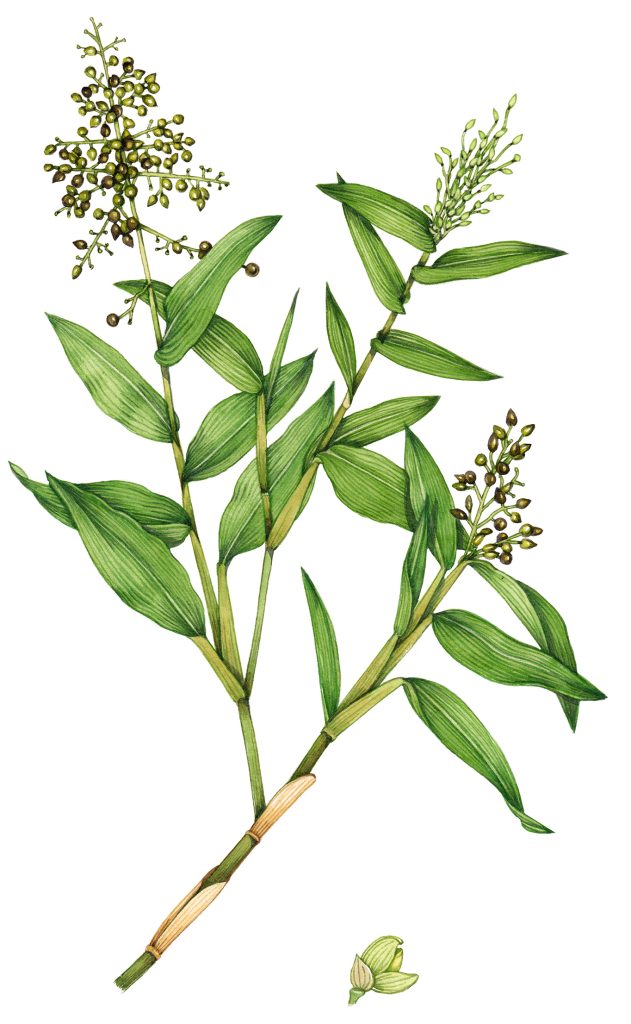
Bamboo grass Lasiacis divaricata
Having a species with wider leaves, and shiny berry-like fruits, was a welcome change from the other grasses on the species list. It looks more like bamboo than any other grass species I can think of. Like bamboo, it grows from a woody stem.
It grows well in shady locations, and is used to provide ground cover.
Montserrat grass species: Sugar cane Saccharum officinarum
The last species of grass I want to focus on is Sugar cane Saccharum officinarum. To call the history of this plant’s use contentious would be a gross understatement. The growing and harvesting of sugarcane was the backbone of the trans Atlantic slave trade. It was introduced to Montserrat in the 17th century, and the importation of enslaved peoples from Africa soon followed. Montserrat has a large Irish population, some of who were plantation owners and merchants, and some of whom were themselves enslaved and worked with sugar cane.
In 1768 a group of Montserrat slaves revolted on St. Patrick’s Day. Although the rebellion was unsuccessful, St, Patrick’s Day is still celebrated on the island, both for the Irish heritage and, I’m guessing, the bravery of those who rose up in 1768 (Fotbot).
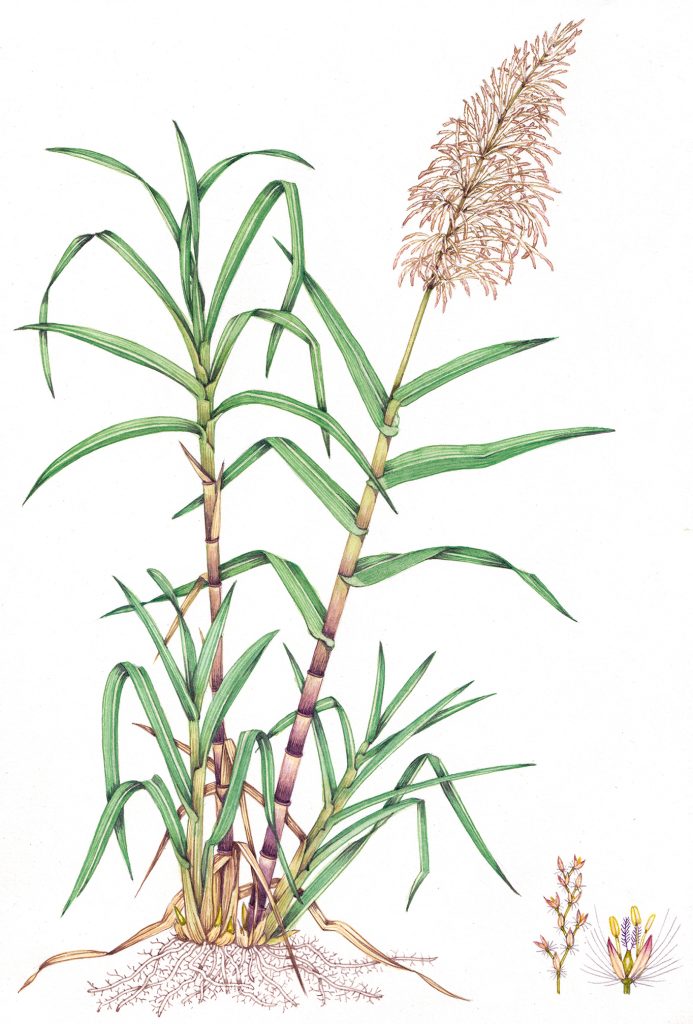
Sugar cane Saccharum officinarum
This grass only thrives if tended by humans, and is delicious thanks to the high concentration of sucrose in the sap of the woody stem. Native to New Guinea, it is now found across the tropics. It is grown commercially in many places, and provides half the world’s cane sugar. However, on Montserrat, sugar cane plantations ceased to be viable many decades ago (and long before the 1990s eruption of the Soufriere hills).
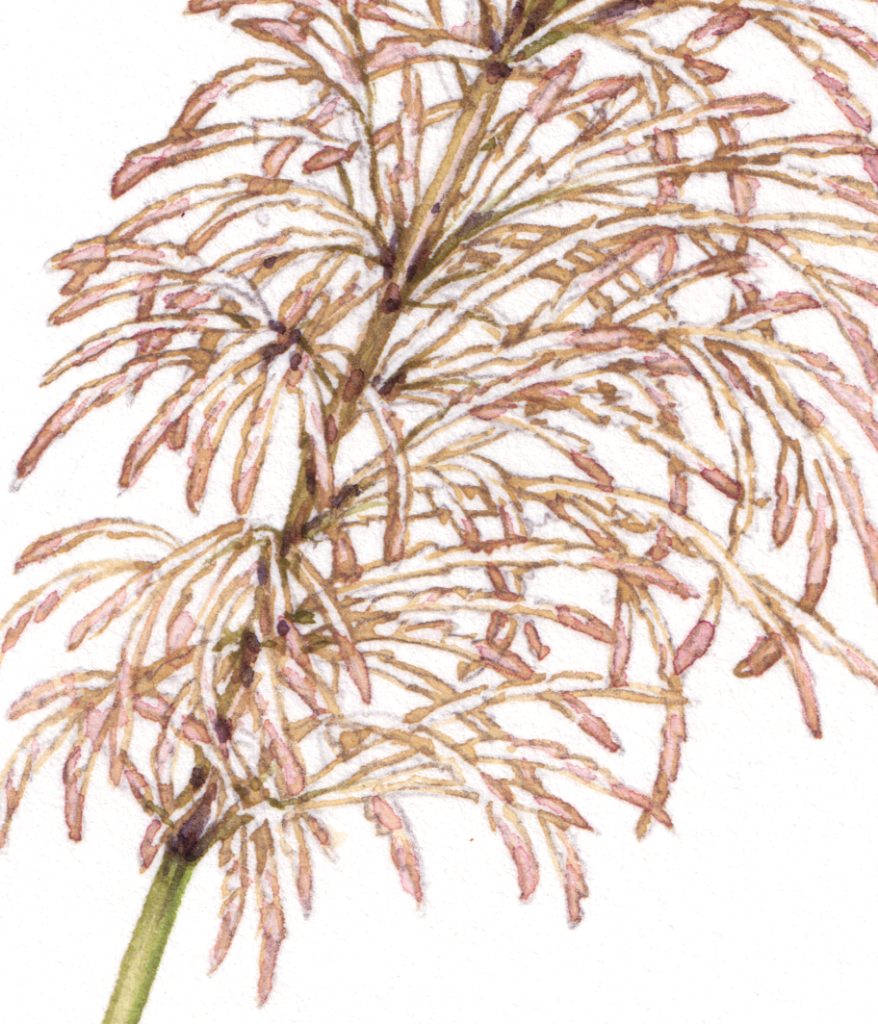
Detail of the panicle of sugar cane
Illustrating the complex panicles was a real challenge as the plant is large but each spikelet is tiny. This meant representing the branches as irregular “twigs” rather than showing each flower. The deep purple flush on the stem made up for this challenge though. Many plants are flushed purple, but few grasses are as dramatically striped as the sugar cane.
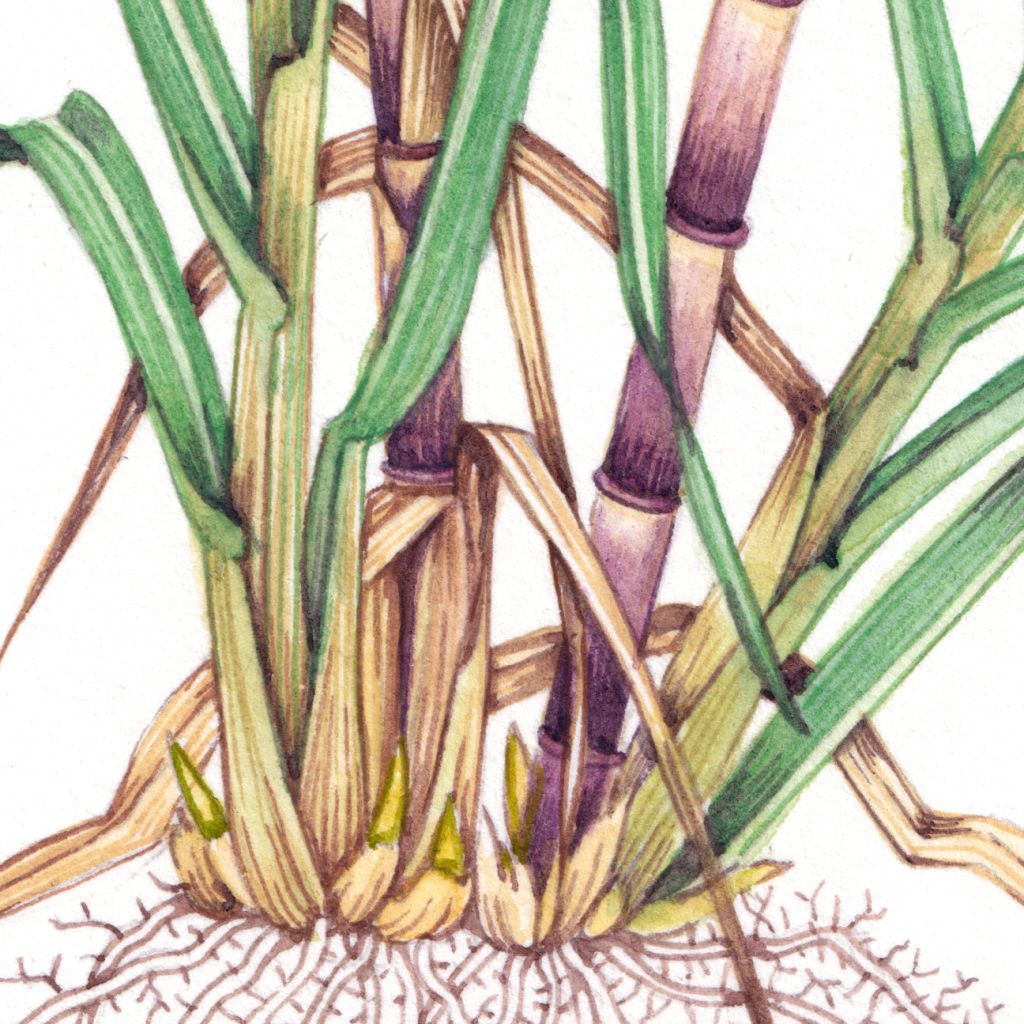
Base of sugar cane stems
Other grasses
There were 12 grasses on the species list, so this is just a selection. Guinea grass Megathyrsus maximus, Gophertail lovegrass Eragrostis cilarius, Crab grass Digitaria ciliaris, Dutchgrass Eleusine indica, and Seashore paspalum Paspalum vaginatum also featured.
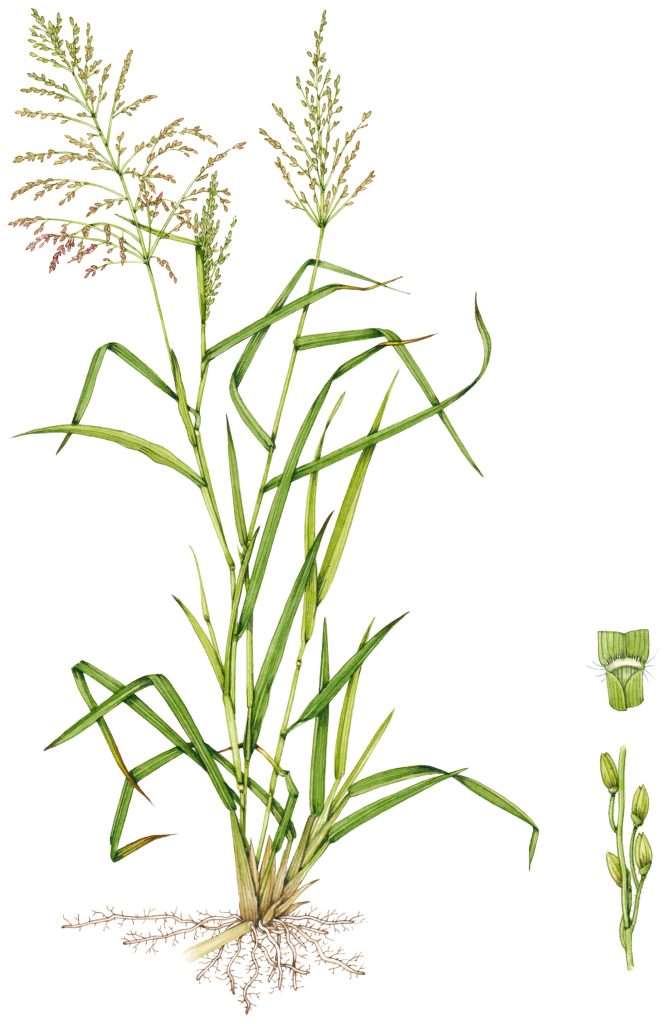
Guinea grass Megathyrsus maximus
As always, I was so pleased to be able to spend a few weeks researching and illustrating grasses species. And to be doing it for the team I worked with at Montserrat National Trust and UKOTCF was a real treat.
I only wish I’d taken more notice of the grasses under my feet when I visited back in February!
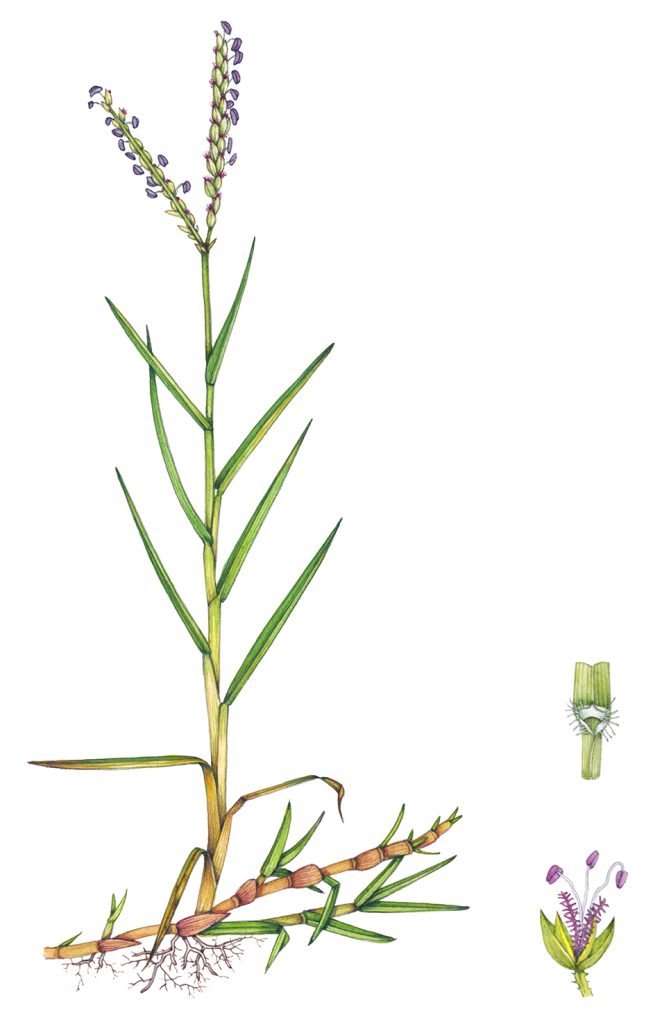
Seashore paspalum Paspalum vaginatum with its beautiful purple stamens

So beautifully explained with images!!
Thanks!