




Grasses in Cambridge Collections: Combating grass blindness
Grasses in Cambridge Collections: Combating grass blindness discusses an amazing day I spent recently, looking at herbarium specimens and illustrations of grasses held in Cambridge collections. The collections were gorgeous, but the accompanying talks and interchange of ideas will leave the longest lasting impression.
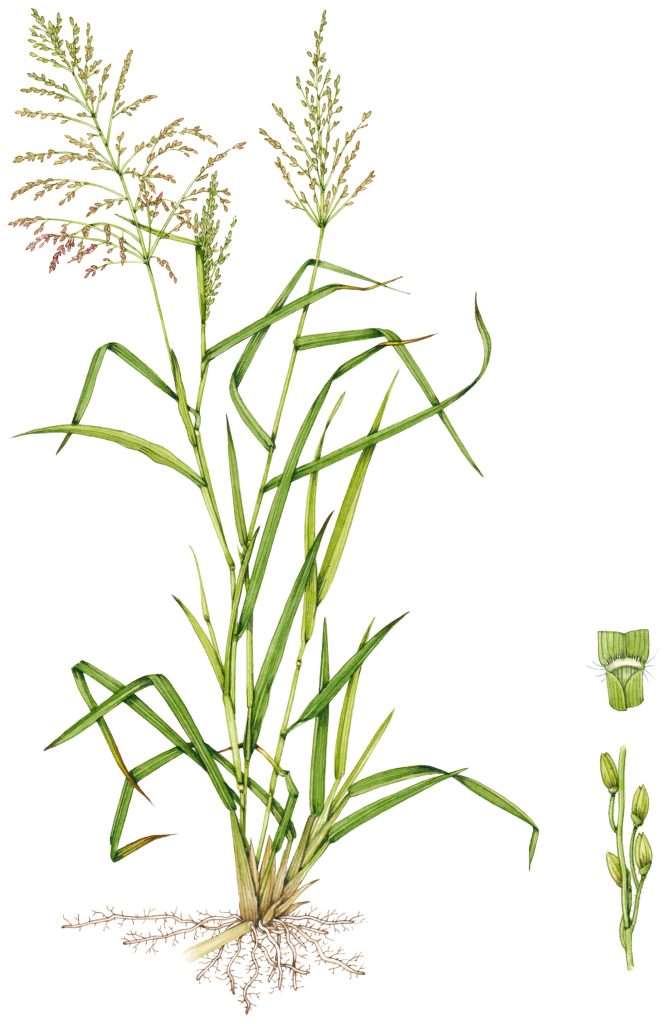
Guinea grass Megathyrsus maximus
As many who read this blog regularly will know, I love illustrating grasses, so this day was a real treat for me. (For more on grasses, see my blogs on Shortcuts to identifying some common grass species, Grasses of Montserrat, telling Sedges, Grasses and Rushes apart, An introduction to grass, the C4 Rice project, A class on Grass, and Glorious Grasses. Unless otherwise noted, all illustrations in this blog are by yours truly.)
A day of grasses
This one day event was organised by Kimberley Glassman, who is a postdoctoral research associate for the botanical collections at the Fitzwilliam Museum in Cambridge.
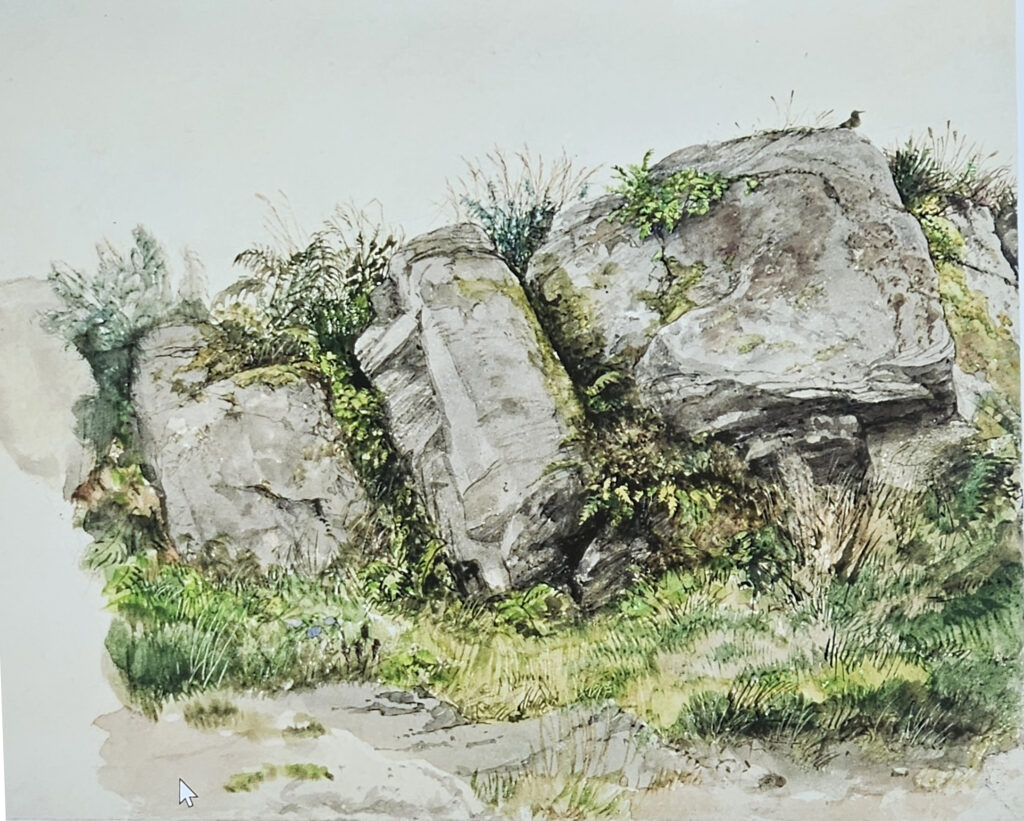
Landscape of rocks & Grasses, William Pyce 1806
Not only did she organise botanical drawings for us to see, and get us access to specimens from the Cambridge University Herbarium collections, but she pulled together an extraordinarily diverse group of students and experts to spend the day talking about why grasses don’t get the attention they deserve. And what we can do about it.
Grass blindness
We are surrounded by grass. Most of our food crops are grasses. Fields of oats, barley, rice, sorghum, corn, and wheat are common across the globe. Parks and hillsides are swathed in grass. Our gardens are full of the stuff. But how often do we stop and look at these diverse and amazing plants below our feet?
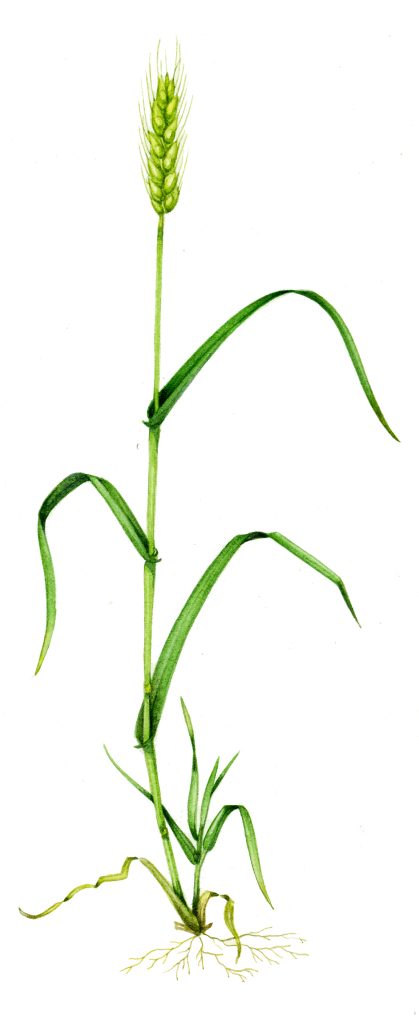
Bread Wheat Triticum aestivum
As Howard Thomas says in Grass Blindness (2019), “Some plants are born invisible, some achieve invisibility, and some have invisibility thrust upon them. Grasses are a case in point”.
The conversations during the day focused on how the collections could be used to engage future museum and herbarium visitors (and researchers), and help shine a spotlight on the long-forgotten grasses.
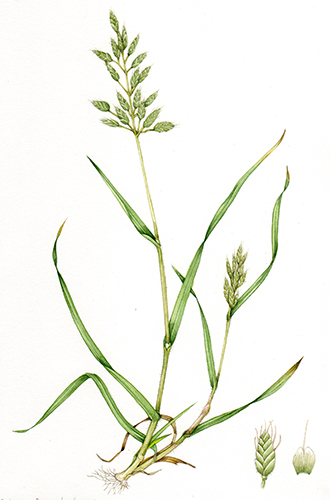
Soft brome Bromus hordeaceus
Botanical drawings of grasses at the Fitzwilliam: Grasses as secondary subjects
After assembling and introducing ourselves, we got to see a selection of botanical illustrations, selected by Kimberly.
Everyone came with different areas of expertise, seeing the images in contrasting ways. Conversations flowed, on topics ranging from women naturalists in the 19th century, to how grass is used as a material for making baskets and textiles in Vanuatu, field botany in the 17th C, and the manufacture of artificial flowers in 18th C France. Members of the group are researching herbalism in book history and plant dyes, Victorian women in paleontology, gene editing in potatoes, North European paintings, and the genetics of crops and grasses.
Interestingly, I felt that only two of the beautiful illustrations laid out for us came close to respecting grasses as subjects in their own right. The majority used grass as compositional elements, or to add heft to another, more blousy species.
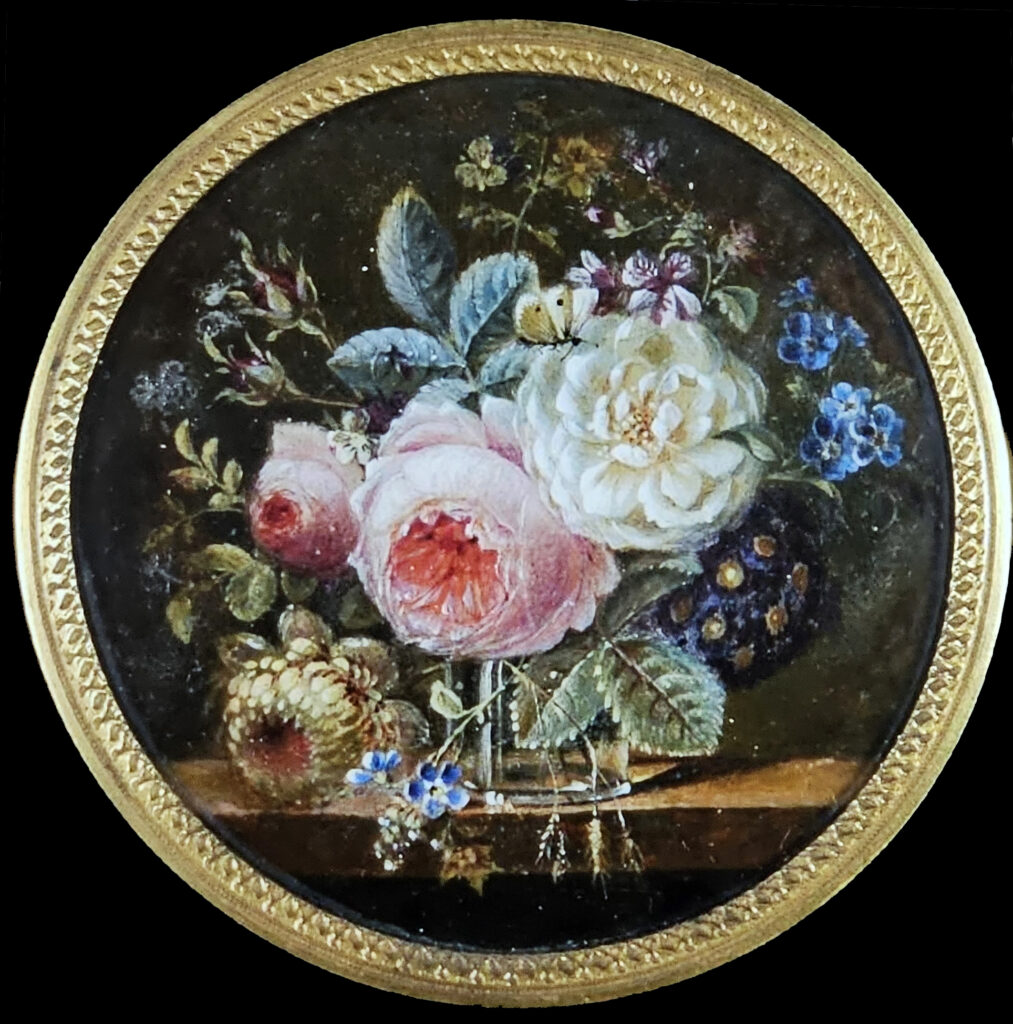
Glass vase of pink & White roses, Antoine Chazal 1893
For example in the painting above, an exquisite miniature, there are grasses in the foreground that might be barley, or wheat. But they are simply adjuncts to the roses and other flowers.
Bermuda grass is shown alongside another rose, in a 19th C illustration produced in Canton. But there’s no focus on the grass, it’s all about the roses.
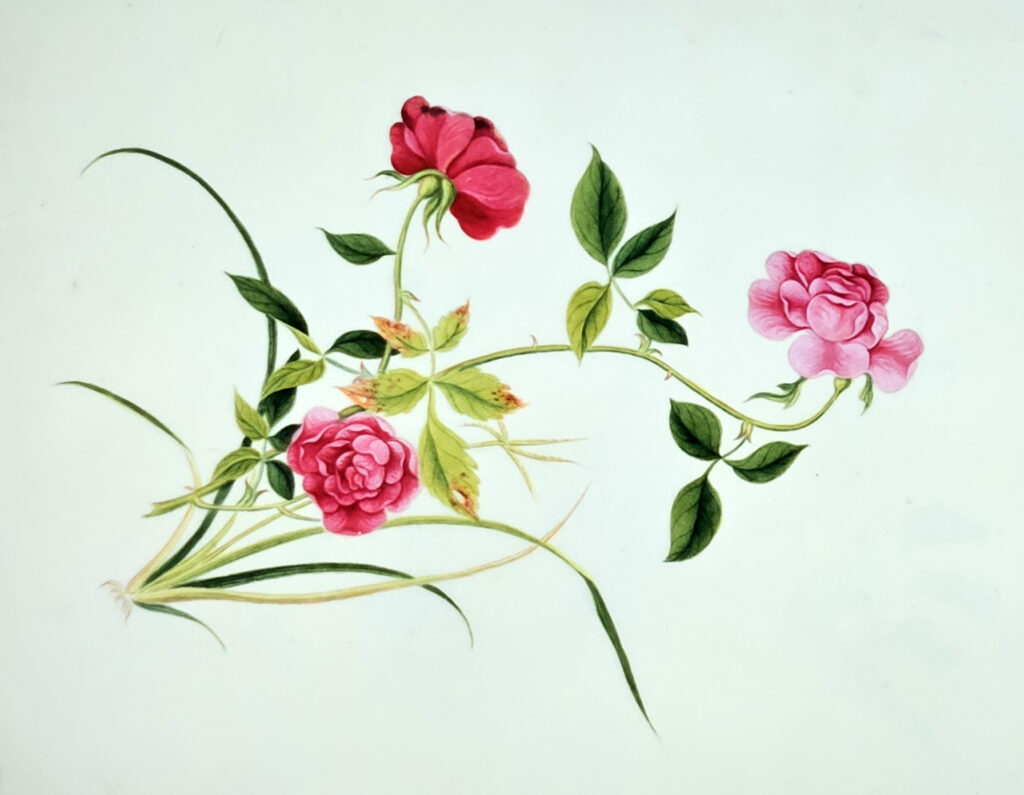
Spray of old roses & Bermuda grass, Canton workshop 19th C
Botanical drawings of grasses at the Fitzwilliam: Grasses as equal subjects
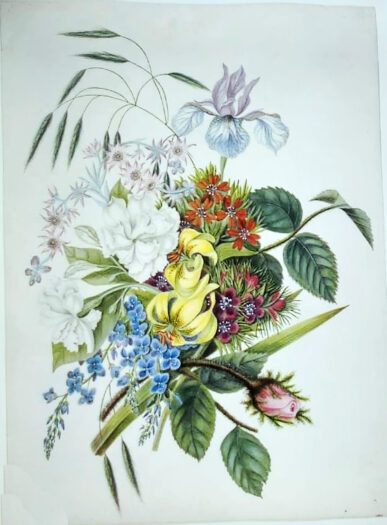
However, it’s clear in the painting by Harriet Cockerell that the grasses in her composition are true to life, probably a brome.
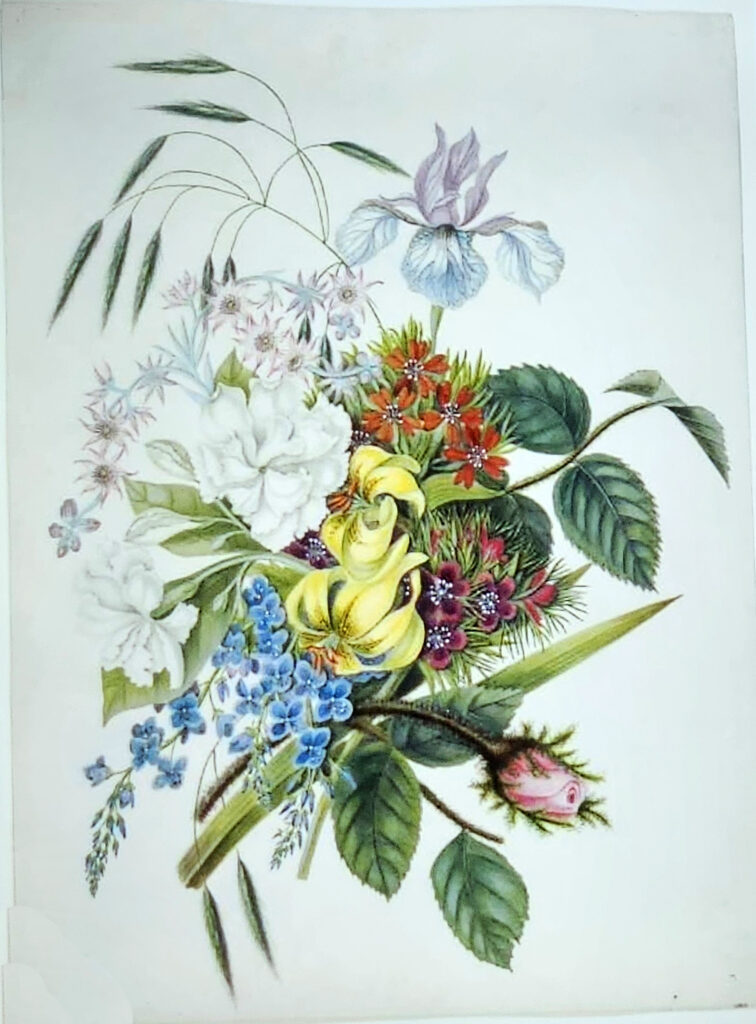
Posy containing Iris, Moss rose, Speedwell, Lilly; Harriet Cockerell 19th C
My favourite piece was a Pre-Raphelite-esque study. Even though it’s not flowering, I reckon the grass painted alongside the snowdrops could only be Cocksfoot, Dactylis glomerata. Grass being seen as worthy of illustrating, not only as an accessory.
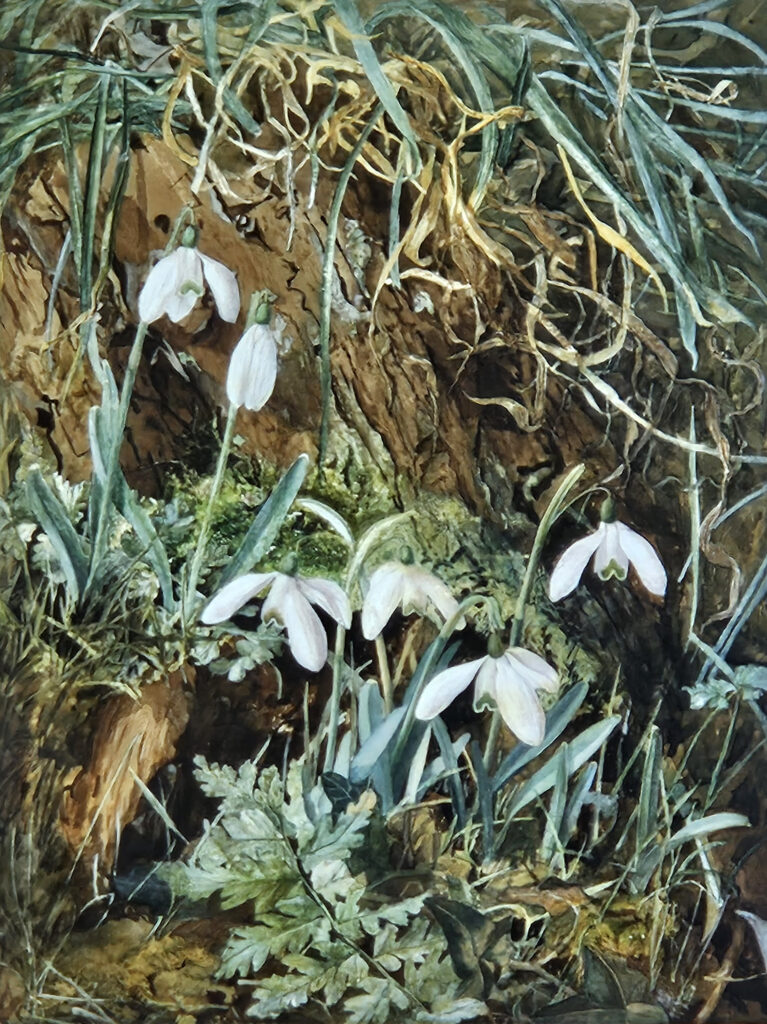
Snowdrops in Undergrowth, Unknown artist 19th C
We wondered if the term “grass” helps reduce this group of plants to a catch-all. Is it, in fact, a derogatory term? Are grasses more visible in other cultures? Braiding sweetgrass by Robin Wall Kimmerer was name-checked. Are grasses mostly classed as “good” (crops) or “bad” (weeds, in itself another very problematic term)? Are we blind to them because they are so familiar? And they are not alone. Moss and even fungi tend to go un-noticed too.
Grasses & Me: A love story by Madelaine Bartlett
Next stop was a fascinating talk by Madelaine. She heads the Bartlett group which studies the evolution of grass and flower morphology at Cambridge University Sainsbury’s lab.
She pointed out that many flowers are morphologically conservative. They get stuck because of their relationship with pollinators. If you evolve and change, your pollinators may not keep up, and you run the risk of not reproducing. Grasses, pollinated by the wind, have no such inhibiting factors. Their morphological diversity is astounding, and perhaps this helps explain their variety?
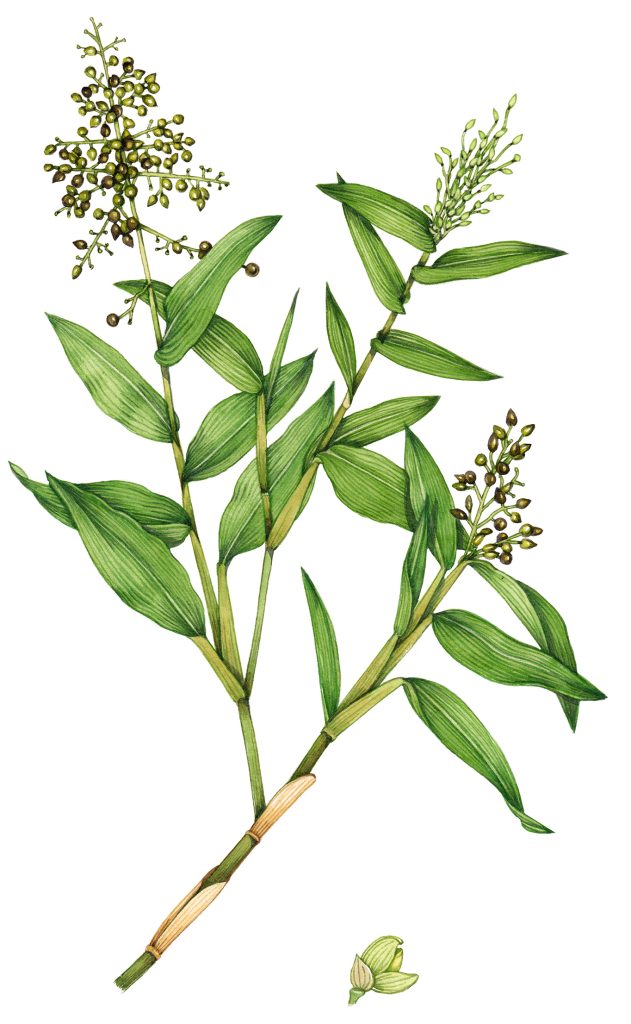
Bamboo grass Lasiacis divaricata
She touched on the importance of corn, both in research and as a crop.
Then we learnt how we can use the genetic codes of diverse living grasses to figure out what the molecules of ancestor grasses may have looked like. Thus empowered, you can switch around and project forward, by-passing the temporal constraints of evolution, and figure out ways to modify crops and imagine new as-yet unevolved species.
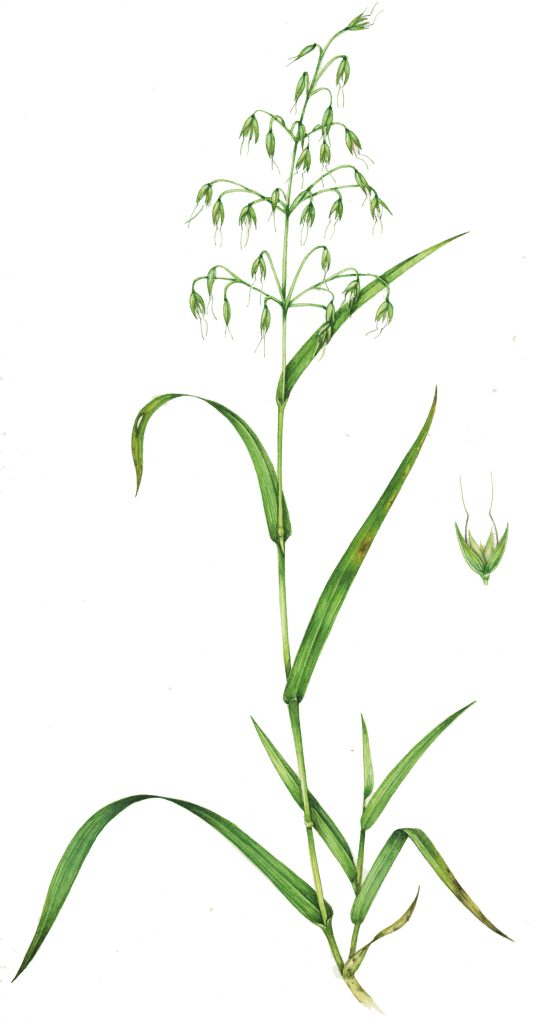
Common oat grass Avena fatua
But you can’t do any of this without really dense sampling. This is where collections come in.
Herbariums have sheets and sheets of grasses. These are not only a visual resource, but a genetic one too. We can sequence DNA and proteins from tiny fragments of preserved materials. Recently, RNA has been sampled as well. Who knows how future scientists will be able to use such collections? Already, herbarium specimens are being used to study changes in specimens due to climate change. We must future-proof, and conserve them, as physical specimens, not just digital records.
Herbarium visit
Next was our chance to see a selection of grasses from the herbarium, chosen by Juliet Anderson. These were exquisite.
I often work from online images of herbarium specimens, and was amazed at how much richer and more beautiful they are in real life. Although flattened, that slight three-dimensionality changed the way I saw them.
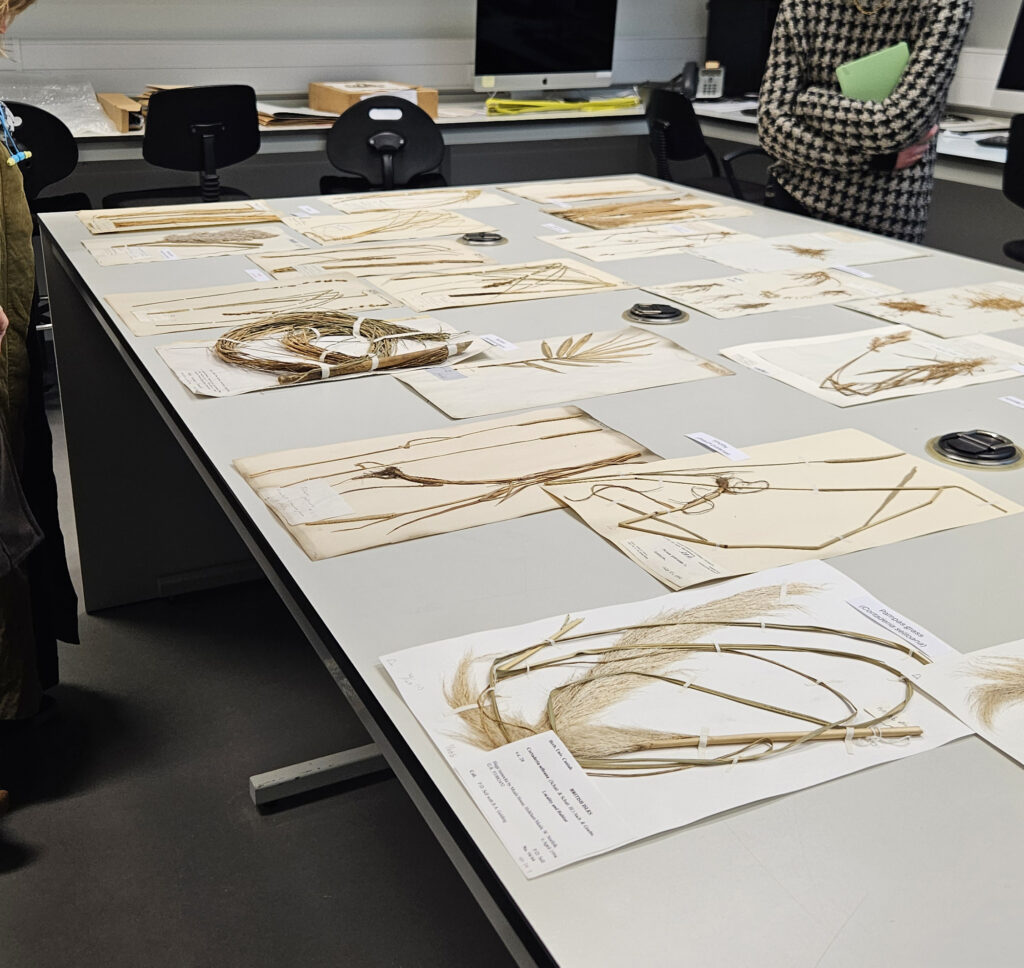
Specimens at Cambridge Herbarium
There was a table of specimens that we’d be drawing later, another of grasses as crops, and a third of historically interesting specimens.
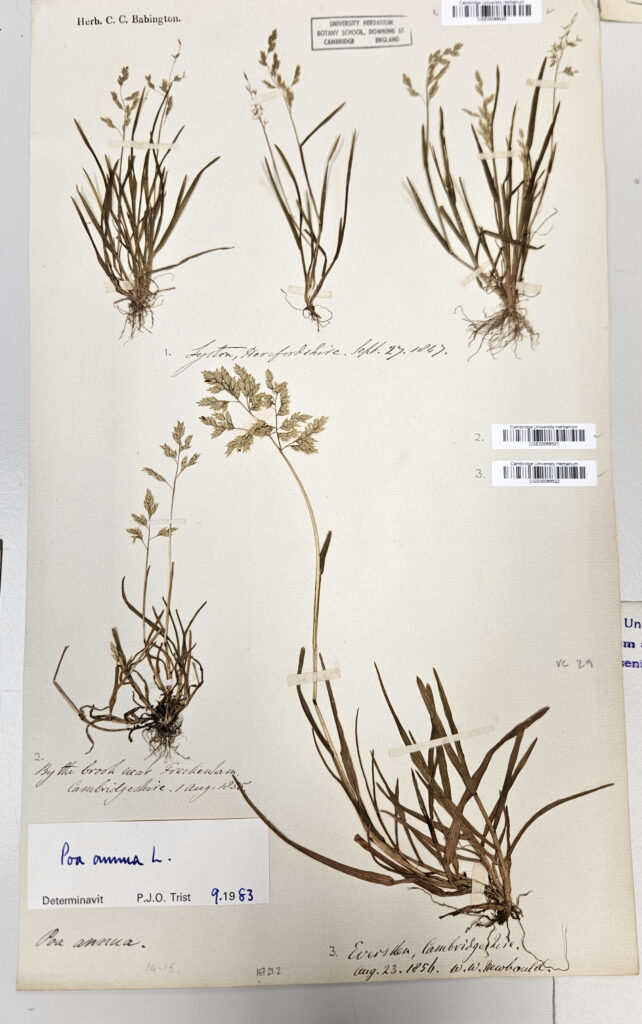
Annual meadow grass Poa annua variety
I’ve had a lot to do with Annual meadow grass recently, and to see this sheet showcasing its extraordinary morphological diversity was lovely.
Juliet had also pulled out some pen and ink studies of grass flowers, and some 19th C teaching aids which I was very jealous of.
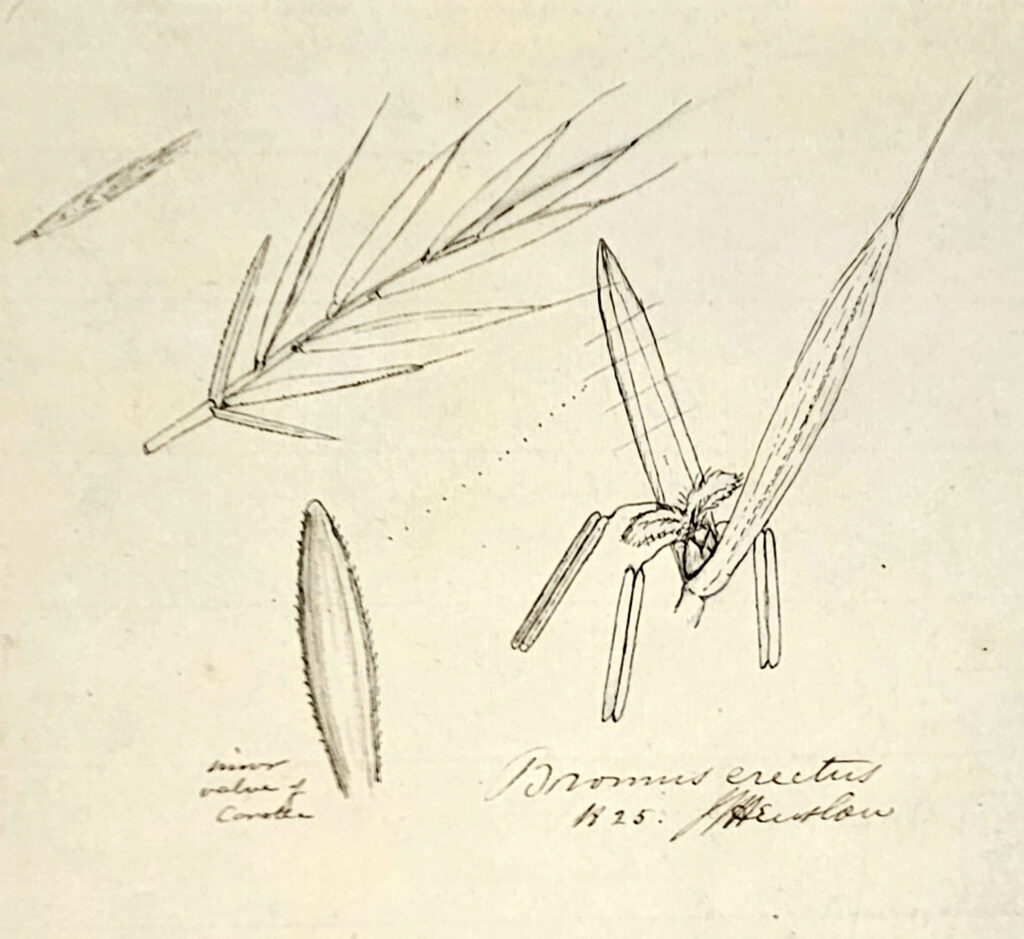
Bromus erectus flower illustration by Hounslow
On one table there were lots of crop species. Looking at the Sugar cane, I felt entirely justified in having found the illustrating of its’ flowers last year something of a nightmare.
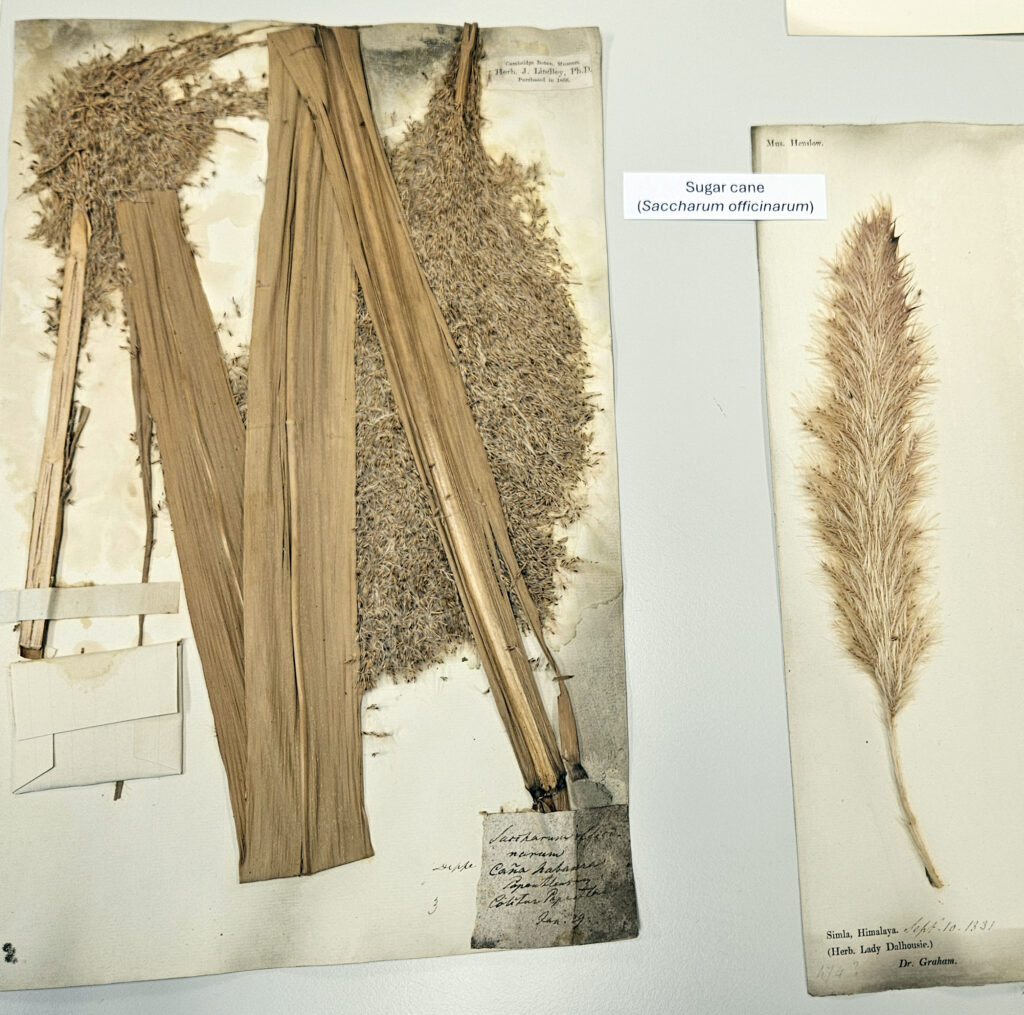
Sugar cane Saccharum officiarum
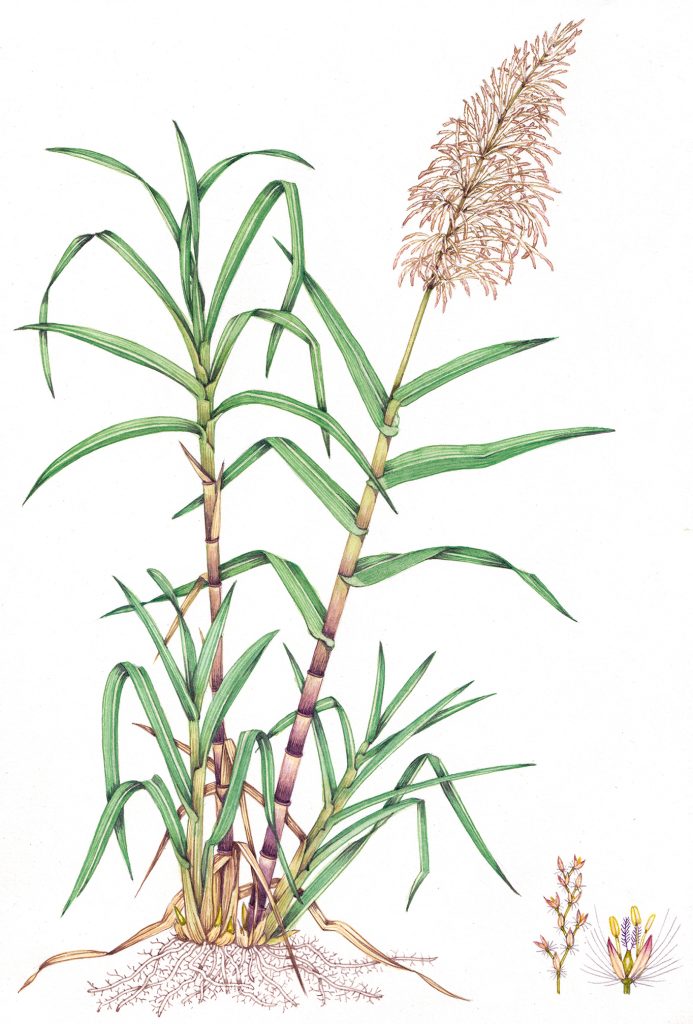
Sugar cane Saccharum officiarum
There were also samples showing Ergot in grains of crop species. I knew about the suggestion that Ergotism was the cause of the hallucinations that sparked the Salem with trials (still hotly debated, see Debunking the Moldy bread theory), but was delighted to hear the suggestions that some of Hieronymous Bosch‘s visions may have been prompted by the same cause.
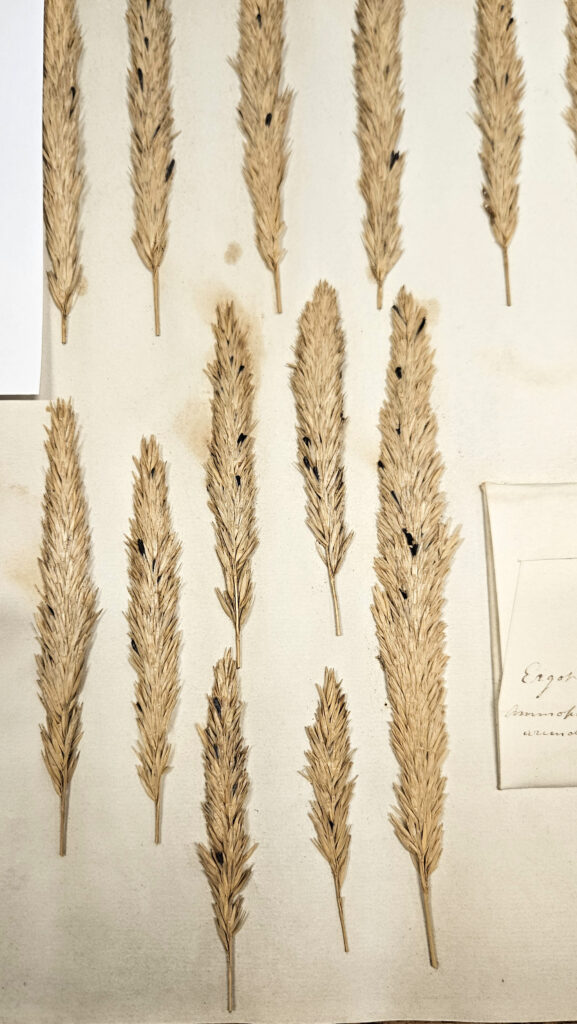
Ergot
Cambridge Herbarium and The Voyage of the Beagle
Entirely unexpectedly, there on a table were three of four grasses which, it transpired, had been collected by Charles Darwin on the Voyage of the Beagle in 1831 -1836 (For more on this remarkable adventure, listen to In out Time: The Voyage of the Beagle).
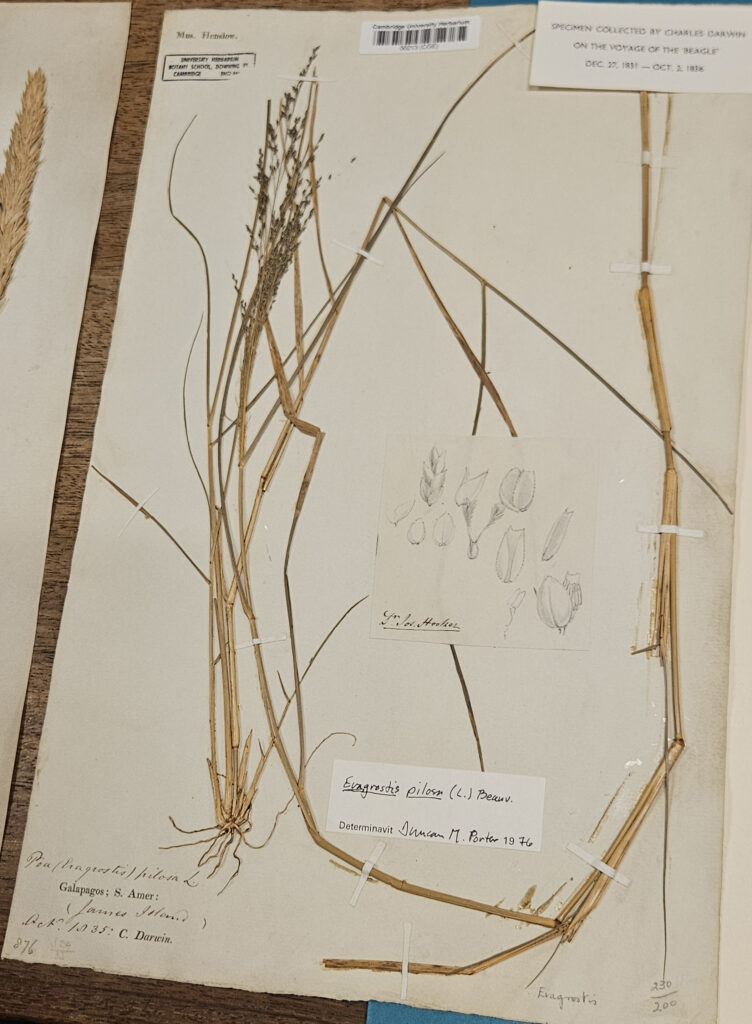
Voyage of the beagle Eragrostic pilosa
For someone who has always been in thrall to Darwin and the enormous changes his research caused, this was incredible. Whether or not he also completed the excellent line drawing of the flowering spikelet, I do not know, But imagining him gathering these specimens of the Galapagos, and seeing them on a table right in front of me, felt surreal.
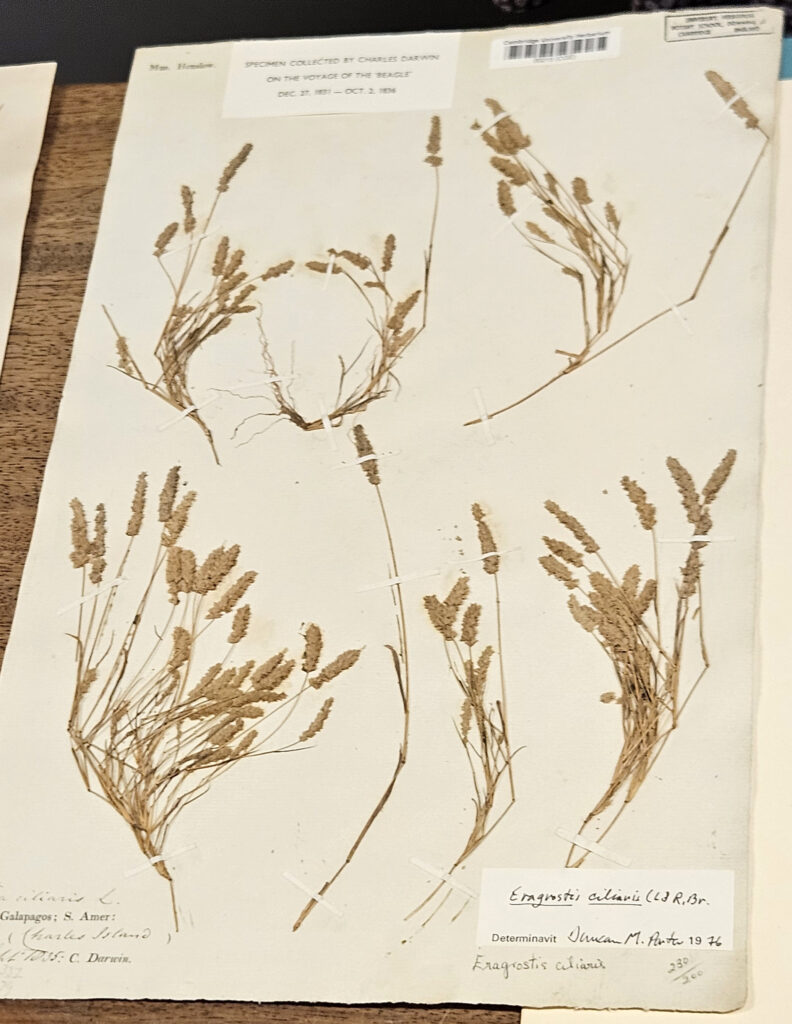
Voyage of the Beagle Eragrostis ciliarius
Leaving the herbarium, it was inspirational to realise that all these collections are open to the public (by prior arrangement.) What a way to combat grass blindness.
Reimagining grasses: A place for art collections & Herbaria
The last talk of the day was the keynote lecture, by Dawn Saunders of Gothenburg University.
This was a whistle stop tour of grasses in art, and an exploration of how artists have tried to build a doorway into the life of plants.

Grasses Harper Collins plate
Dawn was part of the “Beyond Plant Blindness” project, alongside Bryndís Snæbjörnsdóttir, Mark Wilson, Eva Nyberg, and Bente Eriksen. This focussed on the grass Stipa pennata.
One Stipa seed was enlarged to a gigantic 14m long SEM image, hung in a barn. The same image was made into a wool tapestry hung the height of the atrium in Gothenburg University. Dawn talked about how visitors were confused and fascinated by the image.
The image turned our normal view of plants on its’ head. The seed was at the front, an image of the plant become secondary, behind it. Our role as human curators was a mere foot note.
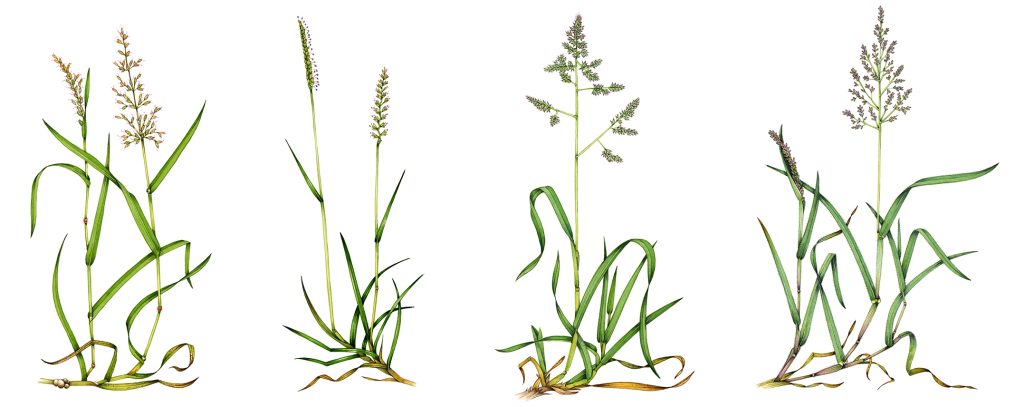
Grasses: False Oat, Crested Dogs-tail, Cocks-foot, and Yorkshire Fog
The aim was to make people consider what being a plant means, what “plant-ness” is.
As Dawn said, “How do we build relational encounters for people to build narratives around their experience with the curated objects?” How do you use art and herbarium objects to invite new people to think about plants in new ways?
The following discussion touched on the conceptualization of wonder, comparisons of preserved herbarium vs taxidermied specimens, the importance of naming things and the delight of recognition. Rich grounds indeed.
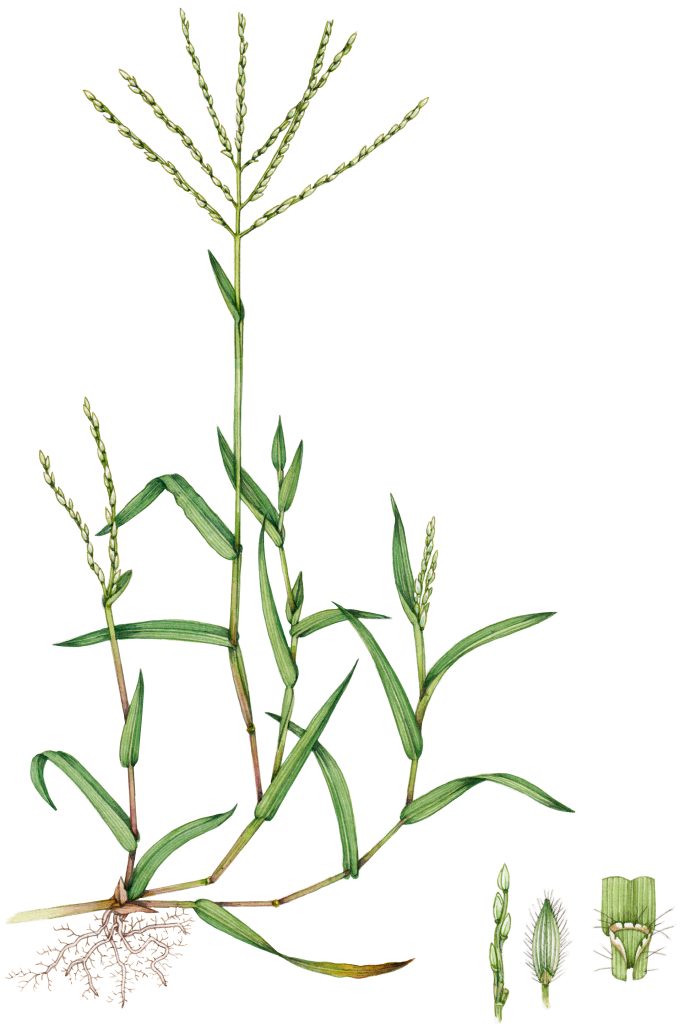
Crab grass Digitaria ciliaris
Grass drawing workshop
The final activity of the day was an hour long workshop, illustrating grasses. I’d been so interested I’d almost forgotten I was leading the session, and setting up was something of a rush.
I’d collected loads of little Poa annua plants, the only grass that flowers in late March in the UK, and some Dactylis, complete with in-your-face ligules to discover. Alas, the Sainsbury’s lab couldn’t allow live material into the building (which is fair enough).
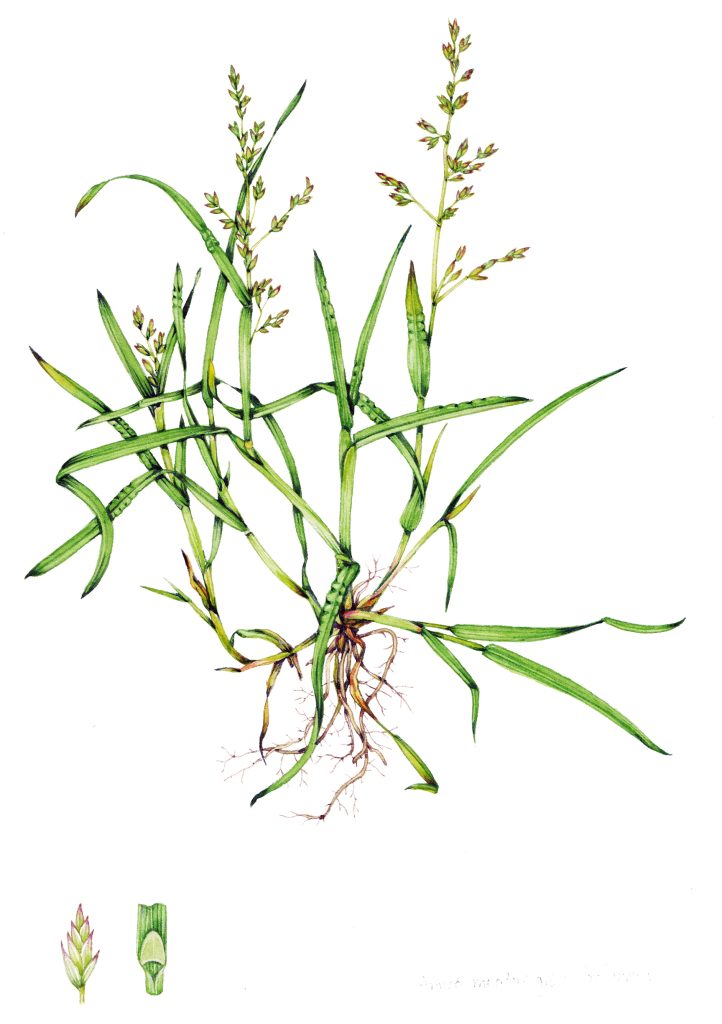
Annual meadow grass Poa annua
Juliet saved the day by selecting and photographing a wide array of common UK grasses held in the herbarium. People worked from these print outs, first on gesture drawings and then on more detailed illustrations.
Quaking grass, Barley, Oats and Rye grass all proved popular. By this point in the day, we were all really comfortable with each other, so people chatted happily as they sketched.
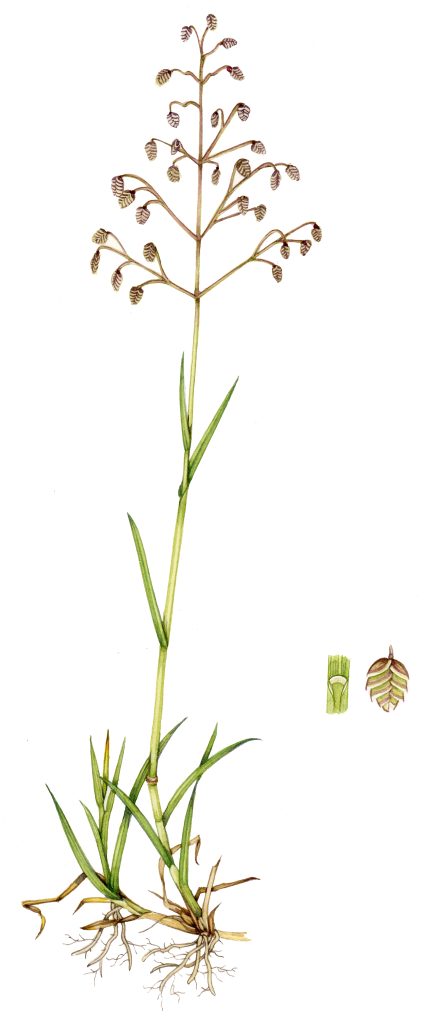
Quaking grass Briza media
An hour was not long enough, and it felt like we needed to finish up much too early.
Conclusion
And with that, the day of grasses was over. It was, as I said to Kimberly, an inter-disciplinary fever-dream. Historians, biologists, sociologists, curators and botanists. All drawn together to be awed, excited, and inspired by grasses. To fight Grass blindness, as individuals and as a group. To work towards finding ways to use the collections at Cambridge University to encourage the whole world to embrace grasses for their beauty, importance, and diversity.
Enormous thanks are due to everyone who was involved in organising this event. It was wonderful.

BBC Wildlife Magazine: Common British meadow grasses
