




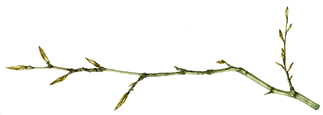
Crop Trust illustration: Ginseng

I recently illustrated four crops for the Crop Trust. These illustrations will be used in published information and online, as prints, and in branding in the charity’s outreach programmes.
The first featured crop is Ginseng, Panax ginseng.
Ginseng: Description
Ginseng is a member of the Apiaceae, or carrot family. It has three to six palmate leaves with serrated leaflets; each leaf has 3 to 5 leaflets. Clusters of 30 to 50 small red flowers are borne on long peduncles, and produces bright red berries, with white kidney-shaped seeds. The plant reaches up to 60cm in height. However, it’s not the leaves, flowers, or berries that are the focus of ginseng use. It is the root, which tends to be cylindrical and have 2 branches.
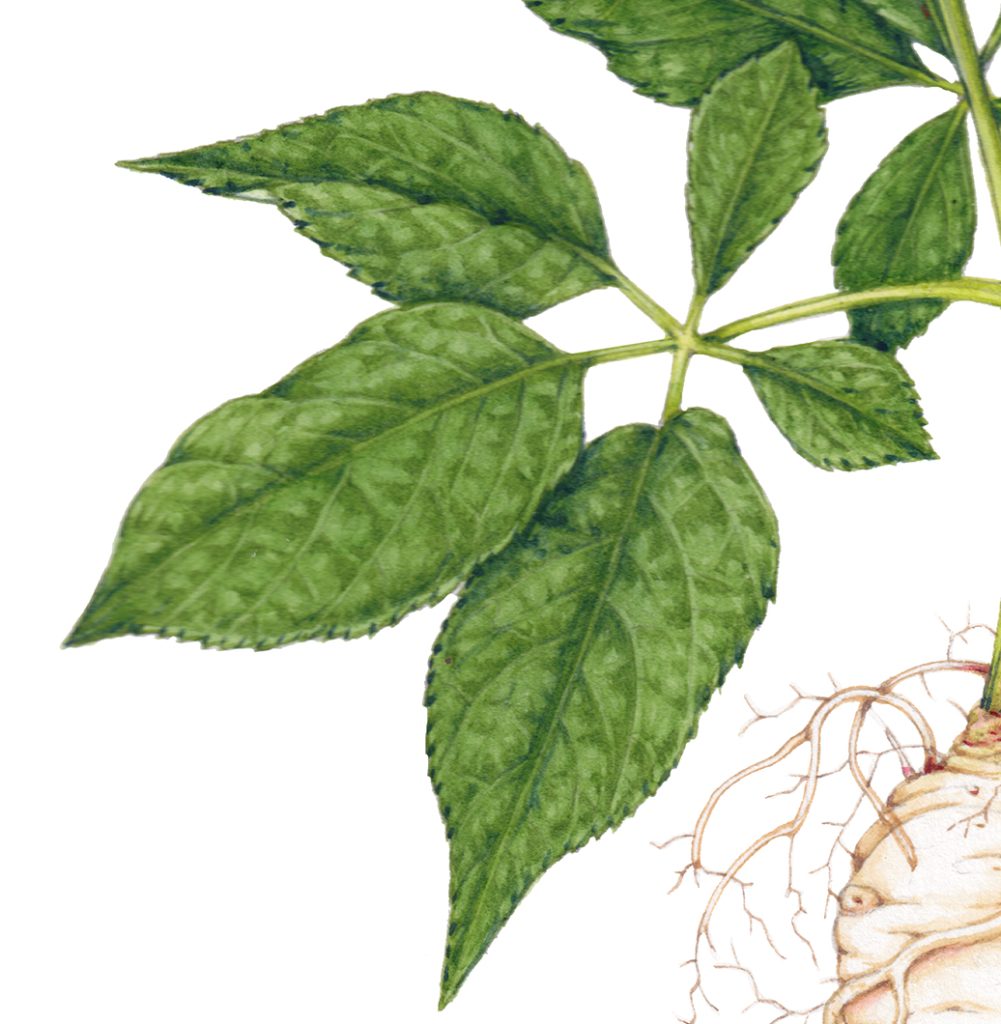
Leaf of ginseng plant
Ginseng: Distribution and History of use
The ginseng is native to temperate mountainous woodland zones in Korea, NE China, and the far east of Russia. It is now cultivated in many other countries where growing conditions can be met; including Canada, Japan, and the USA.
The first written mention of ginseng is from 2,000 years ago, although there is evidence is was used as far back as 4,500 years ago (Journal of Ginseng research. March 2013). It’s Latin name, Panax ginseng, contains the etymological root “Panax” meaning all-healing. This is also the same root as the word for a cure-all, a panacea.
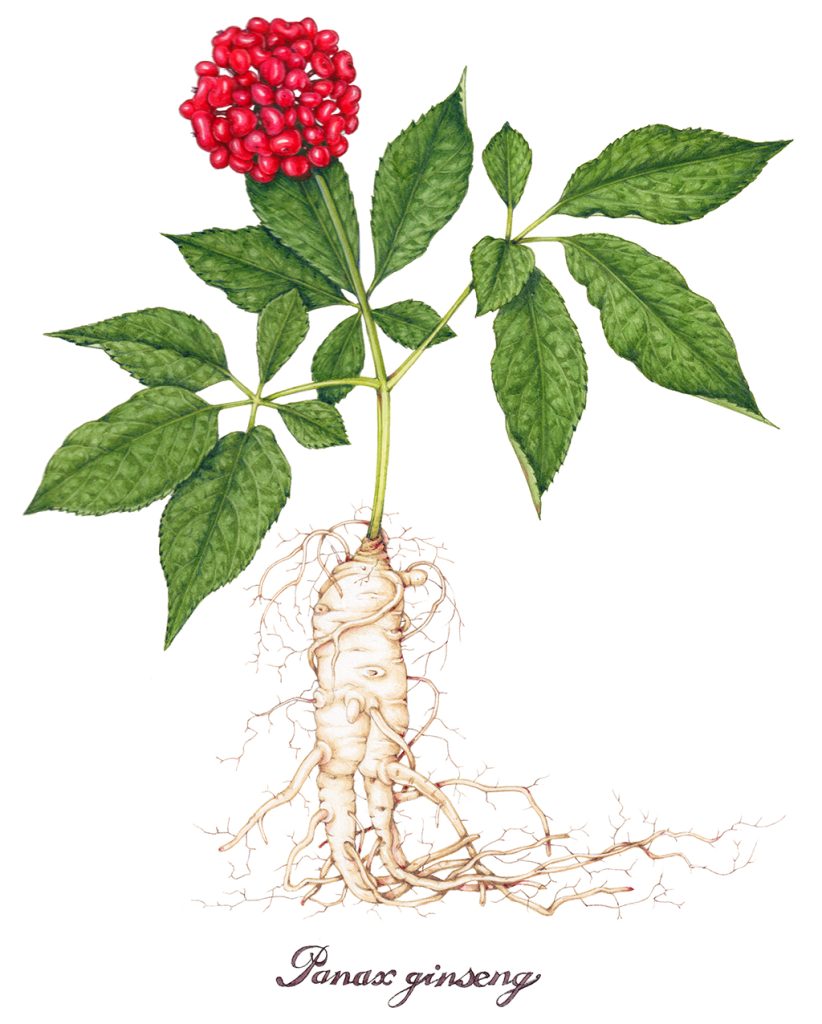
Ginseng: Preparation and cookery
Ginseng root can be used fresh or dried. In its’ fresh form, raw ginseng, it is 75% water, so can’t be stored for long. It is used in traditional Chinese and Korean recipes, often in soups.
There are two dry forms. White ginseng is sun-dried from raw, and thinly peeled. It can be straight, curved, or semi-curved. Red ginseng is steamed before being dried, and can last up to 20 years. This red ginseng makes up the majority of health food supplements and nutritional additives which are sold in many forms. It can be eaten in teas, drinks, as tablets, in candy, as powder, and as extracts.
Ginseng: Medicinal uses
As a cure-all, the ailments treated with ginseng are wide-ranging. They include kidney, liver, reproductive and cardiovascular ailments; as well as a tonic for general well being. It’s also been claimed it is a cure for alopecia; and a preventative for flu, diabetes, and cancer. In ancient China and Korea, it was used as a love potion, and more recently it has been used to treat erectile dysfunction (“Red ginseng for treating erectile dysfunction: a systematic review” British Journal of Clinical Pharmacology 2008). For more on the history of Ginseng use, click here.
Ginseng root contains antioxidants and vitamins (such as B1, B2, B3, B5, and B12). Trace elements found in ginseng include zinc, copper, magnesium, calcium, iron, manganese, vanadium, potassium, sodium and phosphorus; along with volatile oil polysaccharides, pectins, and sterols. (Journal of Ginseng Research 2023). They also contain ginsenocides which may be useful in combating disorders due to old age. ( “Panax ginseng and aging related disorders: A systematic review” de Oliveira Zanuso et al Experimental Gerontology 2022)
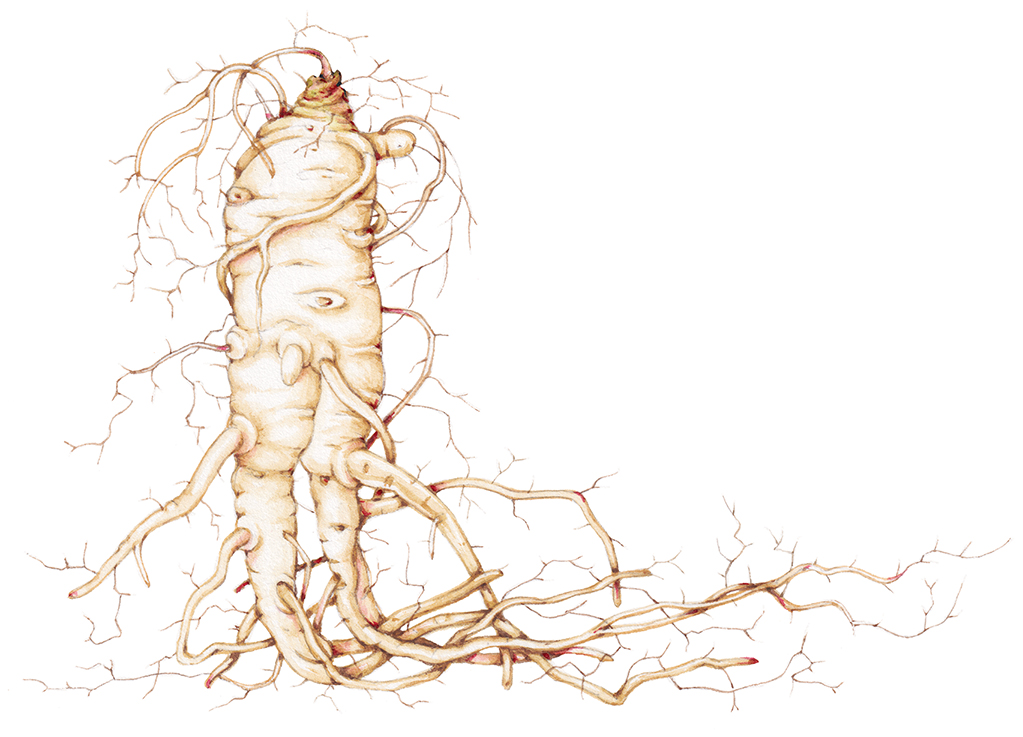
Ginseng root
There is little clinical proof of the medicinal benefits of ginseng use (“Panax ginseng”. MedlinePlus, 2024), although it may have some effect on general health and in reducing stress levels. It can react unfavourably with other drugs such as anticoagulants like Warfarin, with diabetic medicines, and over 100 drugs are known to interact with it (Drugs.com).
As with many established folk medicines, the fact that it has been in constant use for over 2,000 years carries some weight.
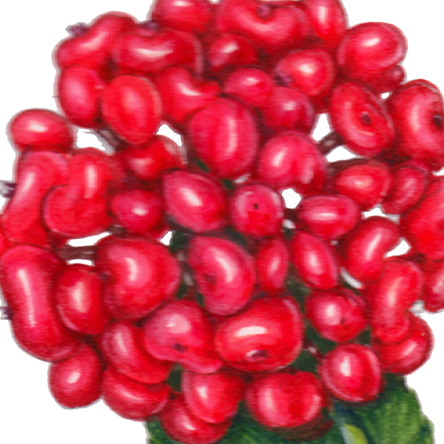
Ginseng berries
Ginseng: Commercial considerations
Four countries produce 99% of the world’s ginseng. In 2013 this was 80,080 tons, with a value of $2,084 million. Canada, the USA, and South Korea run second to South China where roughly half of the world’s ginseng is produced.
As the Journal of Ginseng Research puts it, over ten years ago, “Since the interests in alternative medicine and healthy food is increasing globally, the consumer market of ginseng…is expected to expand continuously.” (Journal of Ginseng research. March 2013)
Conclusion
Before illustrating this plant, I knew little about it. I know you can get ginseng tea, and that it is important in Chinese and Korean traditional medicine. The wide ranging cures and effects attributed to it amaze me, as does the commercial importance of this crop. I am equally surprised by the appearance of the plant, with those stunning scarlet berries!
Botanical illustration is full of surprises, and doing the Ginseng illustration for the Crops Trust is another example of just that. Keep an eye out for blogs on the other three crops illustrated; namely Pearl millet, the Date palm, and the Olive.
